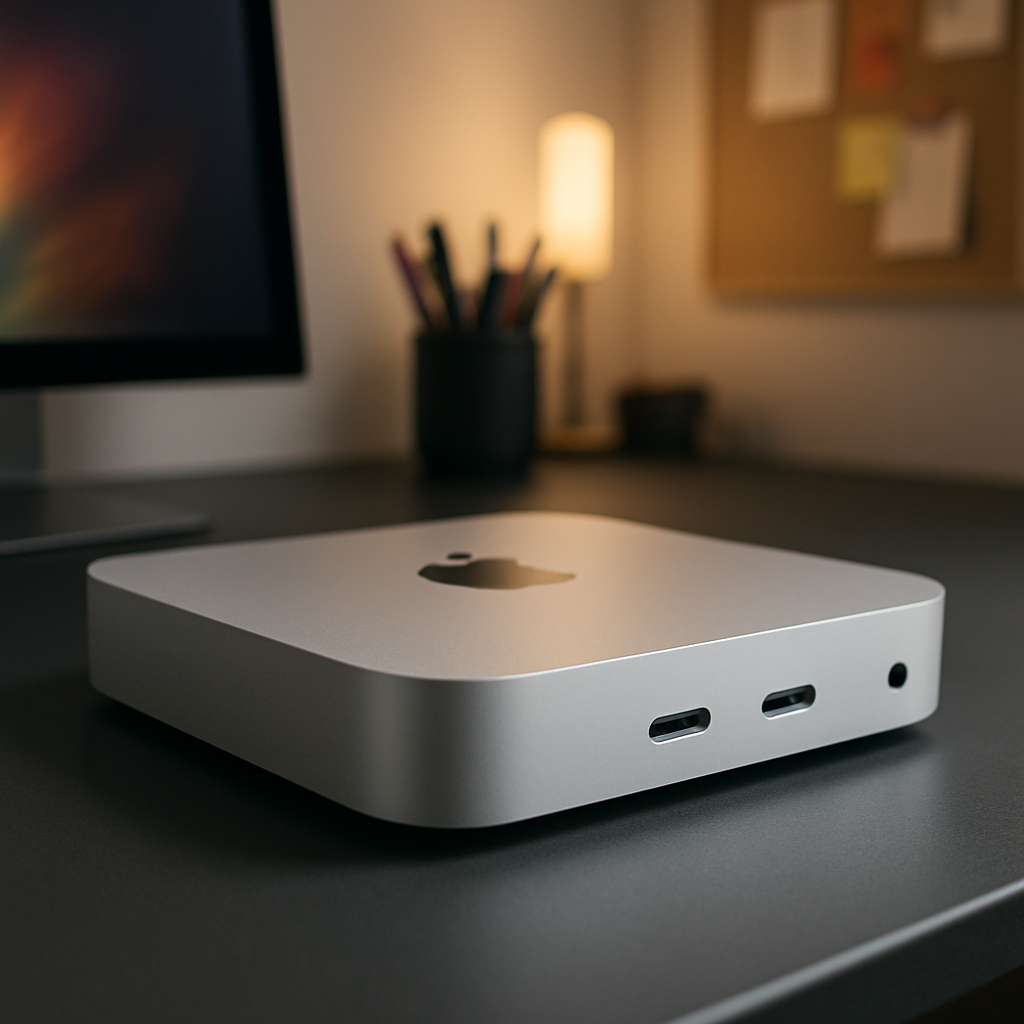
Apple’s latest Mac mini variant, powered by the M5 Pro chip, marks a serious step up in performance—but it arrives with a trade-off in value and positioning. Below the surface of its compact 5-inch square design lies impressive power, including Thunderbolt 5 ports, expansive bandwidth, and notable gains in GPU and multi-core performance. Yet these gains come with higher costs, and a few quirks that make it a less obvious upgrade for many users.
Specs and Architecture: What’s Under the Hood
The M5 Pro Mac mini starts at $1,699 in its base form—featuring 24GB of unified memory and a 512GB SSD. The chip itself packs a 15-core CPU (5 performance cores, 10 performance cores) with options to upgrade to an 18-core CPU and a 20-core GPU. Memory bandwidth climbs to a striking 307GB/s, overshadowing the base M6 Mac mini. Unified memory options go up to 48GB and 64GB. Storage starts modest with 512GB but can be configured up to 8TB.
In its entry configuration, SSD speeds measure around 6,600MB/s for both reads and writes. Moving up to the 1TB variant boosts that to roughly 10,800MB/s—thanks to greater flash chip parallelization.
Design, Display, and Connectivity
Externally, the M5 Pro Mac mini retains the same footprint and aesthetic as Apple’s prior Mac mini models: a tiny, 5-inch square, 2-inch tall, weighing in at 1.6 pounds. On the rear, users get three Thunderbolt 5 ports (maxing out at 120Gbps with video), HDMI, and a 2.5Gb Ethernet jack (which can be upgraded to 10Gb). There are also two USB-C ports on the front, plus a headphone jack. Wireless options include Wi-Fi 7 and Bluetooth 6.
The graphics output setup supports up to three external displays. The primary display option reaches 8K at 60Hz, and other input supports include 5K at 120Hz—catering to high-end creative workflows.
Performance & the AI Element
Performance gains are clear when viewed through multi-core workloads. In Geekbench 7 multi-core tests, the M5 Pro often surpasses the base M6 Mac mini due to its higher core count. It trails behind Apple’s Mac Studio equipped with M5 Max in some tasks, but remains a leap forward over the standard mini for compute and graphics work.
However, the M5 Pro’s Neural Engine is single-core, unlike the dual-core engine of the base M6, making the M6 faster in many machine-learning or AI workloads. Despite this, for models that lean heavily on GPU power or bandwidth, the M5 Pro still brings advantages.
Value and Where It Stands
Pitching the new mini against other Apple machines reveals tension. For most users doing productivity- or creator-level work, the base or lightly upgraded M6 Mac mini—especially with higher storage—is a better deal. The Mac Studio with M5 Max, meanwhile, emerges as the choice for GPU-heavy users: better cooling, more I/O, and larger RAM capacity help it beat even a well configured M5 Pro mini on overall value and long-term performance.
Upgrades from that base price add up quickly. Moving from 24GB to 48GB of memory costs about $600, with another $400 needed to hit 64GB. Storage increase to 1TB improves SSD speeds meaningfully, but storage and memory upgrades combined can push the total closer to Mac Studio territory.
Conclusion: Who This Mini Serves
The M5 Pro Mac mini delivers where its predecessor left off: it’s a powerful machine in a small package. If your workflow demands strong multi-core performance, high GPU power, and cutting-edge port speeds, this mini is highly attractive. But there are trade-offs: the price climbs fast and some users focused on AI or machine learning may be better off with machines offering a dual-core Neural Engine.
For most people, the ideal purchase is either a base or modestly upgraded M6 Mac mini, or stepping up to a Mac Studio with the M5 Max chip if you need serious GPU, thermal, and memory headroom. The M5 Pro mini is strong, but it sits in an awkward middle: technically impressive, commercially less compelling unless you know exactly what you need.
What this signals is that Apple is once more stretching the Mac mini line both upward and downward—and in doing so making the decision harder. As Apple refines chip and port architectures, buyers must be especially clear about their priorities—whether it’s AI capabilities, GPU strength, storage speed, cooling, or sheer value—before investing. This may be the Mini’s most capable version, but it’s not the one that’s right for everyone.