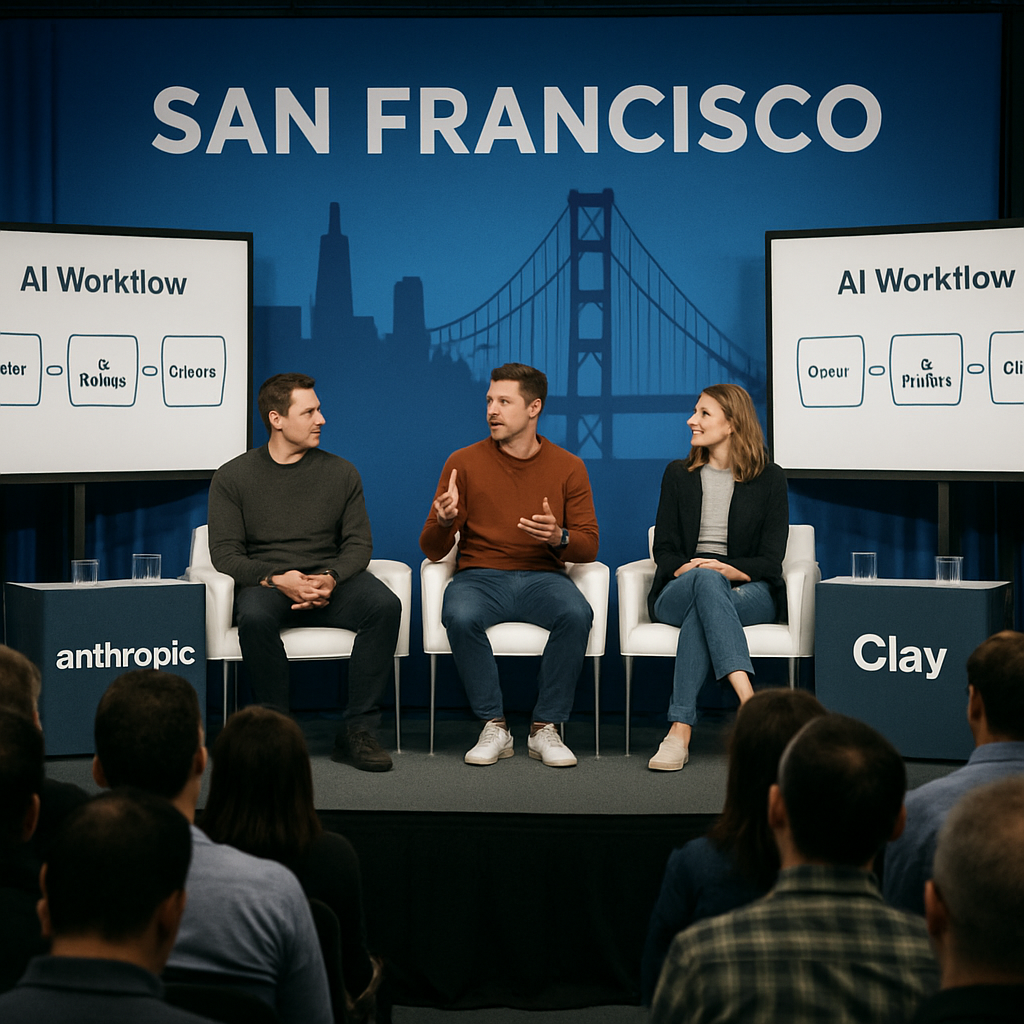
It’s one thing to wow people with an AI demo. It’s another to have that demo survive real work. At Disrupt 2026, leaders from Anthropic, Gamma, and Clay are joining forces on the “What Anthropic Sees When Enterprises Actually Deploy Claude” panel, digging into exactly what changes when organizations move past pilots and begin depending on AI.
Moving Beyond the Proof of Concept
Most enterprise discussions today are full of potential: what AI could achieve, what tasks it might automate, how productivity might improve. But a huge gap opens up after deployment. Anthropic’s Head of Applied AI, Cat de Jong, will be sharing insights from clients who’ve positioned Claude directly in mission-critical workflows. She’ll compare those who cross the threshold into production against those still mired in pilots, sometimes even after 18 months. The real question: what separates adoption from stagnation?
Products That People Actually Use
Grant Lee, co-founder and CEO of Gamma, brings perspective from the front lines of product growth. Originally known as AI-powered presentation software, Gamma has evolved into a platform for visual content across marketing and communication. With user numbers climbing toward 100 million, Lee will reflect on what keeps people coming back—not just for flashy features, but for tools that become sticky parts of everyday work. What expectations shift when users find new, unexpected ways to work with AI? What real problems are being solved—versus simply impressed?
Reliability in the Workflow
Kareem Amin, CEO and co-founder of Clay, adds another critical angle: where AI meets enterprise go-to-market motion and data infrastructure. Clay specializes in stitching together customer data, triggering agentic workflows, and helping companies scale their outreach. Since the company became an integrated app within Claude earlier this year, Amin’s perspective is particularly valuable for understanding what it looks like when customers put AI tools to real use in pipelines—how reliability, scalability, and actual dependency factor in.
Together, de Jong, Lee, and Amin are delivering a combined view of deployment: identifying patterns from enterprise-wide Claude adoption, testing them against what users and founders are seeing firsthand, and uncovering how AI products shift when they escape the sandbox and become embedded.
Event Info: Disrupt 2026 runs October 13–15 at San Francisco’s Moscone West. With over 10,000 founders, investors, and operators expected, more than 200 sessions will explore AI’s full stack—from demos to deep integration—with 250+ speakers leading the charge.
This panel isn’t just for tech watchers—it’s for anyone who cares whether AI becomes a tool that actually changes work routines, or just another pilot that gets shelved.
What actually happens when AI goes from demo to doorstop depends on several critical shifts: focus moves from possibility to reliability; from features to use cases people can’t live without; from prototypes to workflows where downtime or surprise behavior isn’t just an annoyance—it’s a deal breaker. Observing how enterprises cross that distance isn’t academic—it’s the difference between AI as marketing and AI as integrated infrastructure. As this conversation unfolds, watch for signs of what makes that transition stick.