Apple has been ordered to pay $5.72 billion to Taction Technology after a jury found that Apple infringed on patents covering haptic feedback technology used in the Taptic Engine. While Apple did not willfully infringe, the jury concluded that it violated two patent claims from one Taction patent and one from another, and also rejected Apple’s argument that the patents were invalid. The damages award came as part of the verdict.
Origins of the Lawsuit
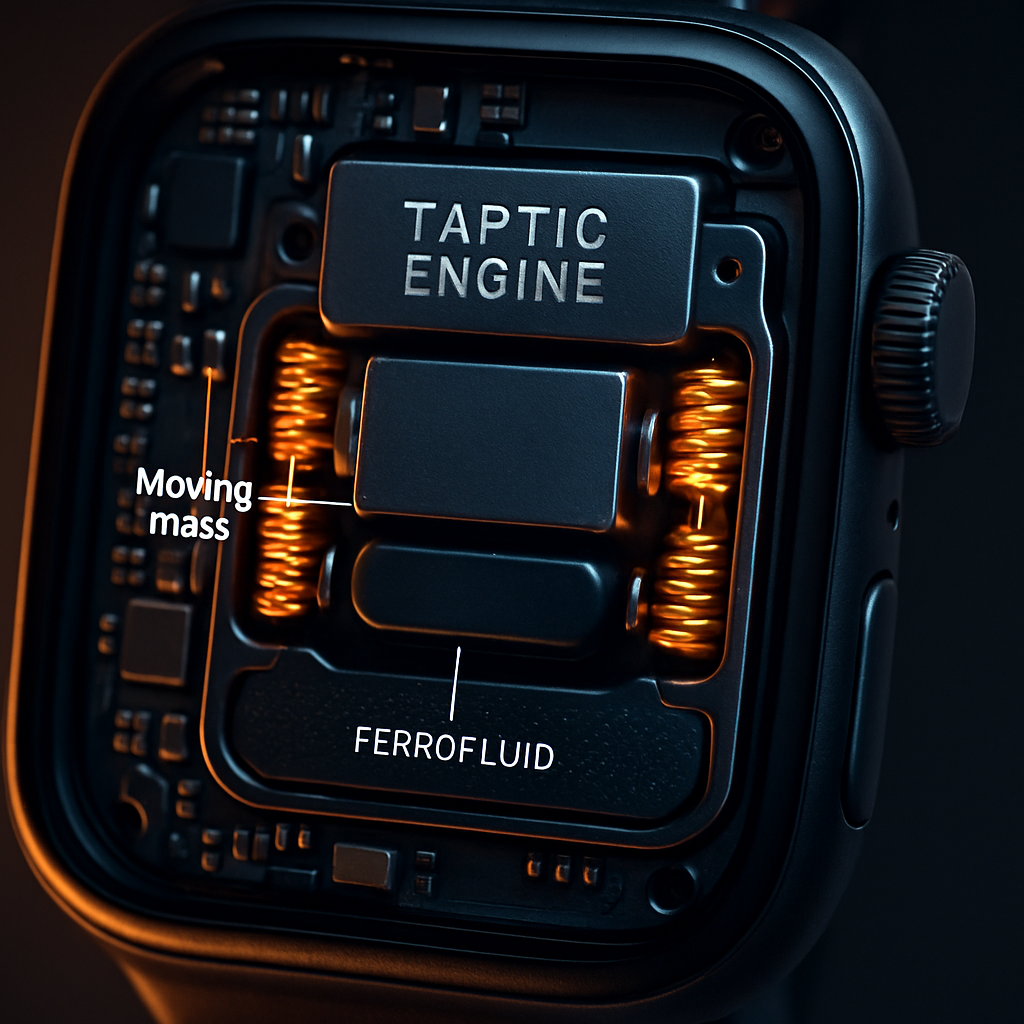
Taction first filed the lawsuit against Apple in April 2021, alleging misuse of certain patents in Apple’s Taptic Engine hardware. The core of the claim involved the mechanisms Apple used to position and constrain the moving mass inside the actuator—specifically, claims that Apple copied designs involving coil springs and locating rods, and later designs with flexures using ferrofluid. Taction also claimed Apple had reverse-engineered hardware from Kannon headsets to build its own system.
Initially, in 2023 a judge in San Diego ruled that Apple had not infringed on Taction’s patents. But in 2025, the U.S. Court of Appeals for the Federal Circuit revived the case, putting it back in play.
Verdict Details and Technical Context
The Taptic Engine made its debut in the Apple Watch in 2014. Rather than using traditional vibratory motors, it uses a linear resonant actuator. This allows more precise manipulation of the moving mass, enabling the device to simulate effects like tapping, buzzing, or even mimicking a heartbeat. Over time, this feedback tech has been adapted across Apple’s product lineup, including iPhones.
In the trial, the jury found that Apple infringed three separate patent claims. They did not, however, find that these infringements were willful, meaning Apple did not knowingly violate the patents. Apple also failed in its attempt to convince the jury that those patent claims were invalid. The resulting damages awarded to Taction were $5,721,961,750.
Aftermath and What Comes Next
Taction’s lead attorney said the verdict vindicated the company’s patent rights. Apple responded by denying that it uses Taction’s technology and confirmed plans to appeal the ruling.
This case marks a significant win for Taction after years of litigation. What started with a lower court loss in 2023 was overturned by the appeals court, which brought it to this decisive jury verdict in 2026.
Why it matters: Haptic feedback has become a central part of modern hardware design. Companies spend heavily on R&D and IP protection in this space—not just to enhance user experience but also to defend proprietary technology. For Apple, a large award like this one not only has financial implications but also raises questions about design independence and patent strategy moving forward.