Apple’s latest announcements introduced two major updates: the AirPods 5 release with upgraded specs and a sweeping $100 price hike across its existing iPhone lineup. Both moves aim to balance enhanced value and rising costs in hardware supply.
What’s New with AirPods 5
The new AirPods 5, now unveiled alongside the iPhone 18 Pro, build significantly on the AirPods 4 foundation. Key improvements include upgraded active noise cancellation (ANC) that’s up to 50 percent more effective than in AirPods 4, a redesigned acoustic system, next-generation Adaptive EQ, and sound tuned for more detail across different ear shapes. Damage resistance has also been improved: the new earbuds sport an IP57 rating for better resistance against dust, sweat, and moisture. All models feature ANC as standard.
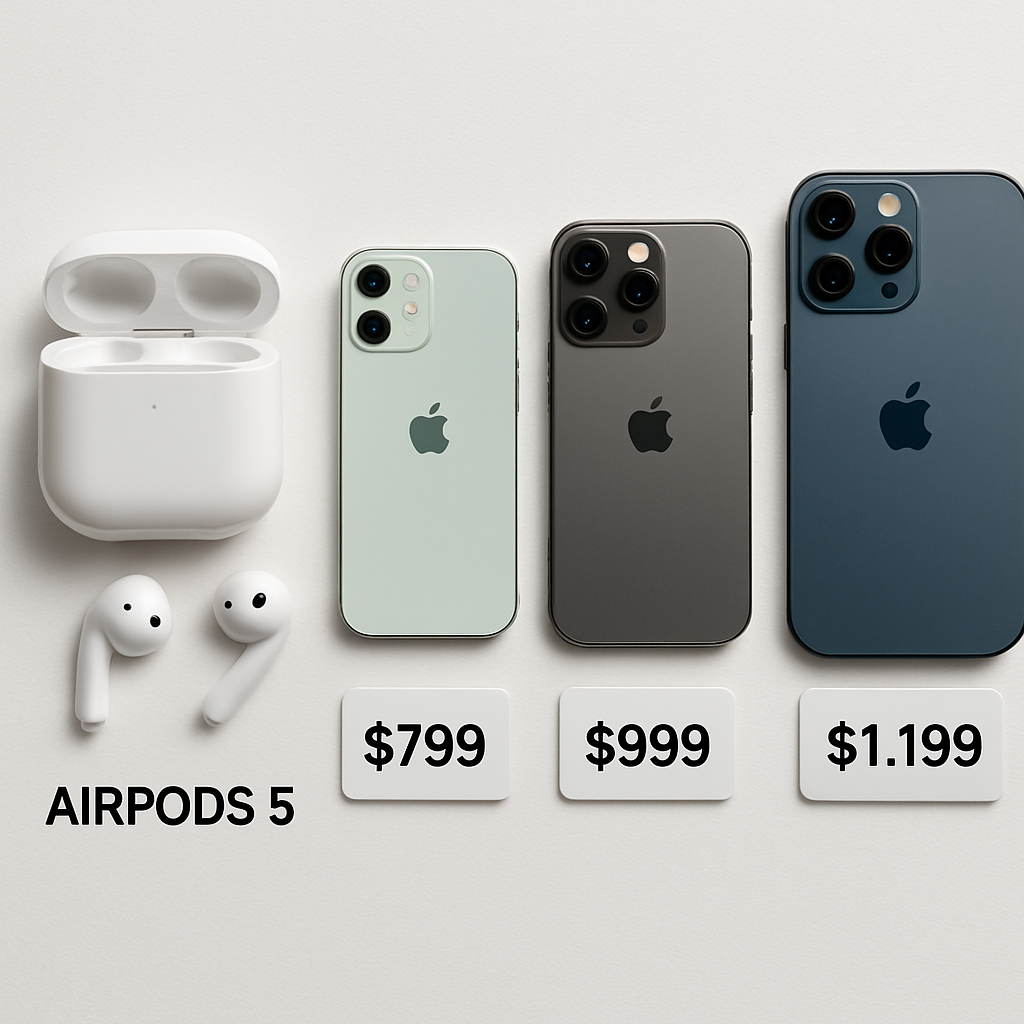
There are two versions this time: the base model with a wired charging case and a premium model with wireless charging, stem-mounted volume controls, and better battery life. The starting price matches what AirPods 4 cost originally—$129 for the base version. The wireless charging version goes for $149. Preorders are live now, with shipping beginning September 18.
Across-the-Board iPhone Price Surge
Apple has quietly increased the price of every iPhone model it still sells by $100 in the U.S.—including ones with no hardware upgrades. The base iPhone 17 now starts at $899 (up from $799), while the iPhone 17e has jumped from $599 to $699. The Air version enters four-figure territory, now starting at $1,099. Even the two-year-old iPhone 16 has seen its lowest-capacity model rise to $799.
The iPhone 18 Pro and Pro Max lines, launched this week, also carry the price bump when compared to last year’s iPhone 17 Pro models. Alongside those changes, Apple has discontinued the iPhone 17 Pro and iPhone 17 Pro Max, further simplifying the product tiers.
OS Update and Timing
To coordinate with hardware releases, Apple confirmed that iOS 27 will formally release on Monday, September 14. The update introduces a new Siri powered by Apple’s own AI, refined visual styles (notably with a customizable transparency slider in interface elements), and performance improvements across app launches, camera, photos, AirDrop, and networking transitions. Most devices compatible with iOS 26 will also support iOS 27—though some of the most advanced AI features will be limited to newer or more powerful models.
These announcements come amid rising costs in chip manufacturing—especially memory and storage used in AI infrastructure and data centers—and a wider trend of supply chain inflation. Apple’s CEO previously described price increases as “unavoidable,” a sign that the company has hit a point where subsidizing costs across models is no longer sustainable.
What this means: For consumers, the AirPods 5 deliver significant value, especially since ANC is now standard even in the base model. But the $100 price hikes across existing iPhones may reshape buying decisions—what used to be cost-cutting by buying “last year’s model” is less of a discount now. Moving forward, Apple’s margin pressures—driven by AI hardware demand and component scarcity—are likely to be baked into its pricing strategy. Watch whether competitors follow suit and how consumers react to the narrowing price differences between newer and older phones.