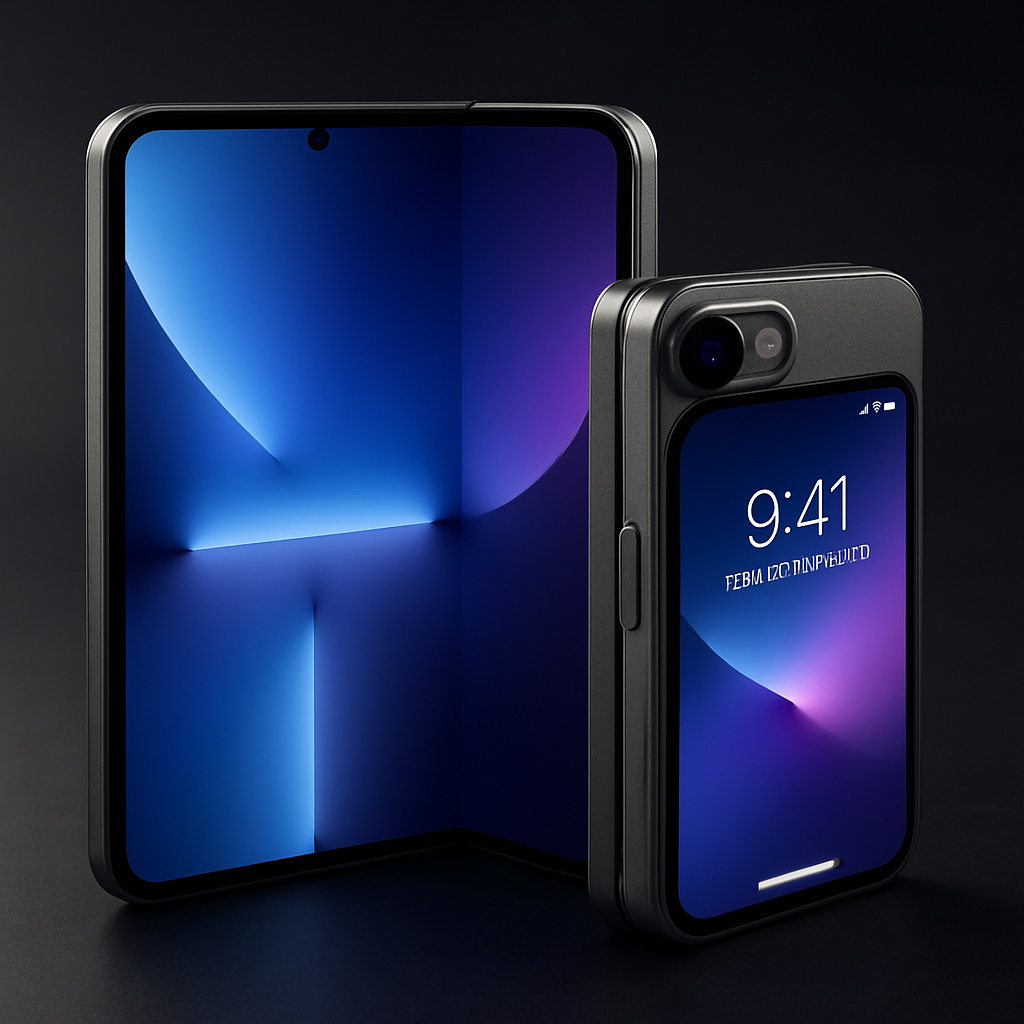
Apple has officially entered the foldable phone market with the iPhone Duo, announced today at its “Surprise and Shine” event. This marks the company’s first phone built around two screens and a hinge mechanism that folds out into a larger inner display, while retaining a traditional outer screen.
Design, Build, and Display Features
The iPhone Duo integrates two displays into a single, continuous frame. When folded open, Apple claims it’s the thinnest iPhone ever, with core components consolidated into the distinctive camera plateau. Titanium framing, a Ceramic Shield back, and Ceramic Shield 2 upfront ensure durability, while IP68 rating confirms the device is water and dust resistant. The Duo comes in two finishes: Star White and Night Sky. Unlock options include Touch ID built into the side button or via Apple Watch.
A custom hinge composed of over 100 precision components enables a seamless fold. Its multilayer lamination and viscoelastic adhesives are engineered to allow the display layers to glide during folding—reducing distortion over time. Additional rigidity comes from titanium at the base and internal carbon fiber supports.
The primary internal screen spans 7.6 inches—roughly 50% larger than the iPhone 18 Pro Max and 80% bigger than the iPhone 18 Pro. The outer screen measures 5.4 inches, offering about 90% of the iPhone 18 Pro’s screen area. Later this year, users will be able to use Apple Pencil on both displays. To address a common foldable issue, Apple applied a custom nano texture finish to cut glare, and created a micro lens texture using maskless laser lithography. The result: a matte-like surface that masks the crease visually but maintains a refined touch feel.
Software, Cameras, and Performance
The iOS interface has been optimized for the Duo. Key controls are tucked into the display edges for thumb access; the Home Screen dock switches to vertical, and status information is shifted to corners. Both displays transition smoothly as the phone opens, with content scaling appropriately. The Duo can sit partially folded, and content adjusts to avoid the crease. On the audio front, the speakers adjust with device angles, and users can run dual-app mode or duplicate apps side-by-side. A new Standby mode transforms the Duo into a clock with soft glowing widgets when idle.
Camera tech carries over familiar 48MP Fusion main and ultra-wide sensors, matching the ultra-wide lens used in the iPhone 18 Pro. Users get upgraded Photographic Styles, the ability to shoot 4K Dolby Vision time-lapses using the Duo as its own stand, and new front-facing shooting features. The outer display houses a 12MP Center Stage camera for previews; the inner display hides its FaceTime camera beneath the screen. Dual-capture mode records front and back simultaneously, and a “Smart Take” helps nail group shots without a timer.
On performance, the Duo is powered by Apple’s new C2 modem, which offers up to 50% speed gains over the previous C1X, adds mmWave 5G support in the U.S., and improves battery efficiency by as much as 15%. AI-driven enhancements aim to maintain signal in weak-cell areas, and the device delivers up to 35% higher sustained performance compared to the iPhone 17 Pro. It’s eSIM-only around the world.
Battery, Pricing, and Availability
The Duo uses twin batteries—one in each half—that operate as a combined power source. Apple rates video playback up to 31 hours using the inner display, or up to 44 hours on the outer screen; with both screens used evenly, battery life drops to around 24 hours. Quick charge offers 50% in approximately 20 minutes, and a five-minute session gives five hours of video on the outer display.
Storage starts at 256GB and goes all the way up to 2TB. Pricing kicks off at $1,999. Pre-orders open on October 16, with the device shipping starting October 23. New accessories include a folio-style case with built-in kickstand and a split-case that encloses both halves.
Analysis: This launch puts Apple in direct competition with foldables from Samsung and Google, which have experimented with hinge design and flexible materials for years. If Apple’s durability claims, crease-minimizing texture, and dual-screen software—especially the ability to fluidly shift content and support Pencil—hold up, this could reshape expectations of premium smartphones. Watch closely for real-world battery stamina, how seamless transitions feel over time, and whether Apple’s $2,000 price tag deters or defines the market.