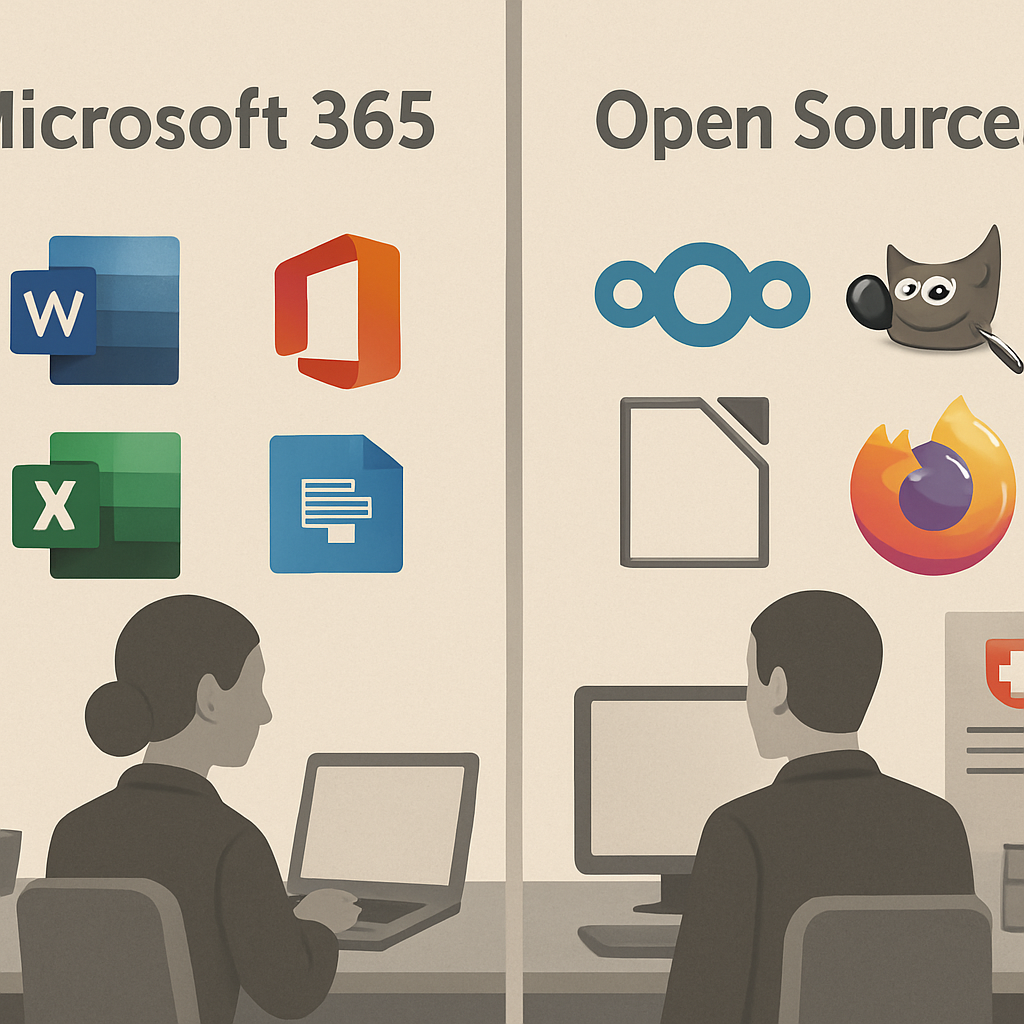
Switzerland’s federal government is launching a new program to test an open-source workplace platform designed to reduce dependence on Microsoft 365 for its most sensitive operations. The initiative comes after a feasibility study presented to the Federal Council on September 2, 2026, prompting a follow-up effort by the Federal Chancellery to build and roll out the platform among select agencies.
What’s Being Planned
The proposed open-source digital workplace will be offered alongside Microsoft 365 rather than replacing it immediately. By the end of 2027, roughly 3,000 federal employees who handle especially critical tasks are expected to gain access to the sovereign platform — for functions including email, calendars, editing documents and presentations, telephony, file storage, real-time collaboration, and audio/video conferencing.
The budget for the first implementation phase is around CHF 9 million, funded by previously approved parliamentary allocations for a sovereign Swiss open-source office automation platform. Officials emphasize this effort as one of digital sovereignty and resilience, aiming to ensure governmental operations can continue even during service disruptions, geopolitical challenges, supply-chain issues, or cloud provider outages.
Feasibility Findings & Next Steps
The initiative builds on the PoC BOSS (Proof of Concept for Office Automation with Open-Source Software) assessment, which involved 172 participants from several departments. Users generally rated the browser-based tools positively—especially for document editing, file storage, collaboration, email, and calendars. These results suggested that standard office workflows could be adequately supported outside Microsoft 365 under certain conditions.
However, the proof-of-concept also revealed limitations: large-scale video conferencing remains a weak spot, and questions linger around interoperability, identity management, operational testing, security controls, integration with legacy and specialist systems, and required internal expertise.
The planned rollout will begin as a dual-platform strategy to accommodate existing Microsoft-based infrastructure. Fully replacing Microsoft 365 across the federal administration depends on the 2027 pilot’s outcomes—costs, resilience, user satisfaction, maintenance burdens, and security. Only then will officials decide whether broader adoption is sensible.
Switzerland has long mapped out efforts to boost digital sovereignty as part of its “Digital Switzerland” strategy. A locally controlled office platform is seen as a safeguard against disruptions—whether technical, geopolitical, or regulatory.
What to watch: how well the pilot handles complex workloads, the trade-offs in performance versus integration costs (especially in conferencing and legacy systems), and whether other nations follow suit. If successful, this could mark a broader shift in how governments balance cloud-based services against locally controlled, open-source alternatives.