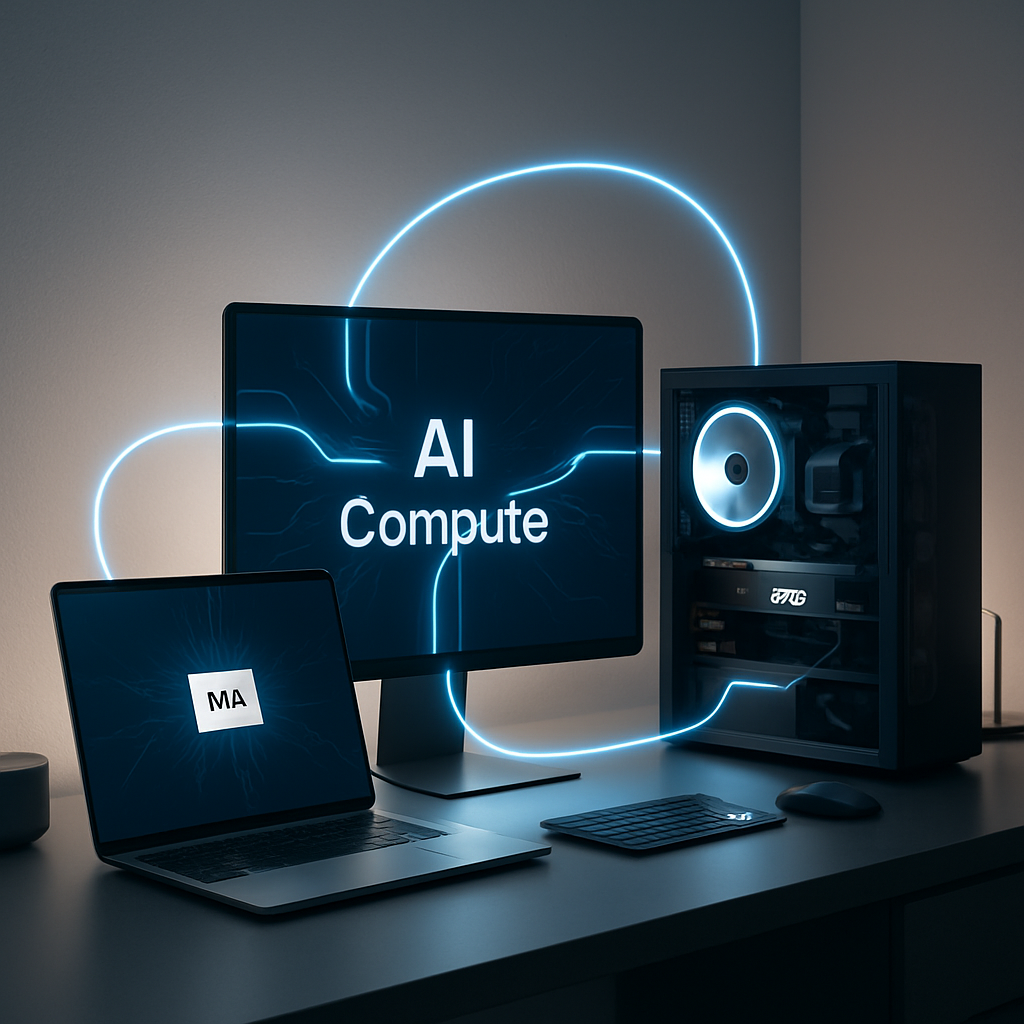
Starting today, owners of M4 Macs gain the ability to distribute AI workloads locally by linking their machines with Nvidia-powered PCs. The tool enabling this is Personal AI Router (PAIR), a software platform that allows Apple Silicon Macs and Nvidia RTX desktop systems (including DGX Spark units) to share AI inference tasks without relying on cloud servers.
How PAIR Operates
PAIR integrates with Ollama and LM Studio—platforms that handle AI models running directly on devices. When users launch AI jobs across their network, PAIR scans for connected, eligible computers and routes work to whichever system is available. For example, rather than overloading the Mac when multiple AI queries arrive, PAIR can offload some tasks to a gaming PC. This setup enables simultaneous task handling on different machines without manual configuration for each.
Nvidia’s open-source beta for PAIR was released on September 3, 2026. It is designed to choose target machines per request, rerouting to others when systems are busy or offline. However, PAIR doesn’t merge RAM or GPUs between devices—it doesn’t turn two 16GB Macs into a 32GB unified system. This means adding more computers improves throughput, but won’t necessarily speed up individual model runs. Nvidia demonstrated this using Ollama and a 35-billion parameter Qwen model split across five AI subagents. A single-task test on just an RTX Spark laptop took 18 minutes; spreading the job across that laptop, a DGX Spark, and an RTX 5090 dropped the time to about 8 minutes and 48 seconds. Notably, no Mac was included in that particular benchmark, so Mac-specific gains are not yet measured.
Who Can Use PAIR
Hardware requirements are precise. Macs must feature the M4 chip or newer and run macOS Tahoe, with at least 8GB RAM and preferably 20GB of free disk space. Surprisingly, the M3 Ultra Mac Studio—though capable and launched in 2025—is not officially supported under these criteria. Nvidia hasn’t clarified what drives the cutoff. On the PC side, systems with GeForce RTX 20-series GPUs—Turing architecture or above—or RTX Pro workstation cards, plus DGX Spark machines, are acceptable. PAIR operates on Windows, Linux, and macOS.
Users install PAIR, pair their Macs and PCs, and make desired models accessible through Ollama or LM Studio. PAIR handles everything across the local network. The models must be downloaded ahead of time. Importantly, prompts, documents, and AI context stay local; only when setting up do you need internet. PAIR doesn’t function as a cloud fallback. It’s a zero-cloud option for local inference.
Aside from combining underutilized resources, PAIR fills a gap for Mac users looking to tap into more GPU power without abandoning privacy or investing in cloud time.
Why this matters: As local AI workloads grow – from agents to document processing – tools that distribute compute across multiple devices will reshape how average users and developers build their setups. PAIR’s limitations—such as its strict hardware eligibility—show that the transition to fully networked local inference is just beginning. Observing how performance scales with real Mac users, and whether the support list expands (especially to powerful non-M4 machines), will indicate where the ecosystem is headed.