Pfizer is deploying the Apple Vision Pro headset in a new immersive experience designed to help cancer patients and their families understand how the company develops treatments—though the result leans more toward well-produced infomercial than neutral education. The project, built in collaboration with creative studio Groove Jones, includes real-time 3D visuals, photorealistic depictions, and hands-on labs, aiming to tell a ”story of resilience and groundbreaking cancer treatments.”
What users see and interact with
When someone puts on the Vision Pro, they’re first presented with a series of films featuring cancer patients, scientists, and family members. These aren’t traditional documentary interviews; the characters have their identities protected through proprietary depth-mapping technology, and their images are rendered in ultra-high-resolution stereoscopic 3D. This technique preserves emotional tone while maintaining privacy.
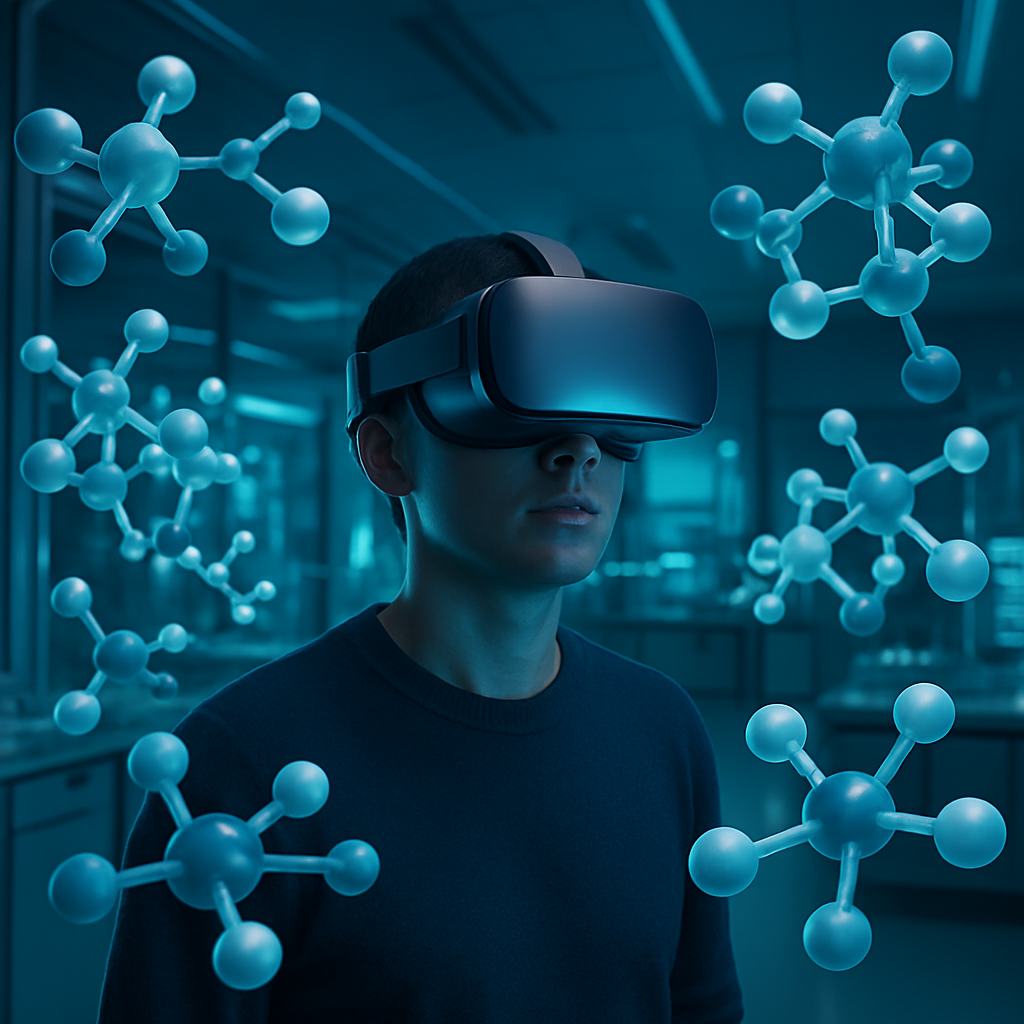
After the narrative segment, users are transported into a virtual 3D laboratory where scientists (rendered photorealistically but largely still) guide them through Pfizer’s technologies. Most interactive content is found in a module called the “ADC Builder,” where users play a kind of reverse Jenga to assemble an Antibody-Drug Conjugate, one of Pfizer’s signature approaches to cancer treatment. The build process has four steps, each accompanied by explanatory text of about 60 words, followed by an animation showing the drug entering the bloodstream.
Caveats and impressions
While the headset delivers on immersion—with spatial audio, 3D modeling, and engaging visual storytelling—some elements feel more like a marketing presentation than an objective educational tool. For instance, the characters are not physically filmed but constructed via 3D models, and the lab scenes are static rather than interactive in real time. The experience suggests users are led through content rather than exploring at their own pace.
Moreover, complex scientific realities—like how long it takes to bring a drug from discovery through clinical trials—are acknowledged only briefly. Though the ADC Builder allows users to simulate designing a drug, the actual process normally takes a decade or more. Condensing that into seconds makes the experience more symbolic than accurate.
Why this initiative matters
This move marks a shift in how pharmaceutical companies communicate with patients. Using mixed reality to tell medical stories is still rare but growing, especially for aiding patient understanding and emotional support. The project shows how Vision Pro is finding use beyond entertainment or gaming, entering harder-to-define domains like healthcare education.
Still, whether this particular experience will resonate outside controlled environments—like Pfizer events—or with users seeking detailed scientific insight is unclear. The text overlay and the storyline may serve well for emotional impact, but may fall short for those looking for depth.
By turning cancer research into an immersive narrative, Pfizer demonstrates what’s possible when medicine meets spatial computing. The effect is powerful for awareness, but the gap between storytelling and scientific transparency will shape how meaningful this kind of experience is perceived long-term. As mixed reality tools like Vision Pro become more accessible, the test will be whether they can balance immersive engagement with informative rigor.