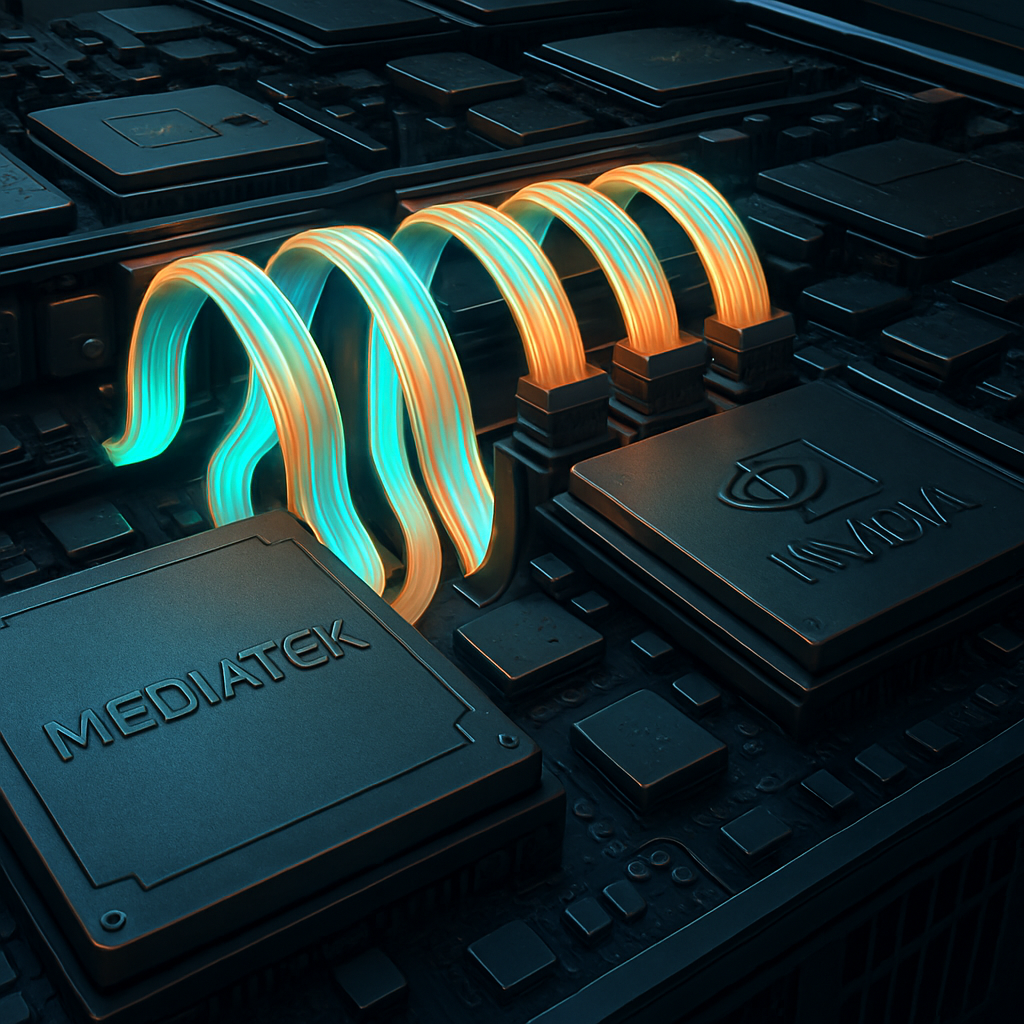
Nvidia is investing $3.5 billion in MediaTek under a deal aimed at weaving the Taiwanese chipmaker into the heart of cloud-scale AI infrastructure. MediaTek will adopt Nvidia’s technologies so that new custom chips designed by AI companies and large hyperscalers can drop seamlessly into Nvidia-based data centers. The goal: stay relevant in a market where cloud giants want less dependence on Nvidia’s own GPUs.
What the Deal Actually Means
Under this partnership, MediaTek will get access to Nvidia’s NVLink Fusion ecosystem—including NVLink, a high-speed interconnect fabric usually seen in Nvidia-only setups. That means non-Nvidia chips can now talk fast enough to be plugged directly into racks alongside Nvidia’s hardware. In turn, MediaTek aims to ramp up its custom ASIC business: it estimated about $2 billion in revenue from that line in 2026 and is targeting broader growth over the coming years.
The agreement also doubles down on collaborating in multiple domains. Working together, the companies will advance projects like DGX Spark (a small AI development system) and expand Nvidia’s RTX Spark push into consumer AI PCs. On the auto side, MediaTek’s existing platforms—responsible for smart vehicle cockpits and wireless systems—will increasingly mesh with Nvidia’s Drive AGX suite and RTX graphics for software-defined vehicles.
Why Nvidia Is Playing Coy About Giving Up Ground
A new wave of AI startups and cloud providers—including Amazon, Google, Microsoft, OpenAI, and Anthropic—are building their own AI chips to reduce reliance on Nvidia’s GPU dominance. This trend threatens Nvidia’s traditional stronghold in AI compute. By investing in MediaTek, Nvidia isn’t retreating but rather enabling partners to build custom silicon while keeping Nvidia’s infrastructure central.
Nvidia senior leadership emphasizes that the company has long been more than just a GPU maker—it sees itself as an AI infrastructure company. Customized chips, rack-scale architectures, and ecosystem integration are part of a strategy to ensure that the whole AI “factory,” from custom silicon to system deployment, runs on Nvidia’s platforms. This deal aligns with earlier moves, like its collaboration with AWS, where NVLink Fusion is also being deployed at scale.
MediaTek, traditionally known for chips in smartphones, automobiles, and smart homes, is accelerating its push into data center ASICs. The plan is to give its AI and cloud customers the tools to spec chips for their specific workloads, but use Nvidia’s ecosystem underneath so they can slot smoothly into AI infrastructure already running Nvidia stack.
As for financials: MediaTek expects its custom AI chip segment to bring in about $2 billion in 2026, with Nvidia’s investment helping accelerate that growth and deepen ties in newer markets like autonomous vehicles and AI-infused consumer devices.
This bet is as much about preserving control over the ecosystem as it is about any single chip. For Nvidia, helping others compete with its dominance while still setting the rails may be the smartest way to keep leading in a market that wants both performance and specialization.
Why this matters: The chip arms race is fragmenting. Hyperscalers want more say in chip design; chip giants want to stay in control of infrastructure. Nvidia’s deal with MediaTek is a smart pivot—rather than fight the shift toward custom silicon, Nvidia is leaning in on infrastructure, interconnects, and platform dominance. What to watch next: who else pairs with Nvidia or builds rival interconnects—because if NVLink Fusion becomes the standard glue, Nvidia could end up owning the future of custom AI chips.