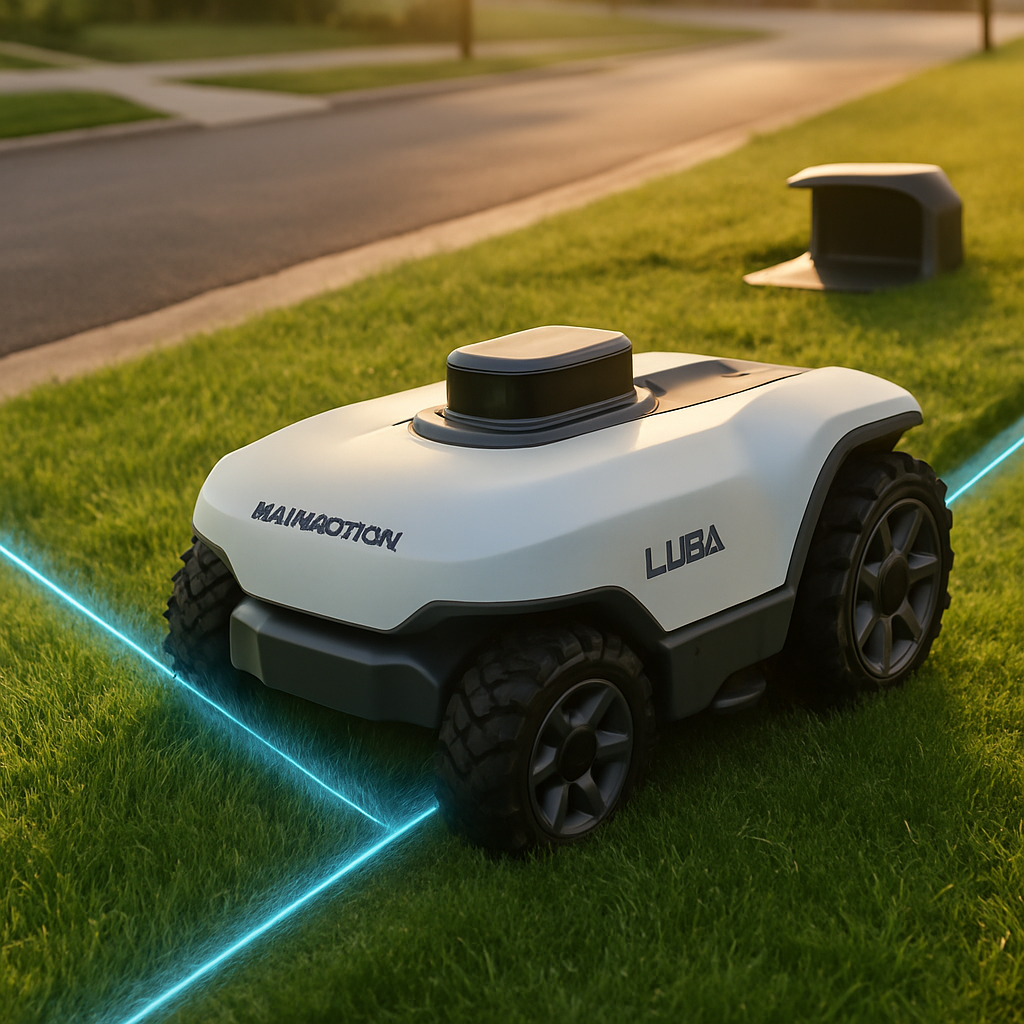
Robot lawnmowers have long seemed like a luxury with too many trade-offs. That changed after spending several weeks with Mammotion’s Luba 3 AWD. This model solves many of the issues that have kept me skeptical of hands-free mowing — namely setup, navigation accuracy, cutting performance, and battery runtime.
Setup & Navigation: No Boundary Wires, NetRTK Positioning
Instead of relying exclusively on perimeter wires or demanding RTK base stations, Luba 3 uses “NetRTK”: a fusion of satellite positioning and LiDAR. The result is mapping that stays within user-defined lines almost perfectly. Even areas bordering a busy road required less buffer than expected, thanks to strong positional consistency. There were spots where a ditch or narrow corner caused the mower to hesitate, but those were rare issues.
The included app is how everything gets managed. Users draw virtual fences, designate zones (even across driveways or gated sections), schedule when different parts of the yard get mowed, and monitor progress. A live camera feed lets you see the mower’s view in real time. Hardware setup is fairly painless — assembly and the physical dock took under 30 minutes. You also get a traditional RTK station, but in many use cases it’s optional.
Cut Quality, Terrain, & Runtime
Luba 3’s cutting height reaches up to 3.9 inches, delivering a healthier lawn look during hot weather. It performs well both on thick grass and in dry, stressed conditions. Most lawns are trimmed evenly, though longer cuts or infrequent mowing sometimes leave a few missed blades. Slopes? The AWD handles steep inclines — rated at up to 38.6 degrees — capably, though tracks on uneven ground can cause some patchy grass.
Battery life on the 0.75-acre test model is solid: roughly two hours of runtime in hilly terrain. In optimal conditions, Mammotion claims up to about 3.5 hours (215 minutes) on a full charge. Switching zones is easy, letting you tackle gated yards, fences, or odd layouts flexibly.
Design, Usability & Trade-Offs
Luba 3 is big — about two to three times the size of a robot vacuum. At 41 pounds, it’s manageable for occasional manual repositioning, but its size is noticeable in the yard. Its white finish shows dirt but helps with heat management. There’s a large stop button and the blades are relatively safe compared to full-size mowers.
Unlike push mowers, this robot won’t fully replace yard work — expect to still deal with weeds, edges, and tight corners that are hard for a robot to reach. But the majority of mowing time has dropped from hours to minutes per week, especially with frequent runs.
Price is where the biggest barrier remains. The AWD model starts at around $2,399 in the U.S. That’s a significant investment, though discounts and practical time savings make it more attractive depending on your yard and temperament.
Ultimately, Luba 3 delivers one of the best robot mower experiences I’ve tested. It addresses catalogues of concerns: navigation drift, performance on slopes, and setup complexity. If your yard is well-suited, it’s expensive — but arguably worth it.