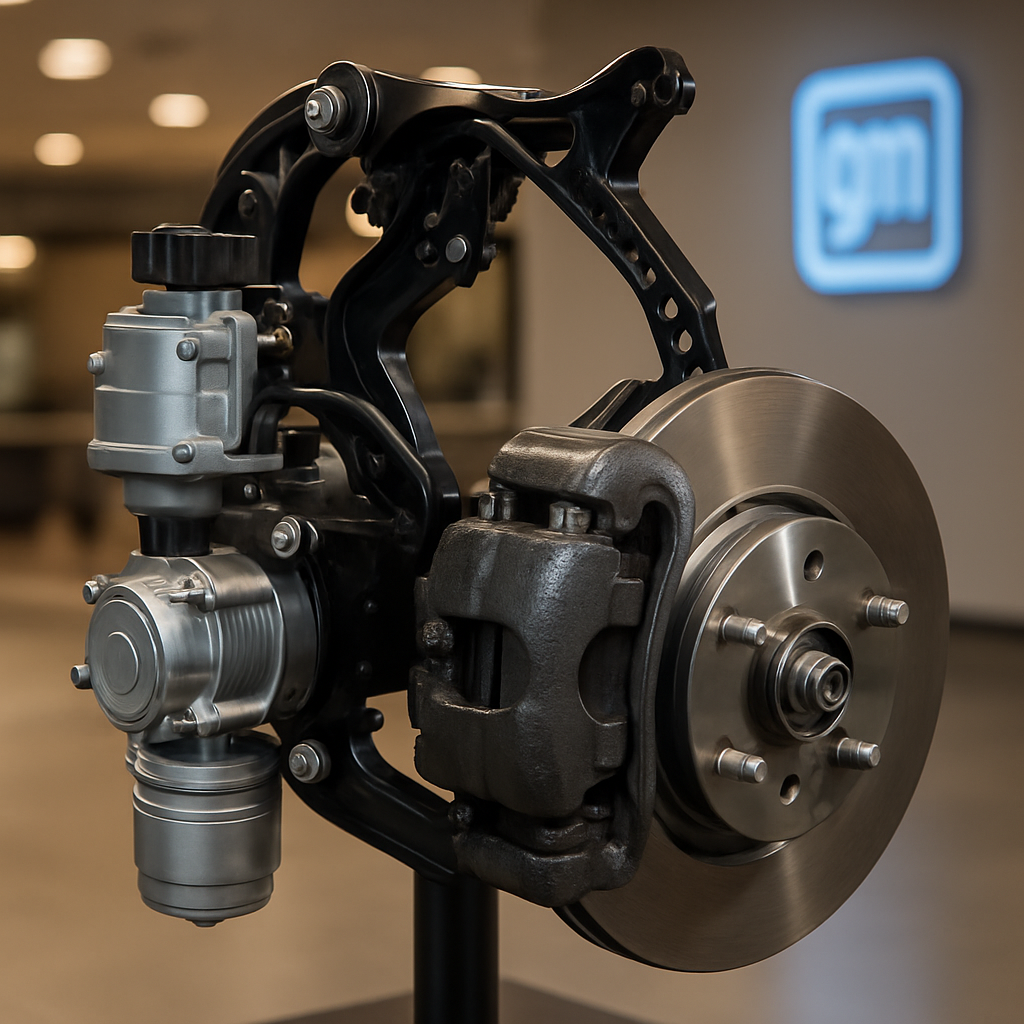
The U.S. auto safety agency has escalated its investigation into braking problems in certain General Motors electric vehicles after accumulating hundreds of customer complaints, over 20 crashes or fires, and multiple injuries. The probe, initiated in April 2024, now involves more than one million vehicles—including both electric and non-electric GM models—suspected to have failures linked to its brake-by-wire system known as eBoost.([techcrunch.com](https://techcrunch.com/2026/08/24/brake-problems-in-gm-evs-draw-greater-federal-scrutiny/))
From Initial Alerts to Engineering Analysis
The National Highway Traffic Safety Administration (NHTSA) originally launched its Office of Defects Investigation (ODI) inquiry two years ago following reports from owners of 2023 Cadillac Lyriq models encountering “Brake System Failure” messages at startup or after stops. GM’s internal study attributed those instances to fractures in the spindle component of the eBoost system.([techcrunch.com](https://techcrunch.com/2026/08/24/brake-problems-in-gm-evs-draw-greater-federal-scrutiny/))
Despite those findings, further complaints emerged that diverged significantly from GM’s descriptions. Some drivers reported sudden loss of brake assist while decelerating, not just during startup or idle, raising the risk of longer braking distances and potential crashes. In response, ODI upgraded the inquiry to an “engineering analysis,” its most comprehensive level of investigation short of mandating a recall.([techcrunch.com](https://techcrunch.com/2026/08/24/brake-problems-in-gm-evs-draw-greater-federal-scrutiny/))
Scope of the Problem & Affected Models
Introduced in 2019, eBoost replaces the traditional mechanical linkage between pedal and brakes, allowing braking behavior to be adjusted across driving modes. Models equipped with eBoost include the Blazer EV, Equinox EV, Cadillac Lyriq, and the Honda Prologue and Acura ZDX, which are part of GM’s joint venture with Honda. Some non-EV models cited in the investigation are the Chevy Colorado and GMC Canyon, as well as Buick’s Enclave and Envision models.([techcrunch.com](https://techcrunch.com/2026/08/24/brake-problems-in-gm-evs-draw-greater-federal-scrutiny/))
The issue has reportedly led to real danger. One driver of a 2025 Lyriq described crashing through a store front after the vehicle failed to decelerate while parking. Another Blazer EV driver said they had to steer into a curb to avoid colliding at an intersection when brake assist failed mid-brake.([techcrunch.com](https://techcrunch.com/2026/08/24/brake-problems-in-gm-evs-draw-greater-federal-scrutiny/))
GM’s discontinued autonomous vehicle, the Cruise Origin, also used eBoost, though its development halted in 2024.([techcrunch.com](https://techcrunch.com/2026/08/24/brake-problems-in-gm-evs-draw-greater-federal-scrutiny/))
The engineering analysis will allow NHTSA to examine whether the reported failures in the eBoost system track with GM’s earlier spindle fracture diagnoses or involve other issues leading to abrupt loss of braking assistance. Depending on findings, a recall or other regulatory actions could follow.([techcrunch.com](https://techcrunch.com/2026/08/24/brake-problems-in-gm-evs-draw-greater-federal-scrutiny/))
This expanded investigation underscores deeper tensions in the growing brake-by-wire shift in vehicle design. By removing mechanical linkages, systems like eBoost aim to offer flexibility and control benefits, but depend heavily on electronic, hydraulic, and software reliability. As automakers push further into EV platforms with these architectures, problems like these could become industry-wide case studies in safety trade-offs. Observers should watch for NHTSA’s final report, GM’s corrective measures, and whether eBoost-equipped models will see urgent firmware or hardware fixes—or a full recall if required.