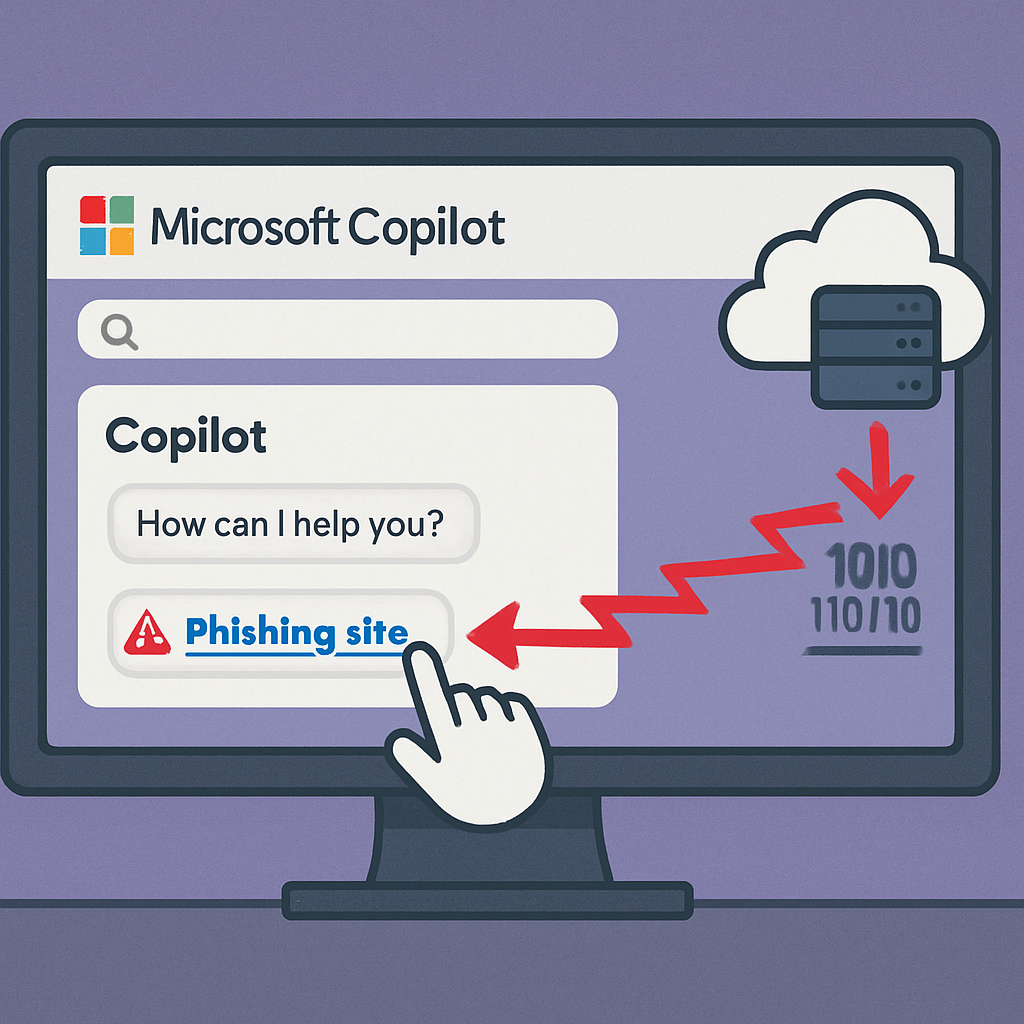
Recent findings have unveiled critical vulnerabilities in Microsoft Copilot Personal that could allow attackers to exfiltrate sensitive user data with a single click. These flaws, collectively termed ‘CoSnitch’ by Varonis Threat Labs, exploit an undocumented URL parameter, enabling unauthorized access to information from connected applications.
Understanding the CoSnitch Vulnerabilities
Varonis Threat Labs identified three primary vulnerabilities within Copilot Personal:
- Automatic Prompt Execution: By combining specific URL parameters, attackers can craft links that, when clicked, execute malicious prompts within the victim’s authenticated Copilot session without any further user interaction.
- Exfiltration via Connected Services: The malicious prompt can access data from services the user has authorized, such as email or cloud storage, and transmit this information to an attacker-controlled endpoint.
- Persistent Memory Manipulation: Crafted web pages, when summarized by Copilot, can embed malicious instructions into the user’s memory store, influencing future interactions.
These vulnerabilities were reported to Microsoft in December 2025, and patches were released on August 18, 2026. There is no evidence to suggest that these flaws were exploited in the wild prior to the patch.
Technical Breakdown of the Exploit
The attack leverages an undocumented ‘autorun=1’ parameter, which, when paired with the ‘q’ parameter in a URL, causes Copilot to execute the provided prompt automatically upon page load. This method allows attackers to run arbitrary commands within the user’s session, accessing data from connected services without additional permissions.
In practical terms, an attacker could craft a link that, when clicked by the victim, prompts Copilot to retrieve and send sensitive information—such as email contents, calendar events, or files from cloud storage—to an external server controlled by the attacker. This process occurs seamlessly, without the victim’s awareness or further interaction.
Implications and Recommendations
The CoSnitch vulnerabilities highlight the potential risks associated with integrating AI assistants with multiple services. Users are advised to ensure their systems are updated with the latest patches to mitigate these risks. Additionally, exercising caution when interacting with unsolicited links, even those appearing to originate from trusted sources, is crucial to maintaining security.
As AI assistants become more integrated into daily workflows, it is imperative for developers and users alike to remain vigilant about potential security flaws. Regular updates, thorough testing, and user education are essential components in safeguarding against such vulnerabilities.