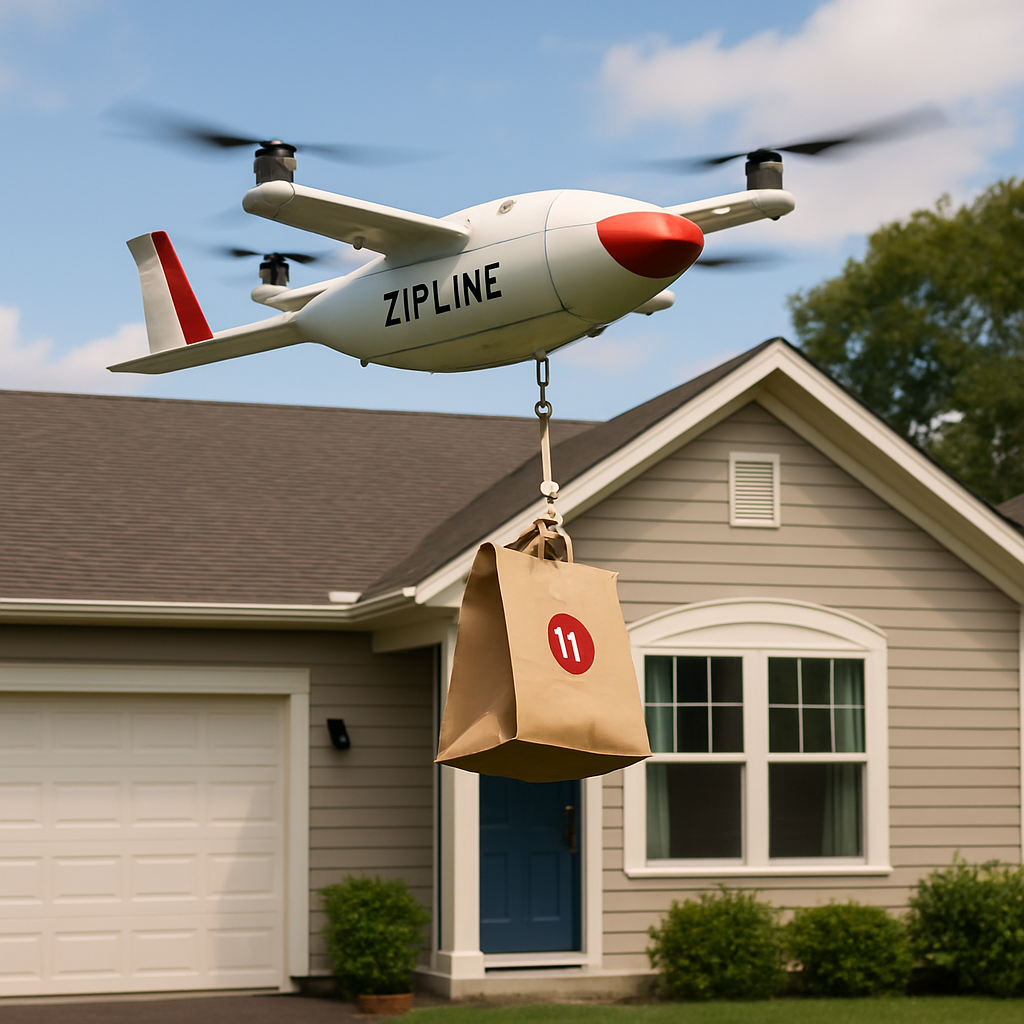
Uber is expanding its food delivery capabilities by partnering with drone delivery company Zipline. This collaboration aims to facilitate up to one million deliveries per day using Zipline’s autonomous drones by the end of 2029. Initial drone deliveries through Uber Eats are expected to commence later this year in Zipline’s existing markets, with plans to extend the service to numerous U.S. cities.
While the specific investment amount remains undisclosed, this partnership underscores Uber’s commitment to integrating advanced technologies into its delivery network. By collaborating with multiple drone delivery partners, Uber seeks to enhance the efficiency and reach of its Eats platform. This strategy mirrors Uber’s approach in the autonomous vehicle sector, where the company has engaged with various partners to stay at the forefront of innovation.
Uber’s history with drone delivery dates back to 2019 when it began testing drone deliveries for Uber Eats in urban environments. The company initially partnered with McDonald’s to conduct trials at San Diego State University, utilizing drones to transport meals to designated drop-off locations. These early tests laid the groundwork for Uber’s continued exploration of drone delivery solutions.
Zipline, headquartered in San Francisco, has been a pioneer in autonomous drone delivery since its inception in 2014. The company initially focused on delivering medical supplies in Africa, developing a comprehensive drone delivery ecosystem that includes aircraft, launch and landing systems, and logistics software. In recent years, Zipline has expanded its services to include food, retail, agriculture, and health products across multiple countries, including the United States and Japan.
In March 2026, Zipline secured an additional $200 million in funding, bringing its Series H round to $800 million and valuing the company at $7.6 billion. This substantial investment reflects the growing confidence in Zipline’s capabilities and the potential of drone delivery services.
Uber’s collaboration with Zipline is part of a broader strategy to integrate autonomous delivery solutions into its operations. In September 2025, Uber announced a partnership with Israeli startup Flytrex to test drone deliveries in select U.S. markets. Additionally, Uber has engaged with autonomous vehicle companies like Nuro to explore self-driving delivery options, further demonstrating its commitment to leveraging cutting-edge technologies to enhance its services.
By integrating Zipline’s drone technology into its Eats platform, Uber aims to significantly reduce delivery times, with projections suggesting orders could be fulfilled within five to ten minutes. This rapid delivery capability has the potential to revolutionize the food delivery industry, offering unprecedented convenience to customers and setting a new standard for service efficiency.
As Uber continues to invest in autonomous delivery solutions, the partnership with Zipline represents a significant step toward realizing the vision of fast, reliable, and scalable drone deliveries. This collaboration not only enhances Uber’s competitive edge in the food delivery market but also signals a broader shift toward the adoption of autonomous technologies in everyday logistics.