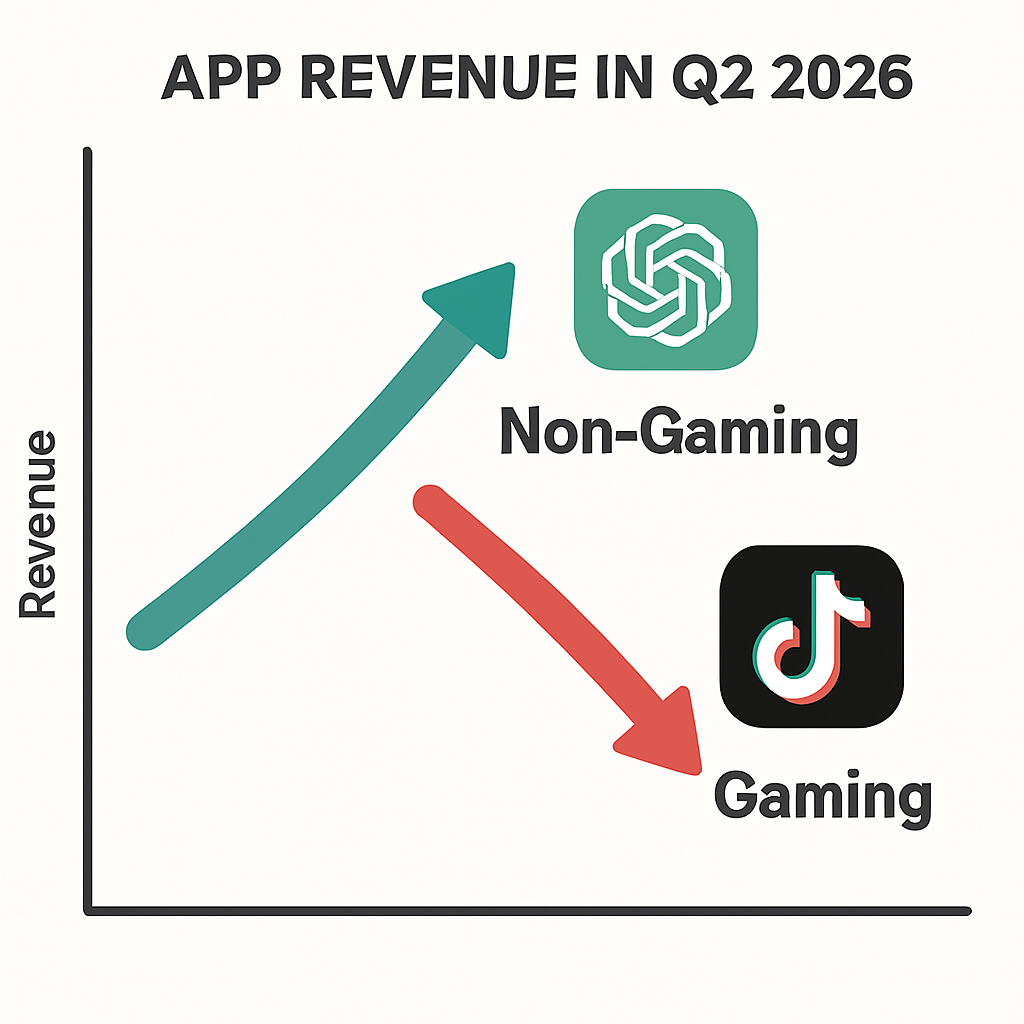
Recent data indicates a significant shift in mobile app spending patterns during the second quarter of 2026. Non-gaming applications have emerged as the primary drivers of revenue growth, while spending on mobile games has experienced a decline.
According to the latest figures, non-gaming app revenue increased by 14.6% year-over-year in Q2 2026, reaching $24.4 billion. In contrast, gaming app revenue declined by 4.5% over the same period, totaling $19.2 billion. This trend underscores a growing consumer preference for non-gaming applications, which also saw 25.5 billion downloads compared to 11.3 billion for games.
Geographically, the United States led in in-app purchase (IAP) revenue, generating $14.8 billion despite a 3% year-over-year decline. China followed with $5.98 billion, marking a 10% increase. In terms of app downloads, India topped the list with 6.67 billion installs, a 4% rise from the previous year. The U.S. and Brazil followed, with 3.08 billion and 2.43 billion downloads, respectively.
Among non-gaming categories, generative AI applications stood out, doubling consumer spending with a 108% year-over-year surge. ChatGPT led this category, holding approximately 60% of the market share and experiencing an 82% growth. Other AI apps like Claude, Grok, and Gemini also saw rapid acceleration, with Claude notably climbing from the seventh to the second position globally within a year.
Conversely, the Dating & Social Discovery category faced an 11% decline globally, primarily due to a 34% contraction in the U.S. market. However, Latin American countries such as Mexico, Brazil, and Argentina exhibited strong growth in this sector.
In terms of individual app performance, ChatGPT emerged as the most downloaded app during the quarter, followed by TikTok and Instagram. TikTok also led in IAP revenue, with ChatGPT and Google One trailing behind. Notably, Claude experienced significant growth, jumping 34 places to rank tenth in IAP revenue, while PineDrama saw the largest increase in downloads, climbing 237 places to reach the twentieth position worldwide.
This shift towards non-gaming applications reflects evolving consumer preferences and highlights the growing influence of AI-driven services in the mobile app ecosystem. As users increasingly seek functional and innovative applications beyond gaming, developers and companies are likely to focus more on enhancing and expanding non-gaming offerings to meet this demand.