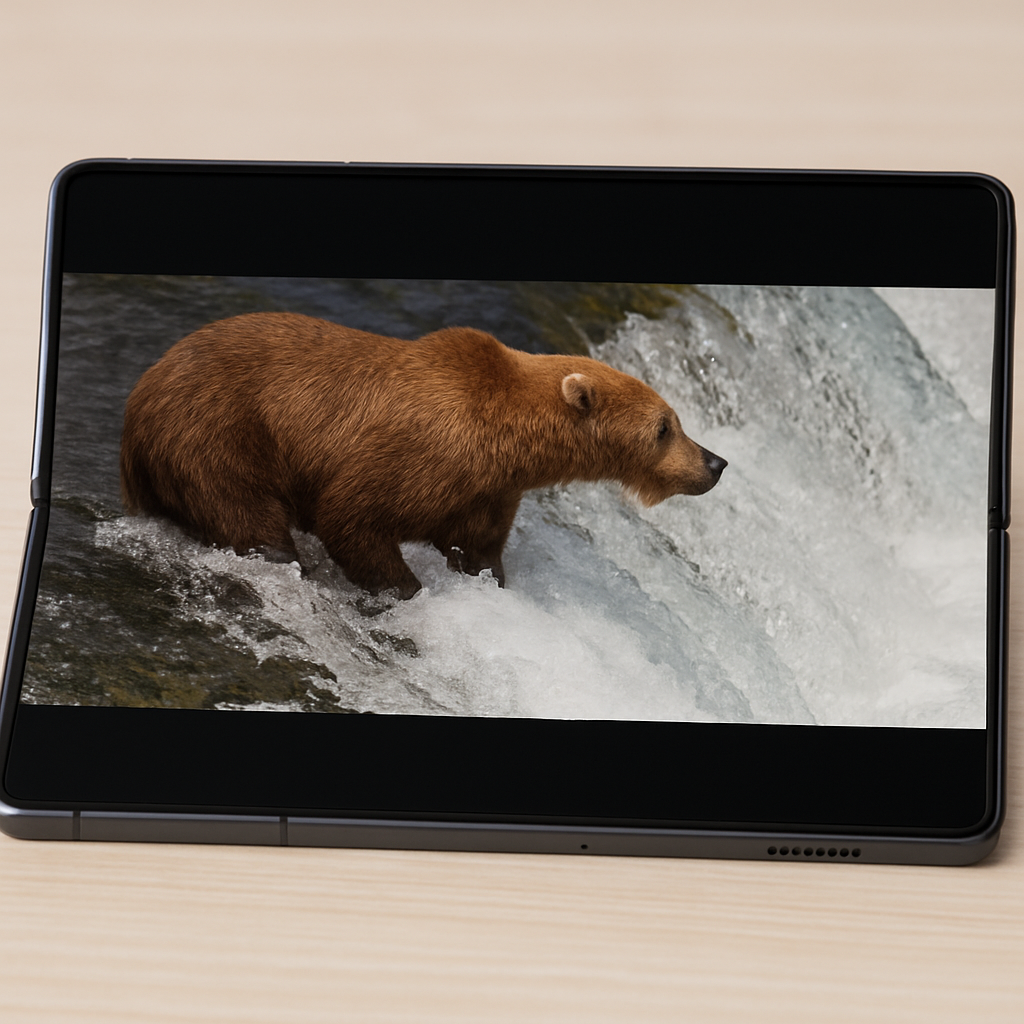
Samsung’s latest foldable smartphone, the Galaxy Z Fold 8, has been heavily marketed as the ideal device for consuming full-screen video content. The company touts its new form factor as “perfect” for such experiences, suggesting that users can enjoy their favorite media without the common black bars associated with mismatched aspect ratios.
However, real-world usage tells a different story. The Galaxy Z Fold 8 features a 4:3 aspect ratio on its main inner display. While this design choice offers a more compact and wider form factor compared to its predecessors, it doesn’t align with the standard 16:9 or 21:9 aspect ratios commonly used in most video content. As a result, users still encounter letterboxing—black bars on the top and bottom or sides of the screen—when watching videos, contrary to Samsung’s promotional materials that depict a seamless, edge-to-edge viewing experience.
Similarly, the cover screen of the Galaxy Z Fold 8 has a 10:16 aspect ratio. While this is closer to the dimensions used in short-form videos and social media content, it still doesn’t perfectly match the standard video formats, leading to some degree of letterboxing.
Adding to the confusion, Samsung’s promotional materials have inconsistently described the device’s display ratios. In some instances, the company has referred to the main screen as having a 16:10 ratio and the cover screen as 4:3, which contradicts the actual specifications of 4:3 and 10:16, respectively.
Despite these discrepancies, the Galaxy Z Fold 8 does offer improvements over previous models. The wider design reduces the amount of wasted space when viewing videos, and the overall form factor is more compact, making it easier to handle. However, the expectation of a true full-screen video experience remains unmet due to the inherent limitations of the chosen aspect ratios.
In conclusion, while the Galaxy Z Fold 8 brings notable design advancements, potential buyers should temper their expectations regarding its video playback capabilities. The device’s aspect ratios still result in letterboxing for most video content, meaning the full-screen experience Samsung advertises isn’t fully realized. Consumers seeking a device primarily for media consumption should consider these factors when making their purchasing decisions.