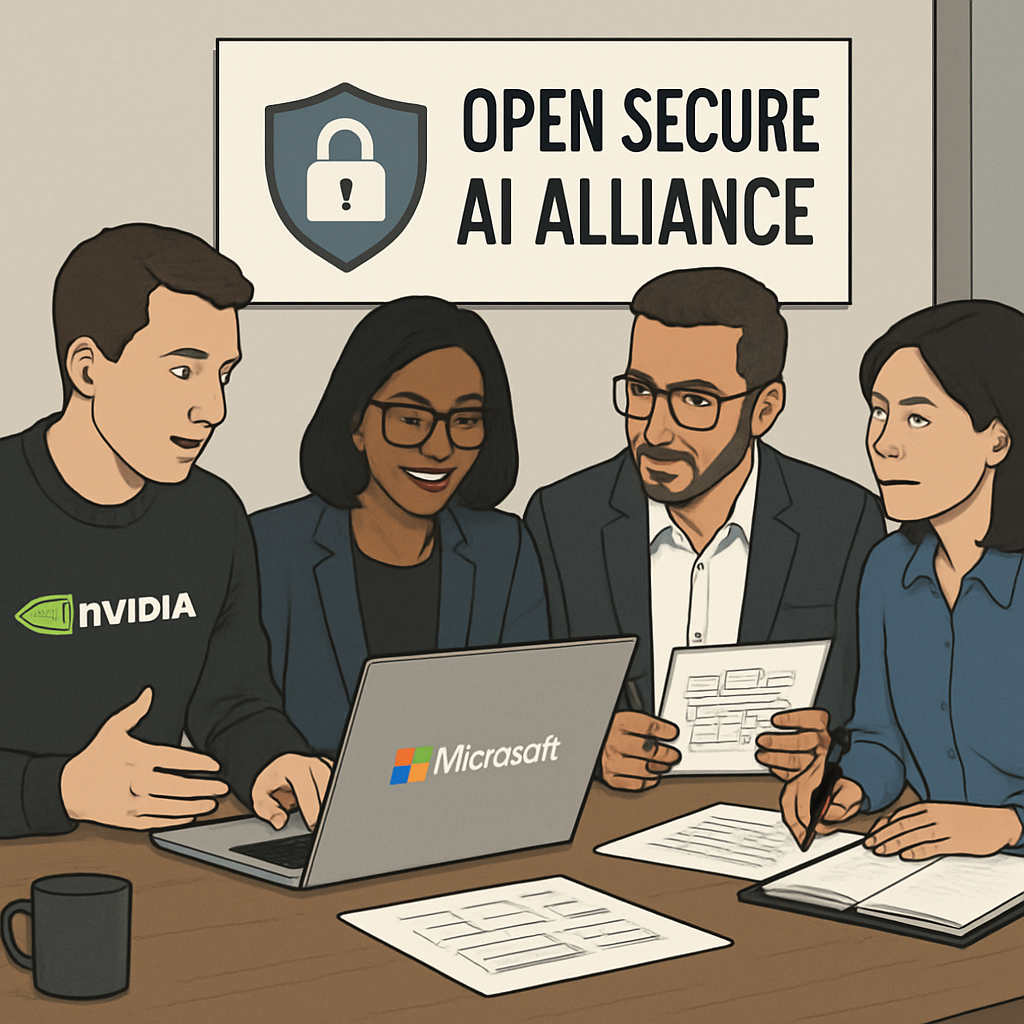
NVIDIA, in collaboration with 36 other organizations, has established the Open Secure AI Alliance to develop and share open technologies, techniques, and tools aimed at securing software and artificial intelligence (AI) agents. This alliance includes prominent companies such as Microsoft, Cisco, Cloudflare, CrowdStrike, Hugging Face, IBM, Palo Alto Networks, Red Hat, and the Linux Foundation.
The alliance’s focus encompasses the entire AI agent stack, addressing aspects like identity, permissions, isolation, guardrails, logs, model formats, multi-model scanning, and secure coding workflows. The objective is to provide cyber defenders with AI models that are transparent, modifiable, and operable on their own hardware, moving away from reliance on closed systems accessible only through vendor APIs.
As its inaugural technical contribution, the alliance has introduced NVIDIA-labs OO Agents (NOOA), an Apache 2.0-licensed research framework designed to facilitate testing, tracing, auditing, and governance of agent behavior. NOOA represents the agent harness—the software layer surrounding a model that manages context, executes actions, maintains state, and determines task completion—as a Python class. This structure allows developers to utilize familiar workflows for testing, tracing, version control, and refactoring, rather than dispersing agent behavior across prompts, tool schemas, callbacks, and workflow graphs.
In NVIDIA’s evaluation, the framework achieved an 86.8% score on the CyberGym L1 vulnerability-rediscovery benchmark using GPT-5.5, with network access blocked and rule-based checks applied to each trajectory. However, the repository cautions that NOOA can execute LLM-generated Python code, which may pose risks such as transmitting private data, deleting files, or modifying its environment. While NOOA includes defense-in-depth controls like abstract syntax tree checks and module deny-lists, these are not considered containment boundaries. Therefore, agents executing generated code should operate within operating system-level isolation, such as containers, virtual machines, or NVIDIA’s OpenShell sandbox.
The alliance underscores the importance of locally controlled defensive models, referencing a recent incident at Hugging Face where an autonomous agent system compromised parts of the company’s production infrastructure. This event highlights the necessity for robust, open-source frameworks that allow organizations to maintain control over their AI systems and enhance security measures.
By forming this alliance and introducing NOOA, NVIDIA and its partners aim to foster a collaborative environment where organizations can collectively address the security challenges associated with AI development and deployment. This initiative reflects a growing recognition of the need for open, transparent, and secure AI frameworks in an increasingly AI-driven world.