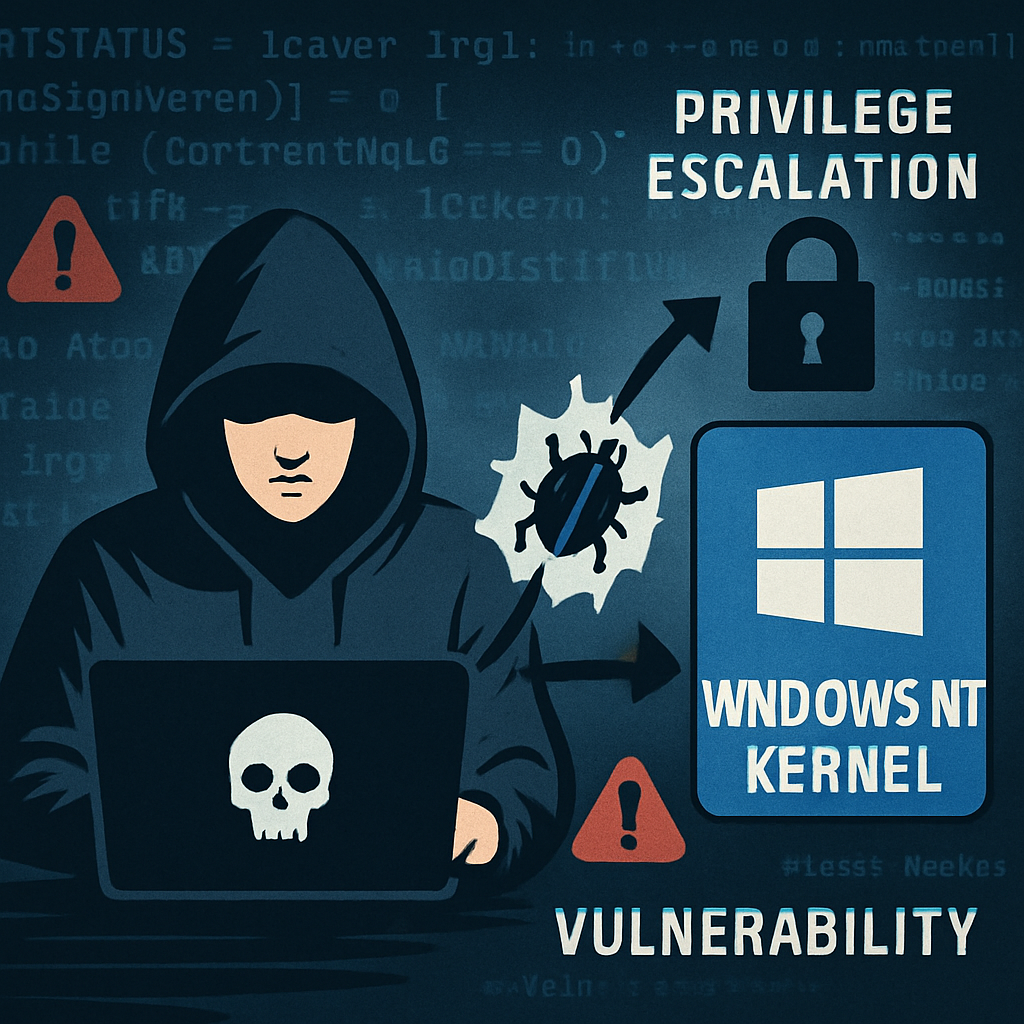
A security researcher operating under the alias G4sp4rCS has publicly released a proof-of-concept (PoC) exploit for CVE-2026-42980, a critical privilege escalation vulnerability in the Windows NT operating system kernel. This flaw arises from an integer underflow within the kernel’s code, allowing authenticated local attackers to elevate their privileges to the highest system level.
The vulnerability, identified as CVE-2026-42980, stems from improper arithmetic handling in the kernel, leading to unsafe operations that can be exploited to execute code with elevated privileges. Successful exploitation enables an attacker to escalate their access from a standard user account to NT AUTHORITY\SYSTEM, effectively granting full control over the compromised Windows system.
Details of the PoC Exploit
The PoC exploit, made available on GitHub by G4sp4rCS, includes comprehensive resources such as build scripts, source code, and a detailed technical write-up. The repository provides C code targeting the vulnerable Windows Management Instrumentation (WMI) kernel path, along with auxiliary files and build tools designed for compilation on Windows systems using Microsoft Visual C++ (MSVC) toolchains.
It’s important to note that the exploit is intended solely for educational purposes, defensive research, and authorized testing within controlled environments. The author emphasizes that the code should only be executed in isolated lab setups to prevent unintended consequences.
Implications and Mitigation
The release of this PoC significantly lowers the barrier for potential exploitation, as threat actors can now more easily incorporate this technique into their attack strategies. Common scenarios include deploying the exploit after initial access through methods like phishing, browser vulnerabilities, or malware, enabling attackers to bypass user restrictions and disable security measures at the kernel level.
Microsoft has addressed CVE-2026-42980 in its recent security updates. System administrators are strongly advised to apply these patches promptly across all affected Windows systems to mitigate the risk of exploitation. Additionally, organizations should:
- Verify the deployment of patches through endpoint management platforms.
- Prioritize updates for high-risk environments, such as multi-user and terminal servers.
- Restrict local logon rights to trusted accounts to minimize the number of users who could potentially exploit the vulnerability.
- Implement application allow-listing to prevent the execution of untrusted binaries.
- Monitor for unusual privilege escalation attempts.
Given the severity of this vulnerability and the availability of a public exploit, immediate action is crucial to protect systems from potential attacks.
The public release of this PoC underscores the ongoing challenges in maintaining kernel security within the Windows NT operating system. It highlights the necessity for continuous vigilance, prompt patch management, and robust security practices to defend against evolving threats. Organizations must remain proactive in their security measures to safeguard against such vulnerabilities.