Apple’s decision to discontinue the Mac Pro in March 2026 marked the end of an era for the company’s high-end desktop line. However, prior to this, Apple had ambitious plans to significantly enhance the Mac Pro’s capabilities, aiming to position it well above the Mac Studio in terms of performance.
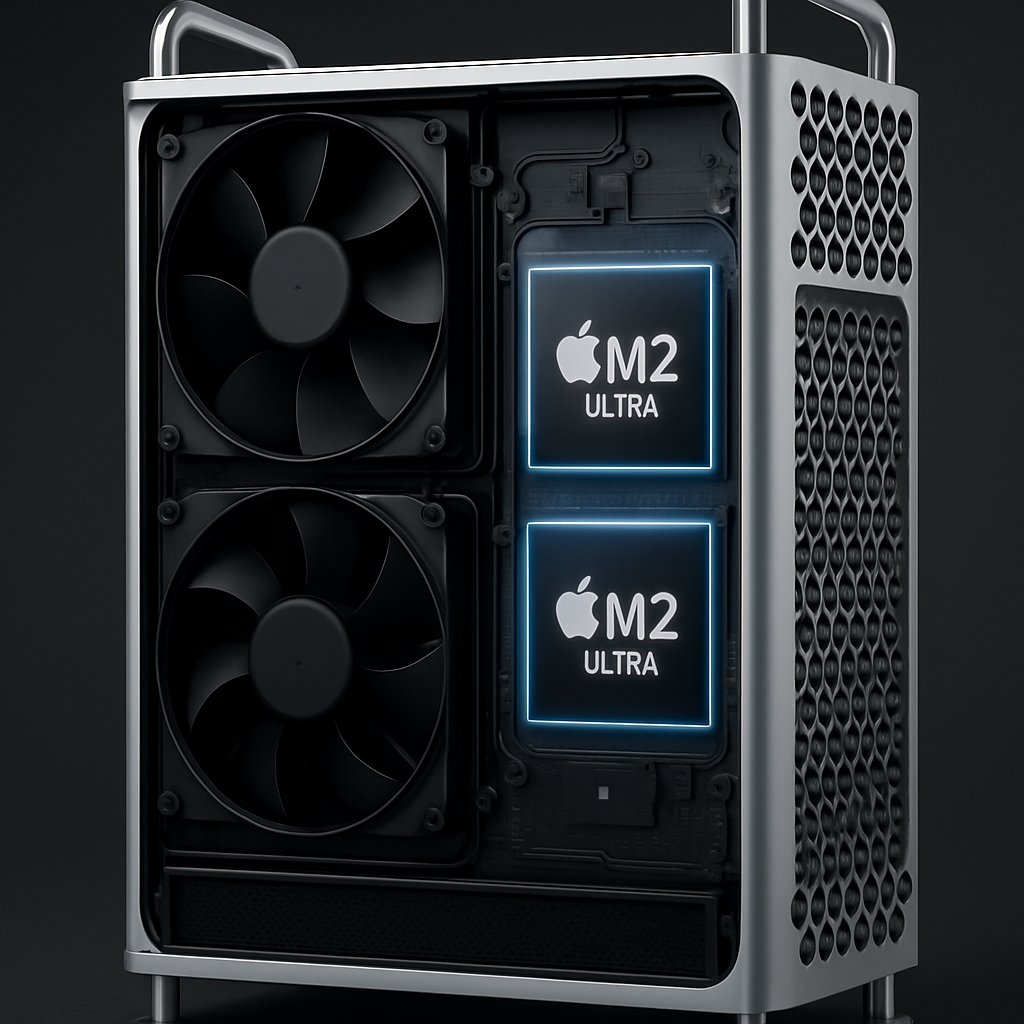
Initially, Apple intended to develop a Mac Pro model featuring a dual M2 Ultra chip configuration. This setup would have effectively doubled the processing power compared to the existing Mac Studio, which utilizes a single M2 Ultra chip. The M2 Ultra itself is a formidable processor, combining two M2 Max dies to deliver substantial performance gains. By integrating two M2 Ultra chips, the proposed Mac Pro would have offered unparalleled computational power, catering to the most demanding professional workloads.
In addition to this, there were considerations to release a final Intel-based Mac Pro model. This version would have been equipped with the latest Intel Xeon processors, providing an alternative for users reliant on x86 architecture and specific Intel-optimized applications. Such a move would have offered a transitional solution for professionals not yet ready to migrate to Apple’s ARM-based silicon.
Despite these plans, Apple ultimately decided to discontinue the Mac Pro line. The reasons behind this decision remain speculative, but factors such as development costs, market demand, and the strategic shift towards a unified silicon architecture likely played a role. The Mac Studio, with its compact design and powerful M2 Ultra chip, has effectively filled the gap left by the Mac Pro, offering substantial performance in a smaller form factor.
The cancellation of these advanced Mac Pro models highlights the challenges inherent in balancing innovation with market realities. While the prospect of a dual M2 Ultra Mac Pro was enticing, Apple’s focus on streamlining its product lineup and emphasizing its proprietary silicon may have influenced the decision to consolidate its desktop offerings. This move underscores the company’s commitment to its silicon transition and the evolving needs of its professional user base.