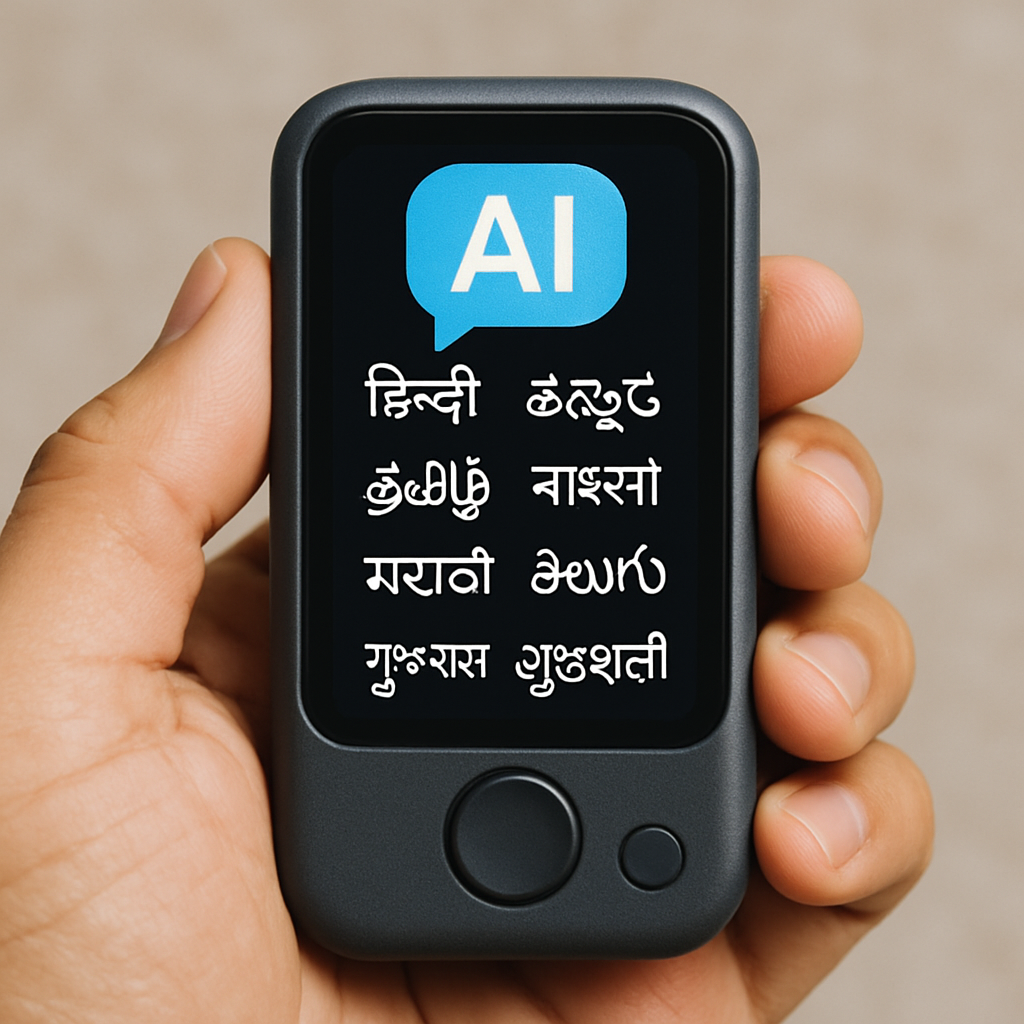
In rural India, a farmer captures an image of a withering plant, seeking information online but hindered by language barriers. Addressing such challenges, the nonprofit organization Current AI is developing open, public AI infrastructure to make technology accessible across diverse linguistic landscapes.
In February, during the India AI Summit, Current AI collaborated with Bhashini, the Indian government’s AI language division, to introduce Suno Sutra, meaning “listening chronicles” in Hindi. This compact, offline device supports AI functionalities in 22 Indian languages without requiring internet connectivity. “In India, there are hundreds of different languages and dialects, and right now AI is not representing them,” stated Current AI CEO Ayah Bdeir. The device is open-sourced, inviting developer communities to enhance and expand its capabilities.
Established in February 2025 by Martin Tisne, Current AI has been rapidly advancing its mission. Last month, it allocated $3.2 million in grants to projects across four organizations. Most recently, it launched an open-source AI chatbot at the AI for Good Summit in Geneva.
Ayah Bdeir, who joined as CEO in January, previously led Mozilla’s AI strategy and founded littleBits, a STEM education company that reached millions of children before its acquisition by Sphero in 2019. Under her leadership, Current AI operates as a public-private partnership, uniting governments, companies, and philanthropies to fund technology serving the public interest. The French government initiated funding with $100 million, joined by the Ford Foundation, MacArthur Foundation, DeepMind, and Salesforce, culminating in a total commitment of $400 million. “They’re not investors; they’re funders,” Bdeir emphasized.
The organization’s objective is clear: to provide a public alternative to major AI systems owned by private companies like OpenAI, Google, and Anthropic. “If AI is truly a transformative technology, if it’s going to change every aspect of everyone’s life, there has to be a public alternative,” Bdeir asserted. “Like the World Wide Web, available to anyone, for free.”
With half of the world’s spoken languages facing extinction, Bdeir highlighted the risk of marginalizing cultures and communities as English dominates large language models and AI systems. She criticized Big Tech’s multilingual initiatives, stating, “Big tech builds multilingual models to expand their market, regardless of consent or context.” This approach can lead to unintended consequences, such as using missionary Bible translations as training data for Indigenous languages without community consent.
Beyond language, Bdeir emphasized that AI’s ability to communicate is intertwined with cultural preservation. “Language is how knowledge, tradition, memory, and identity get carried from one generation to the next. So when a technology can’t speak your language, it can’t hold your culture either,” she explained.
Current AI envisions an open system reminiscent of the early web, where improvements benefit everyone, access is universal, and communities maintain control over their data. This approach aims to democratize AI, ensuring it serves diverse populations without commercial constraints.
As AI continues to permeate various aspects of daily life, initiatives like Current AI’s are crucial in ensuring equitable access and representation. By prioritizing inclusivity and cultural sensitivity, Current AI sets a precedent for future developments in the field, challenging the dominance of private entities and advocating for a more accessible technological future.