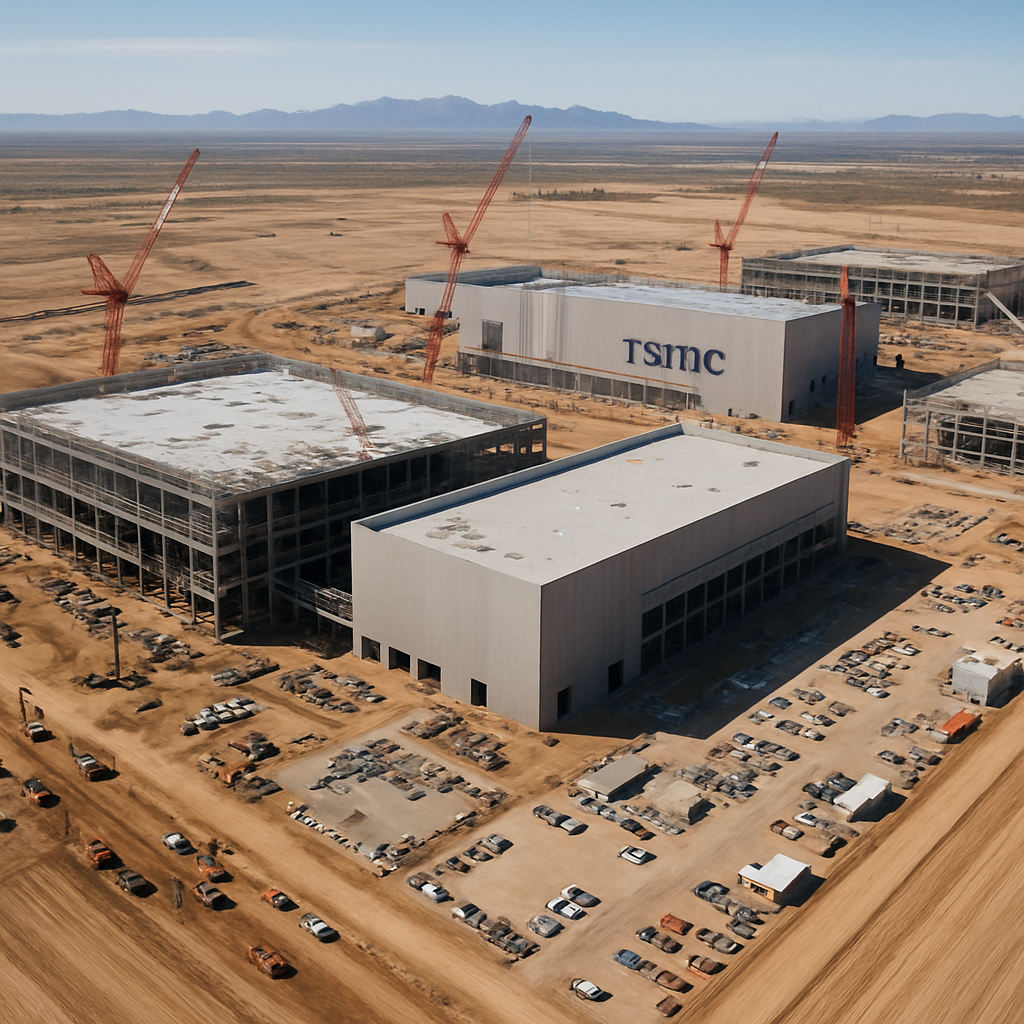
Taiwan Semiconductor Manufacturing Company (TSMC), a key supplier for major tech firms, has announced plans to significantly expand its manufacturing presence in Arizona. The company aims to build a total of 12 facilities, encompassing both chip fabrication and advanced packaging plants. This expansion is part of a broader strategy to bolster semiconductor production within the United States.
TSMC’s initial commitment involved constructing six fabrication plants in Arizona, with an investment of $165 billion. The first of these facilities began production in 2024, focusing on 5-nanometer process technology. Subsequent plans included the development of more advanced 2-nanometer and smaller chips to meet the growing demand driven by artificial intelligence and data center needs.
In a recent announcement, TSMC revealed an additional investment of $100 billion, bringing its total U.S. investment to $265 billion. This funding is intended to support the construction of four more advanced chip fabrication facilities in Arizona, focusing on cutting-edge 2-nanometer and smaller chips. This move aligns with a broader tech agreement between the U.S. and Taiwan, involving $250 billion in Taiwanese investments in the U.S. tech sector. TSMC executives emphasized that these expansions are vital for sustaining long-term growth and strengthening the U.S. semiconductor supply chain and job market.
However, some industry analysts advise caution regarding the full realization of these plans. The construction of such advanced facilities is complex and time-consuming, and TSMC has not provided specific timelines for the completion of the additional plants. The company’s CEO, C.C. Wei, mentioned that the expansion would depend on market conditions, indicating that the plans are not yet set in stone.
Furthermore, while the expansion could enhance the domestic production of semiconductors, there are concerns about the feasibility of manufacturing the most advanced chips in the U.S. Historically, TSMC has reserved its cutting-edge processes for facilities in Taiwan. This strategy raises questions about whether the Arizona plants will produce the latest chip technologies or focus on older generations.
In summary, TSMC’s announcement of expanding to 12 facilities in Arizona marks a significant potential boost to the U.S. semiconductor industry. However, the lack of detailed timelines and the company’s historical practices suggest that stakeholders should approach these developments with cautious optimism. The success of this expansion will depend on various factors, including market demand, technological advancements, and the evolving geopolitical landscape.