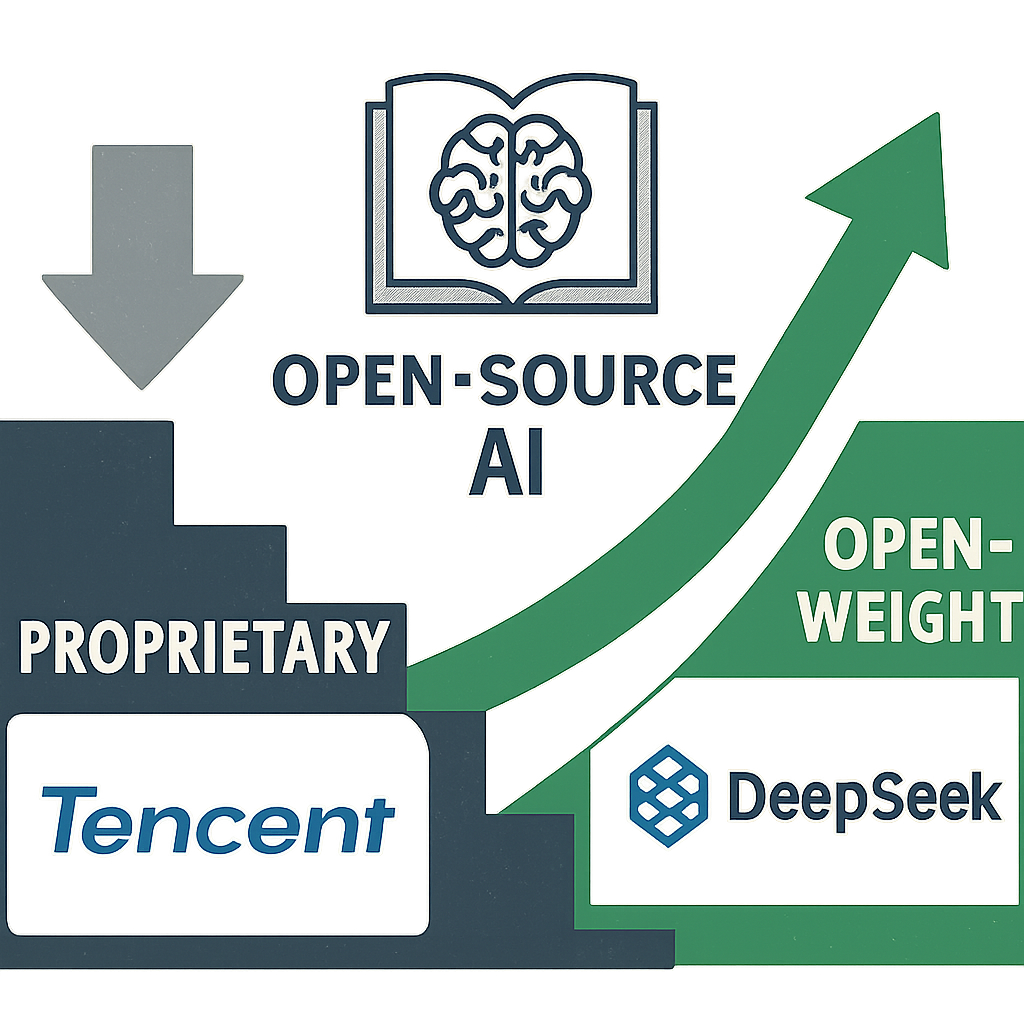
In recent months, the artificial intelligence (AI) landscape has witnessed a significant shift towards open-source models, challenging the dominance of proprietary frontier models. This trend is evident across various platforms and among developers who are increasingly favoring open-weight models for their flexibility and cost-effectiveness.
Data from Hugging Face, a prominent platform for AI model sharing and deployment, reveals that Chinese open-weight models accounted for 41% of downloads this spring, surpassing those from the United States. Similarly, on OpenRouter, a platform facilitating AI model integration, the top six most popular models are open-source offerings from Chinese companies such as Tencent, Xiaomi, DeepSeek, MiniMax, and Z.ai. Notably, Anthropic’s Claude Opus 4.7, a proprietary model, ranks seventh in popularity.
Further supporting this trend, Vercel, a platform for deploying web applications, reports that open-weight models handled nearly a third of AI requests in June. This indicates a growing preference for open-source models in production environments, where they serve as cost-effective and customizable alternatives to closed models.
Hugging Face CEO Clem Delangue suggests that frontier models may become reserved for specialized use cases, while open-source models power the majority of production workloads. He notes that many companies prefer to own their AI models rather than rely on external, opaque APIs. This preference is reflected in the activity on Hugging Face, where a new repository is created every seven seconds, hosting nearly three million public models and one million public datasets.
This shift towards open-source AI models signifies a democratization of AI technology, enabling a broader range of organizations to develop and deploy AI solutions tailored to their specific needs. As this trend continues, it may lead to increased innovation and competition in the AI sector, challenging the traditional dominance of proprietary models.