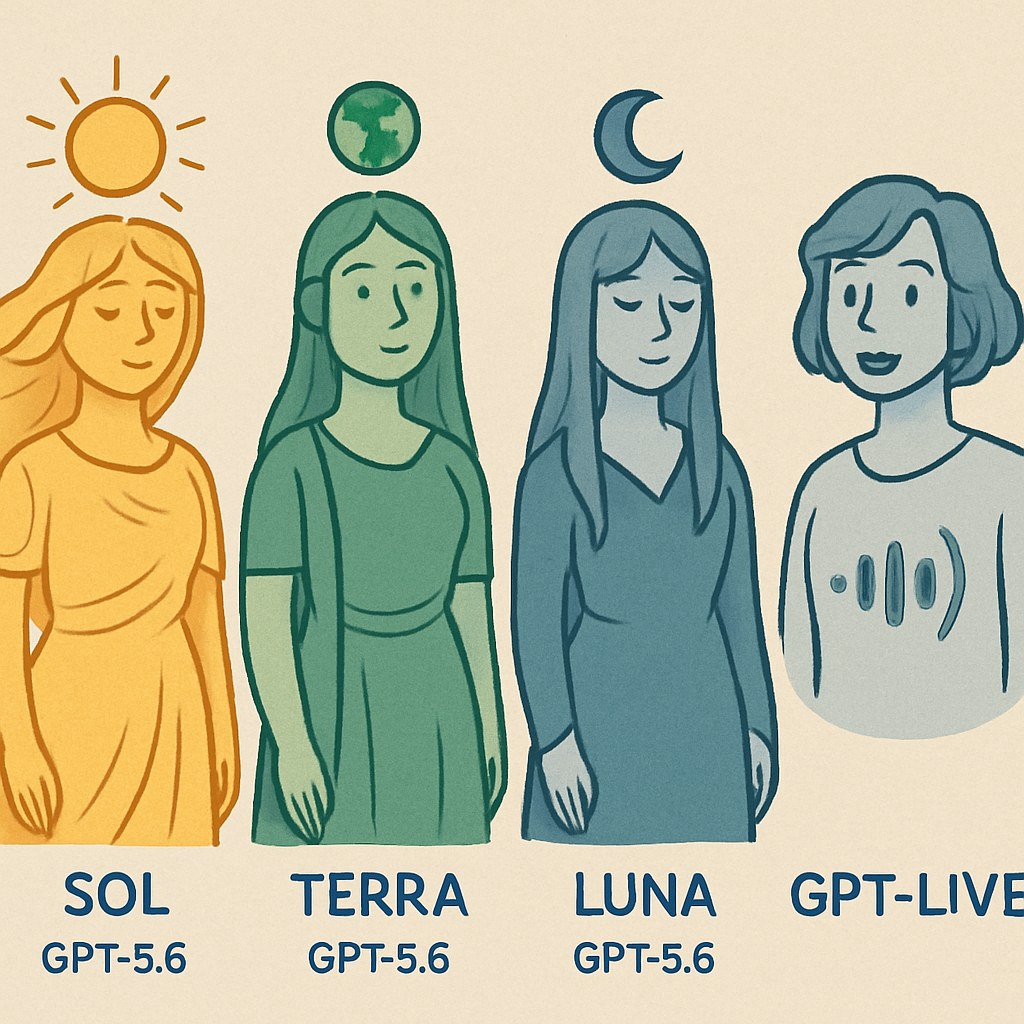
OpenAI has announced the release of GPT-5.6, the latest iteration of its AI language model, alongside significant enhancements to the ChatGPT voice experience. The GPT-5.6 series introduces three distinct models: Sol, Terra, and Luna, each tailored to different user needs.
Sol stands as OpenAI’s flagship model, designed for complex tasks such as advanced coding and cybersecurity. It features new “max” and “ultra” modes equipped with subagents for deep reasoning tasks. Terra offers a balanced approach, suitable for everyday work at a reduced cost compared to its predecessor, GPT-5.5. Luna is optimized for speed and affordability, making it ideal for lightweight and high-volume tasks. Users can expect improvements in multi-step reasoning and instruction-following capabilities across all models. Initially, access will be limited to API and Codex integrations, with broader availability to follow. ([techradar.com](https://www.techradar.com/tech/openais-next-chatgpt-5-6-upgrade-may-be-too-powerful-to-launch-like-a-normal-app-update?utm_source=openai))
In addition to the new models, OpenAI has introduced GPT-Live, a next-generation voice model that enhances the naturalness of conversations with ChatGPT. GPT-Live operates on a full-duplex architecture, allowing it to listen and speak simultaneously. This enables more fluid interactions, where users can interrupt or pause without disrupting the conversation flow. The model can also access web search and memory, display visual results through supported widgets, and handle both text and images within the same conversation. ([openai.com](https://openai.com/index/introducing-gpt-live/?utm_source=openai))
GPT-Live is rolling out to ChatGPT users worldwide, with GPT-Live-1 available for paid users and GPT-Live-1 mini for free users. The new voice experience is accessible on chatgpt.com and the ChatGPT iOS and Android apps in supported regions. ([help.openai.com](https://help.openai.com/en/articles/6825453-chatgpt-release-notes%25252525252525252525252525252525252525252525257C.pict?utm_source=openai))
These developments mark a significant advancement in AI language models and voice interaction technologies. The introduction of specialized models like Sol, Terra, and Luna allows users to select AI solutions that best fit their specific requirements, balancing power, speed, and cost. Meanwhile, the enhanced voice capabilities of GPT-Live bring AI interactions closer to natural human conversations, potentially transforming how users engage with AI in various applications, from customer service to personal assistants.