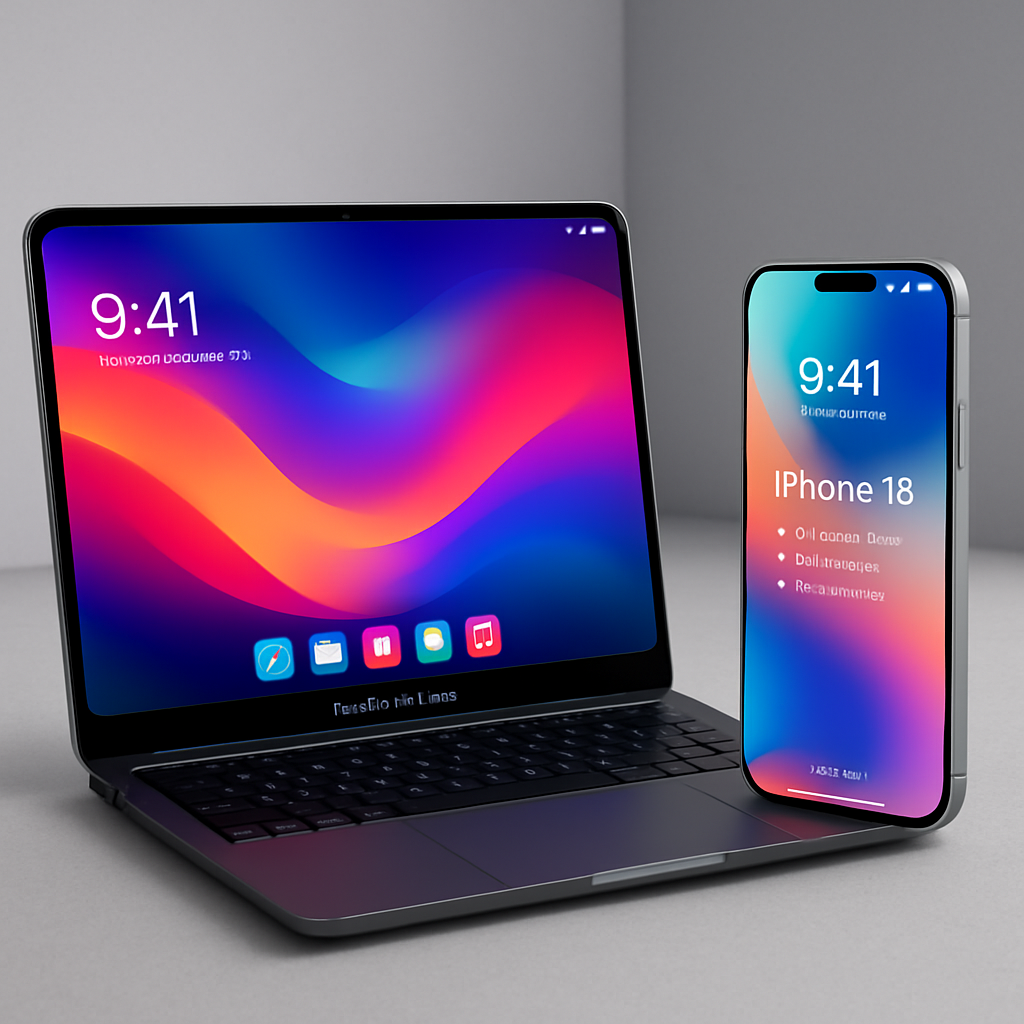
Apple is gearing up to introduce significant updates to its product lineup, with the anticipated launch of the MacBook Ultra and the iPhone 18 series. These developments signal the company’s commitment to innovation and adaptation to evolving consumer demands.
MacBook Ultra: A New Era for MacBooks
The MacBook Ultra is poised to be a groundbreaking addition to Apple’s laptop offerings. Reports suggest that this model will feature an OLED display and touchscreen capabilities, marking a departure from the traditional MacBook design. The inclusion of a Dynamic Island, similar to that found on recent iPhone models, is also expected, potentially replacing the current notch design. This integration could unify user experiences across Apple’s device ecosystem.
Under the hood, the MacBook Ultra is rumored to be powered by the M5 Pro and M5 Max chips. While these chips have been utilized in existing MacBook Pro models since March, their inclusion in the MacBook Ultra indicates a focus on delivering robust performance. The decision to forgo the M6 Pro and M6 Max chips aligns with Apple’s strategy to accelerate the development of the M7 family, which is anticipated to offer enhanced AI capabilities.
Design-wise, the MacBook Ultra may feature a thinner chassis, aligning with modern aesthetics and portability preferences. Additionally, the potential for built-in cellular connectivity could provide users with greater flexibility and mobility.
iPhone 18 Series: Incremental Enhancements
Turning to the iPhone 18 series, Apple appears to be focusing on incremental improvements. The standard iPhone 18 and the new iPhone 18e models are expected to launch in early 2027, featuring 9GB of RAM, an increase from the previous 8GB. This enhancement aims to support more demanding applications and multitasking capabilities.
These models are also anticipated to be equipped with the A20 chip, promising improved performance and energy efficiency. However, significant design overhauls, such as under-screen Face ID, are not expected in this iteration. Instead, Apple seems to be refining existing features to enhance user experience.
It’s worth noting that the release schedule for the iPhone 18 series deviates from Apple’s traditional autumn launch cycle. The staggered release, with Pro models potentially arriving earlier, may lead to consumer confusion and impact purchasing decisions.
In summary, Apple’s forthcoming MacBook Ultra and iPhone 18 series reflect a blend of innovation and refinement. The MacBook Ultra’s introduction of OLED and touchscreen features signifies a bold step forward, while the iPhone 18’s incremental upgrades suggest a focus on stability and performance. As these products approach their respective launch dates, consumers and industry observers alike will be keen to see how these developments influence the broader tech landscape.