Elon Musk’s ambitious plan to deploy orbital data centers has recently come under scrutiny from industry leaders, notably SoftBank’s CEO, Masayoshi Son. At a recent shareholder meeting, Son expressed doubts about the cost-effectiveness and timeliness of constructing data centers in space, emphasizing that the critical period for AI development is in the immediate future, not a decade away.
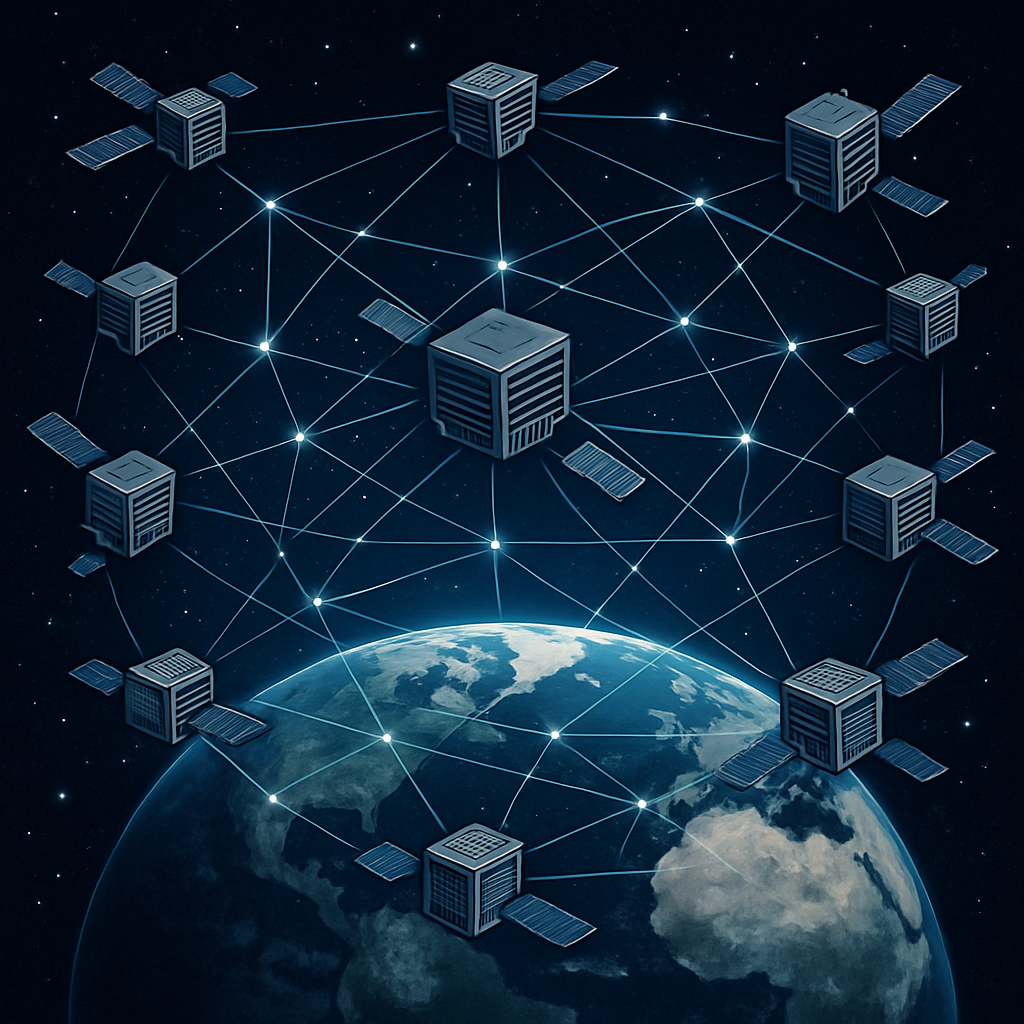
SpaceX’s proposal involves launching a constellation of satellites designed to function as orbital data centers, aiming to alleviate terrestrial constraints such as land availability, cooling requirements, and power consumption. These space-based centers would harness continuous solar energy and operate in cooler environments, potentially offering scalable solutions for the growing demands of AI workloads.
However, significant technical challenges accompany this vision. One primary concern is network latency and connectivity. While terrestrial data centers have largely overcome these issues through fiber-optic networks, orbital centers would rely on wireless transmissions over vast distances, introducing potential delays and reliability concerns. Optical and laser communications present possible solutions but are susceptible to atmospheric interference and require seamless satellite handovers.
Additionally, the economic viability of such a massive undertaking is questionable. The costs associated with launching and maintaining a million-satellite constellation are substantial. A study titled “Orbital Data Centers: Spacecraft Constraints and Economic Viability” highlights that, for a representative 1 MW high-sunlight anchor, the combined launch and spacecraft-build cost allowance is significantly below current benchmarks, raising concerns about the project’s financial feasibility.
Despite these challenges, Musk remains optimistic. He envisions that by 2028, operating AI in space will be more economically compelling than on Earth. He predicts that within five years, more AI operations will occur in space annually than the cumulative total on Earth, citing the advantages of abundant solar power and reduced operational costs in orbit.
In contrast, industry experts like DE-CIX CEO Ivo Ivanov suggest that orbital compute should complement, not replace, terrestrial systems. The goal should be a seamless infrastructure where terrestrial, edge, cloud, and orbital layers operate cohesively, rather than an outright shift to space-based data centers.
As the debate continues, it remains to be seen whether the benefits of orbital data centers will outweigh the technical and economic hurdles. The coming years will be crucial in determining the feasibility and practicality of Musk’s vision.
While the concept of orbital data centers is intriguing and offers potential solutions to current terrestrial limitations, the significant technical and economic challenges cannot be overlooked. The skepticism from industry leaders underscores the need for a balanced approach, considering both the innovative possibilities and the practical constraints of such an ambitious endeavor.