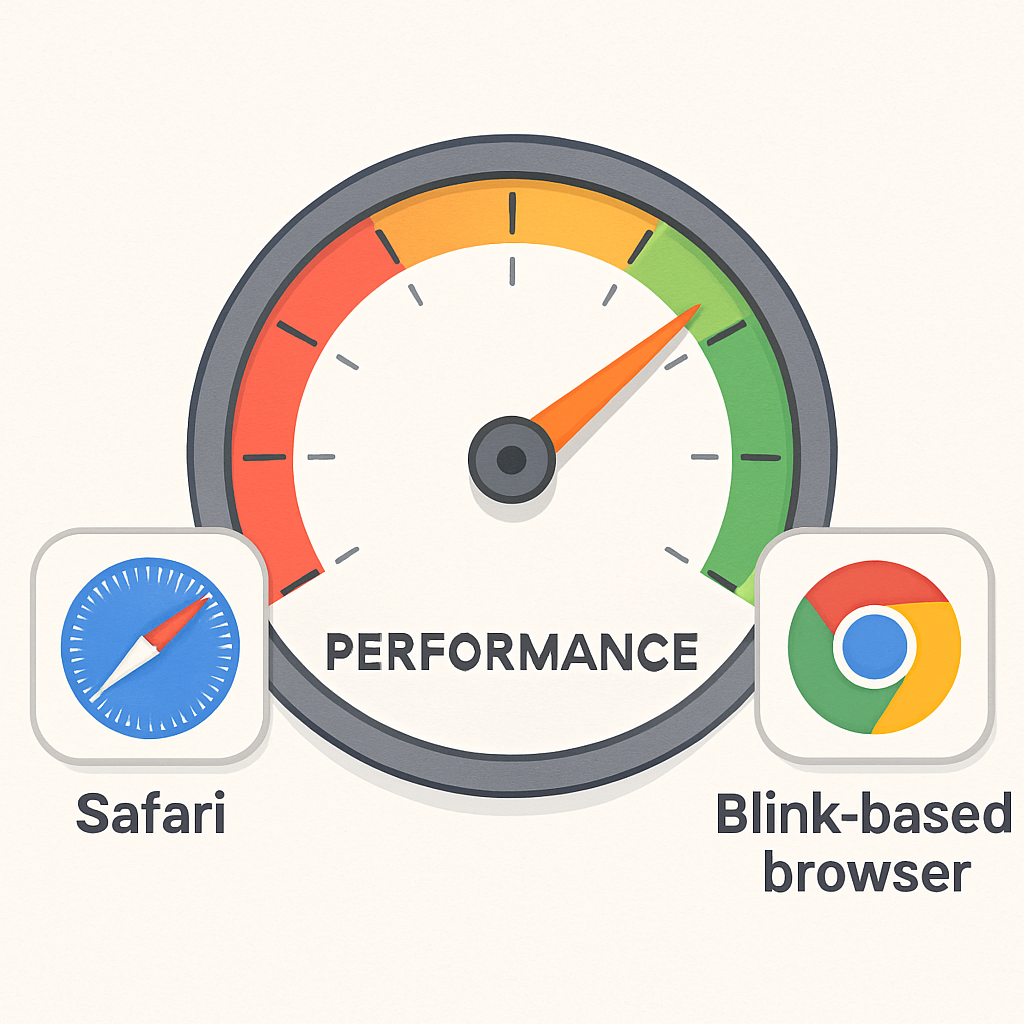
Recent benchmark tests suggest that Apple’s requirement for all iOS browsers to use its WebKit engine may be hindering browser performance on iPhones and iPads. Microsoft engineers developed a prototype of their Edge browser utilizing the Blink engine, which outperformed Safari by 28.6% on Apple’s own Speedometer 3.1 test.
In these tests, the Blink-based Edge prototype achieved a score of 49.27, compared to Safari’s 38.3. Additionally, it surpassed Safari by 13.1% on the JetStream 3 JavaScript benchmark and by 2.1% on the MotionMark 1.3.1 graphics rendering benchmark. These results were shared by Kyle Pflug, a group product manager for the Microsoft Edge Web Platform, who emphasized that the prototype is still in the research phase and the findings are preliminary.
Apple’s longstanding policy mandates that all browsers on iOS utilize the WebKit engine, effectively making browsers like Chrome and Firefox rebranded versions of Safari. This policy has been criticized for limiting competition and innovation in browser development on iOS devices.
The European Union’s Digital Markets Act, enacted in March 2024, aimed to address such restrictions by requiring Apple to permit alternative browser engines through its BrowserEngineKit framework. However, over two years later, no major browser developers have released versions using alternative engines on iOS. Developers cite technical challenges and the necessity to release entirely new applications separate from their existing WebKit-based versions as significant barriers.
Advocacy groups argue that this restriction has cost consumers nearly two decades of potential browser innovation and performance improvements. They urge regulatory bodies to compel Apple to remove obstacles preventing the adoption of alternative browser engines, contending that the current policy stifles the capabilities of the mobile web and maintains Apple’s control over app distribution through the App Store.
These findings highlight the potential benefits of allowing diverse browser engines on iOS, suggesting that users could experience significant performance enhancements if Apple were to relax its WebKit-only policy. As regulatory scrutiny intensifies, it remains to be seen whether Apple will adapt its policies to foster greater competition and innovation in the mobile browser market.