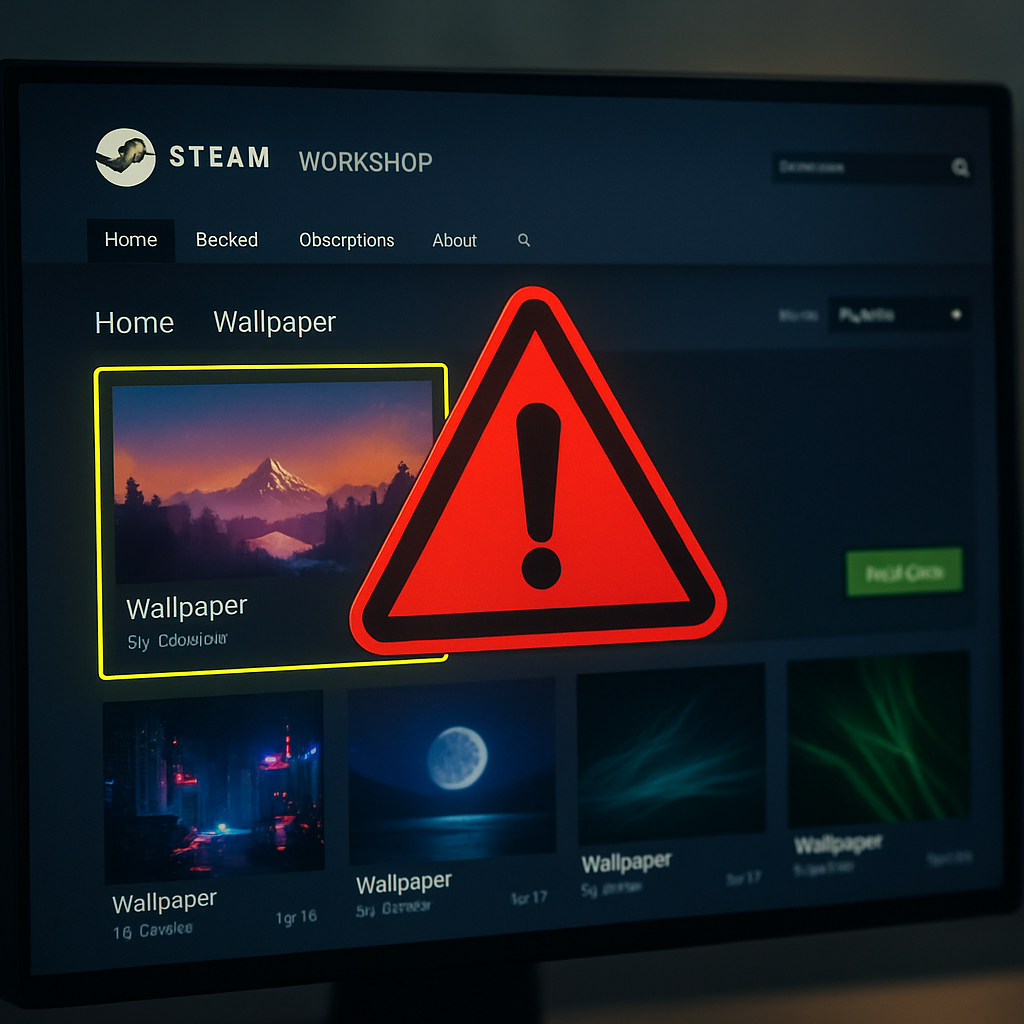
A recent cybersecurity investigation has uncovered a sophisticated malware campaign exploiting Steam’s Workshop platform to distribute malicious software through infected desktop wallpapers. This campaign primarily targets users of Wallpaper Engine, a popular Steam application that enables animated and interactive wallpapers on Windows desktops. With nearly one million reviews and approximately 100,000 daily active users, Wallpaper Engine presents a significant attack surface for cybercriminals.
The attackers have been embedding malware within application-type wallpapers, which are essentially standalone executables running as desktop backgrounds. By disguising these malicious programs as legitimate games, widgets, or desktop tools, they have managed to deceive users into downloading and executing them. Researchers identified dozens of such infected wallpapers, each accumulating thousands to tens of thousands of downloads before detection.
The distribution methods employed by the attackers are notably deceptive. In some instances, the malware is bundled directly with the wallpaper package, including malicious executables, DLLs, or scripts. In other cases, the malware is concealed within password-protected archives, with passwords embedded in archive names or configuration files. Once the wallpaper is installed, these malicious payloads execute automatically, compromising the user’s system.
One particularly insidious example involved a wallpaper that appeared to function legitimately by launching an embedded desktop game. However, in the background, it deployed the DarkKomet backdoor and installed a modified library designed to target Steam users. This library harvested account information and hijacked active Steam sessions, granting attackers full access to the victim’s account.
The campaign is not limited to a single malware family. Investigations revealed the distribution of various malicious tools, including Lumma and Vidar infostealers, the RenEngine loader, ransomware droppers, and botnet loaders. The diversity of these tools suggests that multiple independent threat actors are leveraging this technique rather than a single coordinated group.
Geographically, the majority of the malicious download attempts have been concentrated in China, accounting for 89% of cases, with Russia following at 5.5%. The attackers have tailored the wallpaper art styles and titles to appeal specifically to Chinese-speaking users, indicating a targeted approach.
This campaign underscores the risks associated with user-generated content platforms, even those hosted on reputable services like Steam. Users are advised to exercise caution when downloading and installing content from the Steam Workshop. Verifying the reputation and legitimacy of content creators, being wary of unexpected password-protected archives, and maintaining up-to-date security software are essential steps in mitigating such threats.
The exploitation of trusted platforms like Steam Workshop highlights the evolving tactics of cybercriminals. As attackers continue to find innovative ways to distribute malware, it is imperative for both platform providers and users to remain vigilant. Implementing robust security measures and fostering a culture of caution can help protect against these sophisticated threats.