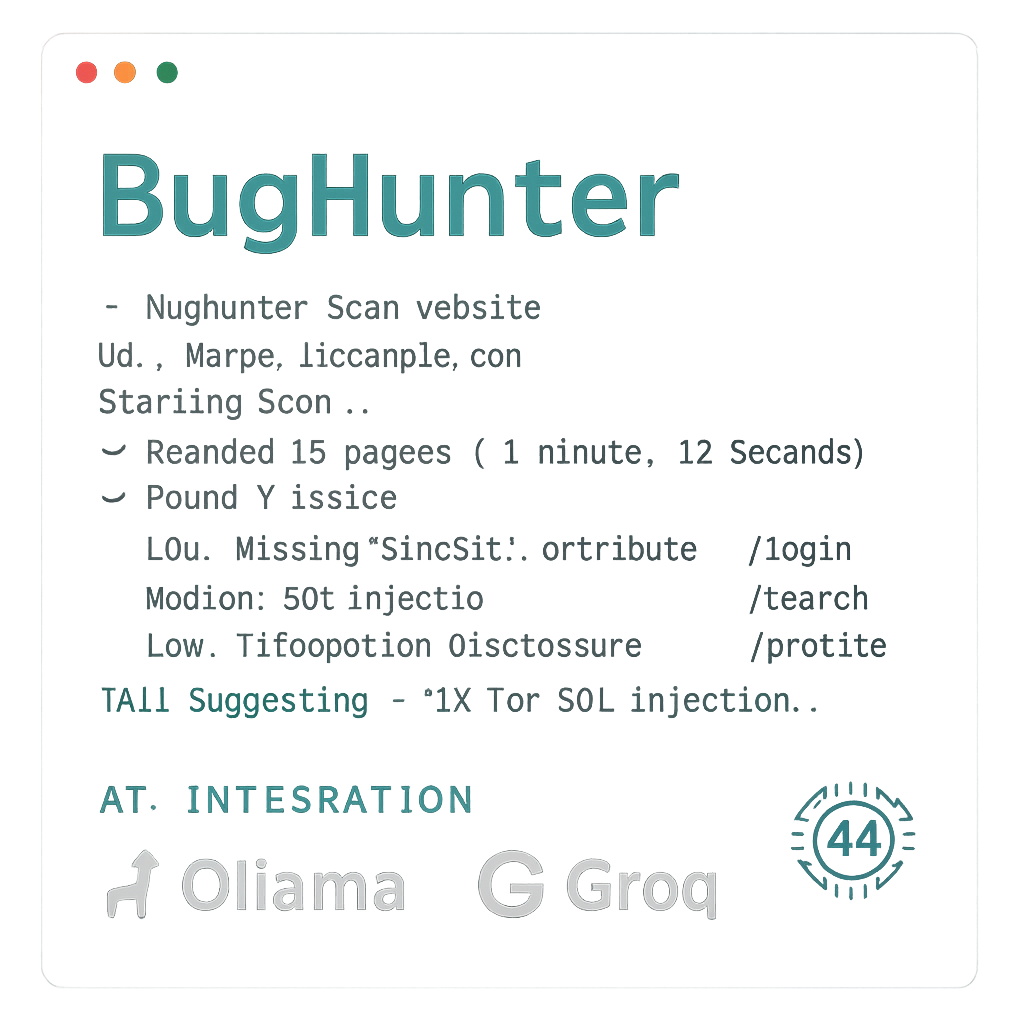
BugHunter, an innovative open-source toolkit, is transforming the bug bounty landscape by automating the entire vulnerability discovery and reporting process. Developed by security researcher Shuvon Md Shariar Shanaz, BugHunter is hosted on GitHub and offers a comprehensive suite of features designed to streamline security research.
Comprehensive Bug Bounty Workflow
BugHunter encompasses every phase of a bug bounty engagement, including subdomain enumeration, live host discovery, and vulnerability testing across more than 20 Web2 and 10 Web3 bug classes. It also features a 7-Question Gate for validating findings and generates submission-ready reports compatible with platforms like HackerOne, Bugcrowd, Intigriti, and Immunefi. All these functionalities are accessible through a single terminal command, enhancing efficiency for security researchers.
Standalone Toolkit with AI Integration
Initially requiring a Claude Code or Claude Pro subscription, BugHunter has evolved into a fully standalone command-line interface (CLI) tool. It now supports free and low-cost AI providers, making it more accessible to independent researchers. The supported providers include:
- Ollama: Operates entirely offline on the user’s machine at no cost.
- Groq: Offers a free cloud tier with rapid inference speeds.
- DeepSeek: Cloud-based service priced at approximately $0.001 per 1,000 tokens.
- Claude API / OpenAI: Paid options for users preferring Anthropic or OpenAI models.
BugHunter automatically detects and prioritizes these providers, defaulting to the most cost-effective available option. Users can switch providers at any time using the `bughunter setup` command.
Structured Command-Line Interface
The toolkit offers a structured CLI that mirrors a professional bug bounty workflow, including commands for reconnaissance, vulnerability testing, validation, report generation, and an interactive AI hunting shell. The 7-Question Gate validation process helps eliminate weak or duplicate findings before submission, saving researchers valuable time.
Advanced Features and Memory Persistence
BugHunter orchestrates approximately 35 scanning tools, such as `subfinder`, `httpx`, `nuclei`, `katana`, `ffuf`, and `dalfox`. Missing tools are skipped gracefully to prevent errors. A notable feature is cross-session memory persistence, which logs findings and discovered patterns to a JSONL-based memory store. This allows vulnerability patterns identified on one target to inform testing on new ones, with session states preserved across restarts.
Web3 Security Capabilities
Beyond traditional web application testing, BugHunter includes a dedicated smart contract audit mode covering 10 vulnerability classes, including reentrancy, flash loan attacks, oracle manipulation, and proxy/upgrade flaws. A token auditor module scans for indicators such as rug pulls, mint authority issues, LP lock status, honeypot detection, and bonding curve anomalies, making it relevant for Immunefi-style Web3 programs.
BugHunter’s integration of AI and support for free providers significantly lowers the barrier to entry for independent security researchers. By automating and streamlining the bug bounty process, it enables more efficient and effective vulnerability discovery and reporting. As the cybersecurity landscape continues to evolve, tools like BugHunter will be instrumental in maintaining robust security postures across various platforms.