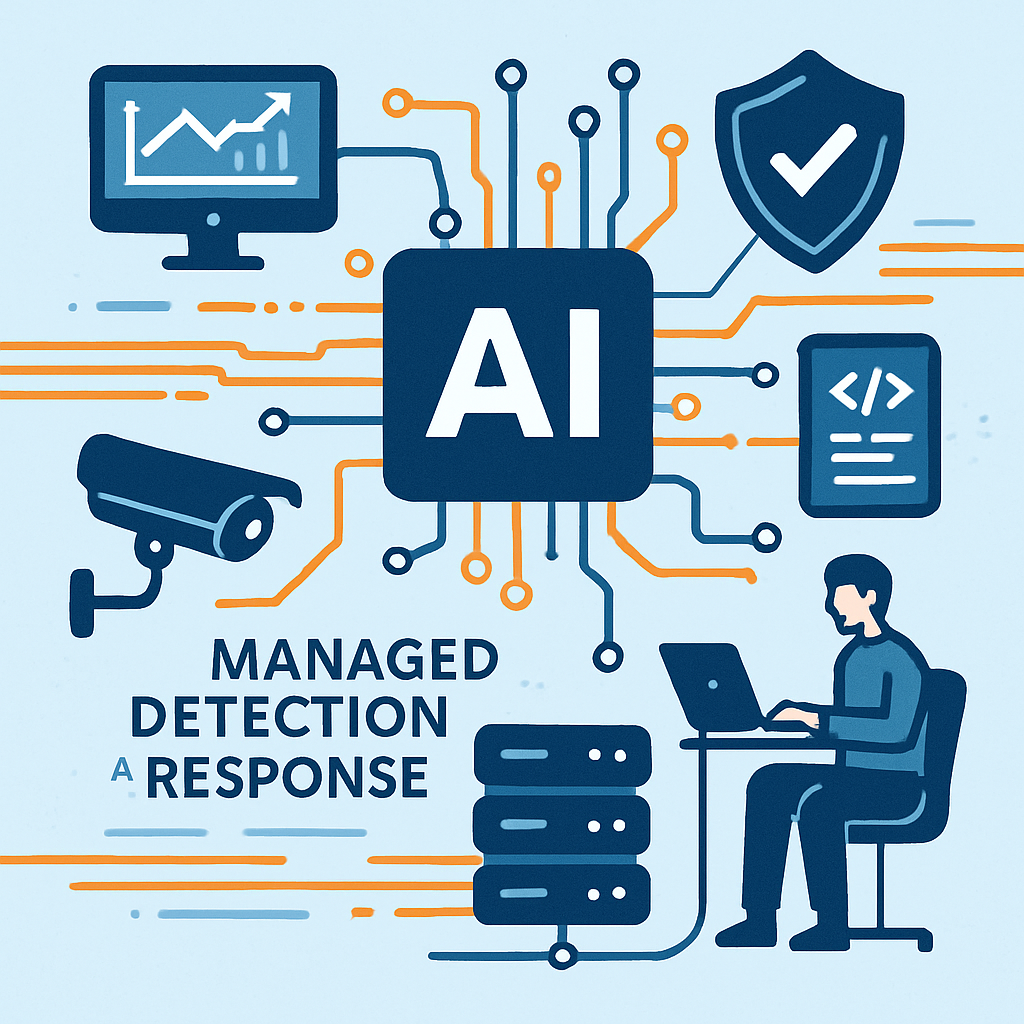
Managed Detection and Response (MDR) services have long been a cornerstone for organizations seeking to bolster their cybersecurity defenses. Traditionally, MDR provided 24/7 monitoring, leveraging human analysts to triage and respond to security alerts. This model addressed the challenges many organizations faced, such as staffing limitations and the inability to maintain round-the-clock vigilance.
However, the cybersecurity landscape has undergone significant transformations. Adversaries are now harnessing artificial intelligence (AI) to expedite their operations, craft more convincing phishing schemes, automate reconnaissance, and develop malware variants that can bypass signature-based detection systems. Concurrently, the attack surface has expanded beyond endpoints to encompass cloud infrastructures, identity systems, and networks. Despite these shifts, many MDR services continue to operate under their original frameworks, relying heavily on human analysts to process alerts sequentially.
Limitations of Traditional MDR Models
One of the critical shortcomings of the conventional MDR approach is its inability to manage the sheer volume of alerts generated in modern IT environments. Studies indicate that approximately 60% of security alerts remain unreviewed. This isn’t necessarily a failure of performance but rather a reflection of the limitations inherent in human capacity. Analysts, whether in-house or part of an MDR service, often prioritize high-severity alerts (P1s and P2s), leaving lower-severity alerts (P3s and P4s) unaddressed. Alarmingly, analysis of 25 million alerts across global enterprises in 2025 revealed that nearly 1% of genuine threats originated from these lower-severity alerts. For an organization generating 450,000 alerts annually, this translates to about 54 real incidents per year—approximately one per week—lurking unnoticed in the backlog.
Moreover, the quality of investigations can vary based on factors such as the experience level of the analyst on duty, the time of day, and the current workload. A high-priority alert at 3 a.m. might receive a different level of scrutiny compared to the same alert during regular business hours. This variability can lead to shallow investigations, where genuine threats are misclassified as false positives, allowing attackers to progress undetected.
Integrating AI into MDR Services
To address these challenges, MDR services must evolve by integrating AI and automation into their operations. AI can process vast amounts of data at speeds unattainable by human analysts, enabling the identification of subtle patterns and anomalies indicative of malicious activity. By automating routine tasks, AI allows human analysts to focus on more complex investigations, enhancing the overall efficiency and effectiveness of the security operations center (SOC).
Furthermore, AI-driven MDR can facilitate continuous improvement in detection capabilities. By analyzing outcomes from previous incidents, AI systems can refine detection rules and adapt to emerging threats, ensuring that the detection posture remains robust and responsive to the evolving threat landscape.
In conclusion, as cyber threats become more sophisticated and pervasive, MDR services must transition from traditional, human-centric models to AI-augmented frameworks. This shift will enable organizations to manage the increasing volume and complexity of security alerts more effectively, ensuring that genuine threats are identified and mitigated promptly. Embracing AI in MDR is not merely an enhancement—it’s a necessity for maintaining robust cybersecurity defenses in the face of evolving adversarial tactics.