Apple’s Towson Store Closure Sparks Allegations of Anti-Union Bias
In a significant development, employees of Apple’s Towson Town Center store in Maryland have publicly protested the company’s decision to close their location, alleging discriminatory treatment due to their unionized status. This store, notable for being the first Apple retail location in the United States to unionize, is among three stores slated for closure by Apple, citing declining retail conditions in the respective malls.
Background on Store Closures
Apple announced the impending closure of three retail stores: Apple Towson Town Center in Maryland, Apple North County in Escondido, California, and Apple Trumbull in Trumbull, Connecticut. The company attributed these closures to deteriorating conditions in the malls where these stores are located. While employees at the non-unionized stores in California and Connecticut were offered automatic transfers to other Apple locations, the unionized staff at the Towson store were required to reapply for positions, a process that has raised concerns among the employees and union representatives.
Employee and Union Response
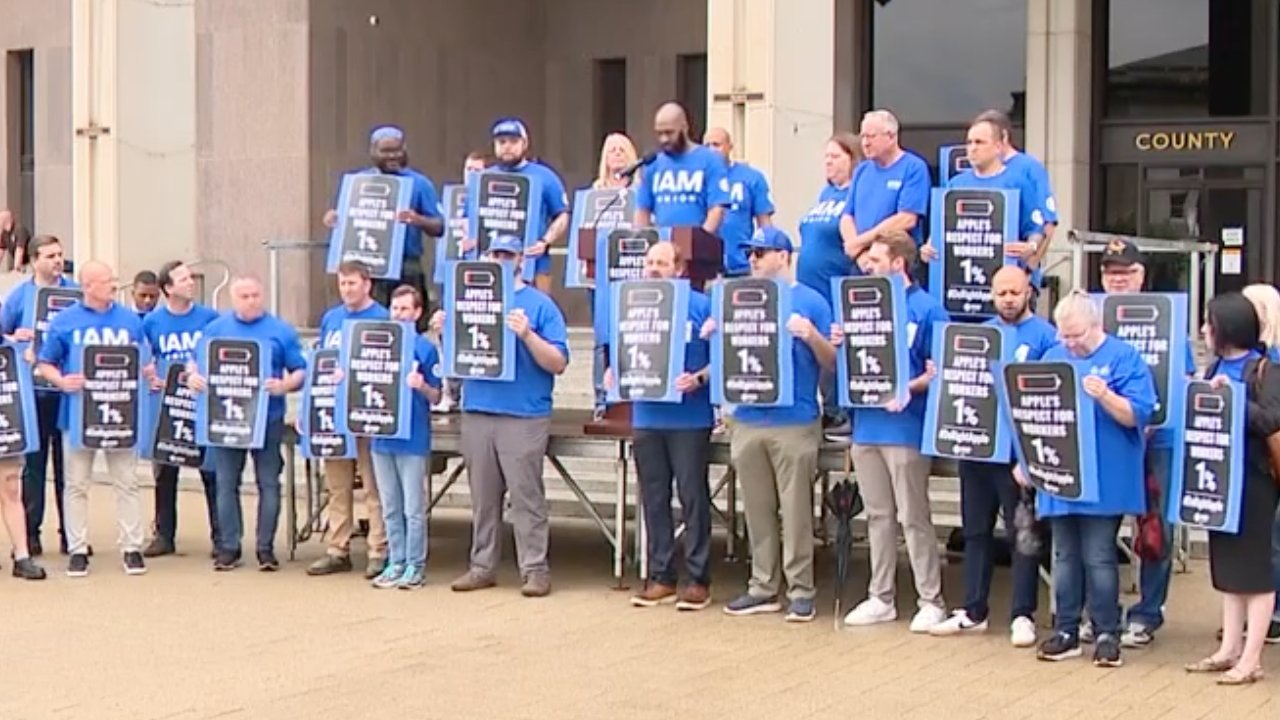
On May 27, 2026, a public rally was held outside the Baltimore County Courthouse, organized by the International Association of Machinists and Aerospace Workers (IAM) Union. The protest saw participation from employees, local elected officials, and union leaders, all voicing their discontent with Apple’s handling of the Towson store closure. The primary grievance centers on the perceived disparity in treatment between unionized and non-unionized employees during the store closure process.
Eric Brown, a worker at the Towson store, addressed the crowd, stating, Apple offers severance to all of their employees, not just what we negotiate. So to say that it’s based on the severance is just false. This sentiment reflects the broader concern that the unionized employees are being unfairly targeted due to their collective bargaining status.
IAM International President Brian Bryant also spoke at the rally, condemning Apple’s actions as retaliatory. This is retaliation plain and simple, Bryant declared. Shame on you, Apple.
Apple’s Position
Apple has maintained that its actions are in line with the terms negotiated in the collective bargaining agreement with the union. According to the company, the agreement stipulates that in the event of a store closure, employees are guaranteed a transfer or rehire only if a new location opens within a 50-mile radius of the closed store. In the absence of such a new location, the agreement provides for severance packages rather than automatic transfers to existing stores.
An Apple spokesperson stated, We strongly disagree with the claims made, and we will continue to abide by the agreement that was negotiated and agreed with the union. We look forward to presenting all of the facts to the NLRB.
Legal Actions and Political Support
In response to the perceived discriminatory treatment, the IAM Union has filed an Unfair Labor Practice charge with the National Labor Relations Board (NLRB), alleging that Apple violated federal labor laws by treating unionized employees differently from their non-unionized counterparts.
The union’s actions have garnered support from political figures. The Maryland congressional delegation, led by U.S. Representative Johnny Olszewski and joined by U.S. Senators Chris Van Hollen and Angela Alsobrooks, as well as other representatives, penned a letter to Apple demanding accountability for the decision to close the unionized store.
Broader Implications
This situation highlights the ongoing tensions between large corporations and unionized workers, especially in the tech industry, where unionization efforts have been met with resistance. The outcome of this dispute could have significant implications for labor relations within Apple and potentially influence how other tech companies engage with unionized employees.
Conclusion
As the closure date approaches, the Towson store employees and their supporters continue to advocate for fair treatment and transparency from Apple. The unfolding events will be closely watched by labor advocates, corporate entities, and policymakers, as they may set a precedent for how unionized workers are treated during corporate restructuring and store closures.