BTMOB Malware: A New Threat Enabling Remote Control of Android Devices
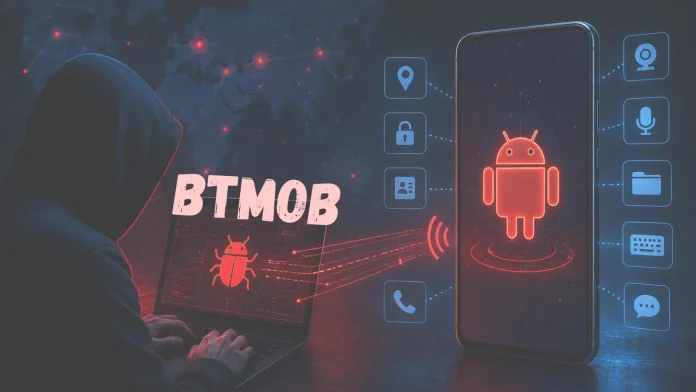
A new Android malware, known as BTMOB, has emerged, providing attackers with the ability to remotely control infected devices. This malware combines a robust Remote Access Trojan (RAT) engine with a user-friendly campaign builder, making it accessible even to individuals with minimal technical expertise. First identified in 2025, BTMOB has rapidly evolved through a malware-as-a-service (MaaS) model, facilitating widespread phishing campaigns across the globe.
Evolution and Capabilities of BTMOB
BTMOB is an Android RAT that has its roots in the SpySolr family, initially documented in early 2025. Unlike traditional banking trojans that primarily target financial data, BTMOB is engineered for comprehensive device surveillance and control. Its capabilities include:
– Data Exfiltration: The malware can extract a wide array of sensitive information from the device, including personal messages, contacts, and browsing history.
– Screen Capture: BTMOB can take screenshots of the device’s display, allowing attackers to monitor user activity in real-time.
– Activity Recording: It records on-device activities, providing attackers with insights into the user’s behavior and interactions.
– Persistent Remote Access: The malware establishes a continuous connection with the attacker’s command-and-control (C2) server, enabling ongoing remote administration of the compromised device.
These functionalities position BTMOB as a significant threat to both individual users and organizations, as it rivals the capabilities of desktop-grade RATs.
Malware-as-a-Service Model
A distinguishing feature of BTMOB is its commercial distribution as a MaaS product, complete with an integrated APK builder. This allows purchasers to:
– Generate Malicious APKs: Users can create new malicious Android Package (APK) files tailored to their specific needs.
– Customize Phishing Lures: The toolkit enables the creation of phishing campaigns targeted at specific countries or demographics without requiring any coding skills.
This approach significantly lowers the barrier to entry for conducting malicious campaigns. The BTMOB toolkit is marketed through promotional pages on the open web, directing potential buyers to Telegram channels, and is also advertised via seller accounts on social media platforms like X (formerly Twitter) and Instagram. Reports suggest that lifetime licenses for BTMOB are priced around $5,000, a relatively low investment considering the potential financial gains from successful attacks.
Delivery Mechanisms and Infection Process
BTMOB relies heavily on social engineering tactics and phishing campaigns to distribute the malware. The typical infection process involves:
1. Phishing Sites: Attackers create fraudulent websites that mimic legitimate services such as streaming platforms, cryptocurrency exchanges, or other well-known brands.
2. Fake App Stores: Victims are redirected to counterfeit app stores that host the malicious APKs.
3. Localized Lures: Attackers tailor their phishing campaigns to specific regions, impersonating local tax authorities or government agencies to increase credibility.
Once a victim downloads and installs the malicious APK, BTMOB requests extensive permissions and exploits Android’s Accessibility Services to grant itself additional privileges without user consent. This abuse of Accessibility Services allows the malware to:
– Manipulate UI Elements: BTMOB can interact with and control user interface components, enabling it to perform actions on behalf of the user.
– Approve Permissions: The malware can silently approve permissions, further entrenching its control over the device.
– Execute Actions: It can perform various actions without user interaction, such as opening applications or navigating through menus.
Additionally, BTMOB conducts overlay attacks against banking and payment applications to steal credentials and one-time passwords (OTPs). Some variants are capable of downloading additional modules, extending their functionalities based on the attacker’s requirements.
Implications and Recommendations
The emergence of BTMOB underscores the evolving landscape of mobile malware, where sophisticated tools are becoming more accessible to a broader range of attackers. The combination of a powerful RAT engine with an easy-to-use campaign builder lowers the technical threshold for conducting malicious activities, potentially leading to an increase in the frequency and scale of attacks.
To mitigate the risks associated with BTMOB and similar threats, users are advised to:
– Exercise Caution with App Downloads: Only download applications from official app stores and verify the authenticity of the app and its developer.
– Be Wary of Phishing Attempts: Avoid clicking on links from unknown sources, especially those received via unsolicited messages or emails.
– Review App Permissions: Regularly check the permissions granted to installed applications and revoke any that seem unnecessary or excessive.
– Keep Devices Updated: Ensure that your device’s operating system and all applications are up to date with the latest security patches.
– Use Security Software: Install reputable mobile security solutions that can detect and prevent malware infections.
By adopting these practices, users can enhance their defenses against BTMOB and other emerging mobile threats.