Surge in DuckDuckGo Installs as Users Seek AI-Free Search Alternatives
In the wake of Google’s recent overhaul of its search engine to incorporate AI-driven features, a significant number of users are turning to DuckDuckGo, a privacy-centric search engine that offers an AI-free experience. This shift underscores a growing demand for search platforms that prioritize user control and privacy.
At Google’s annual developer conference, I/O 2026, the company announced a transformation of its traditional search interface. The familiar list of blue links is being replaced by an AI agent designed to answer queries, execute tasks, and perform background monitoring. While Google positions this as a major advancement, the response from the public has been mixed.
Critics argue that this AI-centric approach could undermine the open web by reducing direct traffic to individual websites. Concerns have also been raised about the accuracy of AI-generated responses and the potential loss of user autonomy for those who prefer traditional search methods. For instance, simple searches like the definition of disregard have become unnecessarily complex due to AI interventions.
In response to these changes, many users are migrating to DuckDuckGo, a search engine known for its commitment to privacy and minimal AI integration. Historically, DuckDuckGo has held a modest share of the U.S. search market, accounting for approximately 2%. However, recent developments suggest a shift in user preferences.
During Google’s 2023 antitrust trial, DuckDuckGo’s CEO, Gabriel Weinberg, testified that Google’s exclusive default search contracts hindered DuckDuckGo’s ability to become the default search engine on various browsers. Weinberg has been vocal about his concerns regarding Google’s AI integration, stating, Google is force-feeding AI with no way to opt out. As a result, their results are getting worse, not better. We want to be the place that puts users in charge and allows them to decide how much or how little AI they want.
Recent data indicates that DuckDuckGo is benefiting from this user migration. Between May 20 and May 25, U.S. app installations increased by an average of 18.1% week-over-week, compared to the period from May 13 to May 18. This growth was sustained over six consecutive days, peaking at a 30.5% increase on May 25. On iOS devices, the growth rate was even more pronounced, with a 33% average increase, reaching a peak of 69.9%.
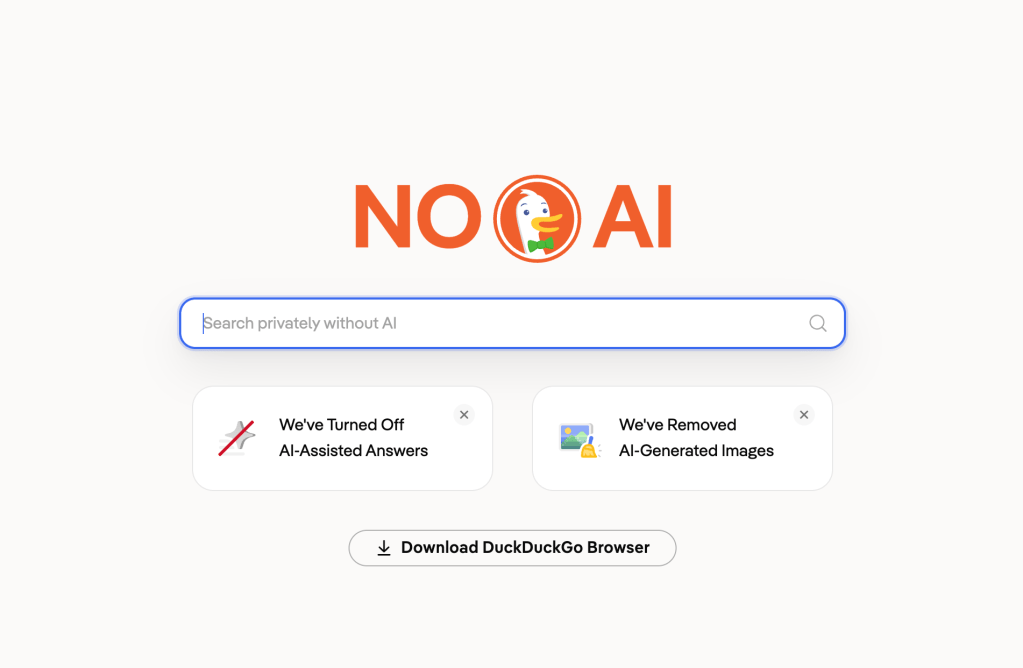
Additionally, visits to DuckDuckGo’s AI-free search page, noai.duckduckgo.com, saw an average week-over-week growth of 22.7%, peaking at 27.7% on May 24. This page disables all AI features, including AI-assisted answers and AI-generated images, by default. The trend is particularly strong in the U.S., with DuckDuckGo experiencing user growth even during the Memorial Day weekend, a period that typically sees a dip in traffic.
While DuckDuckGo offers its own AI product, Duck.ai, it emphasizes user choice and privacy. Duck.ai provides free access to models such as Anthropic’s Claude 4.5 Haiku, Meta’s Llama 4 Scout, Mistral’s Small 3 24B, and OpenAI’s GPT-5 mini. Importantly, all chats are private; DuckDuckGo strips users’ IP addresses before requests reach model providers, deletes conversations within 30 days, and prevents chats from being used for training purposes.
Weinberg underscores this commitment, stating, Not only do we respect user choice, but also user privacy. Everything you do in DuckDuckGo is private; we don’t collect search histories or chats, and nothing is used for AI training.
In addition to Duck.ai, DuckDuckGo offers features like Search Assist, which is similar to Google’s AI overviews, and an AI Image Filter that allows users to exclude AI-generated images from search results. These features have been well-received, highlighting the company’s dedication to providing users with control over their search experience.
Kamyl Bazbaz, DuckDuckGo’s Chief Communications and Policy Officer, notes, People just want a choice. This sentiment reflects a broader desire among users for search platforms that respect their preferences and privacy.
As the digital landscape continues to evolve, the growing adoption of DuckDuckGo suggests a significant segment of users is seeking alternatives to AI-dominated search experiences. This trend underscores the importance of offering diverse options that cater to varying user needs and preferences.