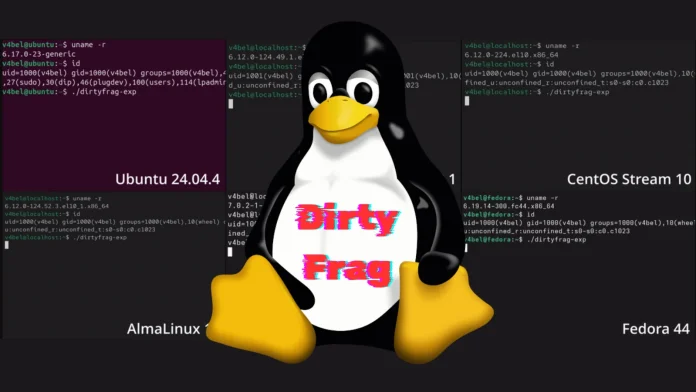
A newly disclosed Linux kernel vulnerability, dubbed Dirty Frag, has emerged as a significant security threat, enabling attackers to escalate privileges to root on most major Linux distributions. This vulnerability combines two distinct page-cache write flaws—xfrm-ESP Page-Cache Write and RxRPC Page-Cache Write—to achieve unauthorized access. A proof-of-concept (PoC) exploit has been publicly released following an embargo break on May 7, 2026, raising concerns about widespread exploitation.
Understanding Dirty Frag
Dirty Frag is part of the same vulnerability class as previous exploits like Dirty Pipe and Copy Fail (CVE-2026-31431). However, it specifically targets the `frag` member of the kernel’s `struct sk_buff` rather than `struct pipe_buffer`. Discovered by security researcher Hyunwoo Kim (@v4bel), the vulnerability exploits the zero-copy send path where the `splice()` system call inserts a reference to a read-only page cache page—such as `/etc/passwd` or `/usr/bin/su`—into the `frag` slot of a sender-side `skb`.
Mechanism of Exploitation
The exploitation process involves the receiver-side kernel code performing in-place cryptographic operations directly on the `frag`, thereby modifying the page cache in RAM. Subsequent reads to the affected file will retrieve the corrupted version, even though the attacker only had read access. Unlike race-condition exploits, Dirty Frag is a deterministic logic bug that does not require precise timing, does not cause kernel panics upon failure, and has a high success rate.
Components of Dirty Frag
1. xfrm-ESP Page-Cache Write: This flaw resides in the `esp_input()` function within the IPsec ESP receive path. When an `skb` is non-linear but lacks a frag list, the code skips the mandatory `skb_cow_data()` buffer allocation step and proceeds directly to in-place AEAD decryption on the attacker-planted frag. By manipulating the `XFRMA_REPLAY_ESN_VAL` netlink attribute, an attacker can control both the location (file offset) and the value (4 bytes) of each write operation, enabling the overwriting of arbitrary bytes in `/usr/bin/su`’s page cache. This variant requires the ability to create a user namespace (`unshare(CLONE_NEWUSER)`), which may be restricted on some systems.
2. RxRPC Page-Cache Write: This flaw is found in the `rxkad_verify_packet_1()` function, which performs an in-place single-block `pcbc(fcrypt)` decryption on the first 8 bytes of the RxRPC payload. Since `skb_to_sgvec()` converts the splice-pinned page cache page directly into the scatter-gather list (SGL), the attacker-controlled page becomes both the source and destination. The 8-byte write value is `fcrypt_decrypt(C, K)`, where `K` is a session key that the attacker can specify via `add_key(rxrpc, …)` without requiring any privileges. The attacker can brute-force `K` in user space until the desired plaintext is produced, such as modifying the first line of `/etc/passwd` to bypass authentication mechanisms.
Implications and Affected Systems
Neither vulnerability alone covers all Linux environments:
– ESP Variant: Available on most distributions but requires user namespace creation, which is blocked on some configurations (e.g., certain Ubuntu setups with AppArmor policies).
– RxRPC Variant: Does not require namespace privileges but depends on the presence of the `rxrpc.ko` module, which is absent by default on many distributions like RHEL 10.1 but is present and auto-loads on others like Ubuntu.
By chaining these two exploits, attackers can achieve root access on virtually every major Linux distribution.
Mitigation and Recommendations
Given the severity of Dirty Frag, it is imperative for system administrators and users to take immediate action:
1. Apply Patches: Monitor official channels from your Linux distribution for security patches addressing Dirty Frag and apply them promptly.
2. Restrict User Namespace Creation: If not required, disable user namespace creation to mitigate the ESP variant of the exploit.
3. Audit Kernel Modules: Review and manage the loading of kernel modules like `rxrpc.ko` to reduce the attack surface.
4. Monitor System Logs: Implement monitoring to detect unusual activities that may indicate exploitation attempts.
Conclusion
The emergence of Dirty Frag underscores the critical need for vigilance in maintaining system security. By understanding the mechanics of this vulnerability and implementing the recommended mitigations, organizations can protect their systems from potential exploitation.
Twitter Post:
Alert: ‘Dirty Frag’ vulnerability allows attackers to gain root access on major Linux distributions. Immediate patching recommended. #Linux #CyberSecurity #DirtyFrag
Focus Key Phrase:
Dirty Frag Linux vulnerability
Article X Post:
Hashtags:
Article Key Phrase:
Category: Security News