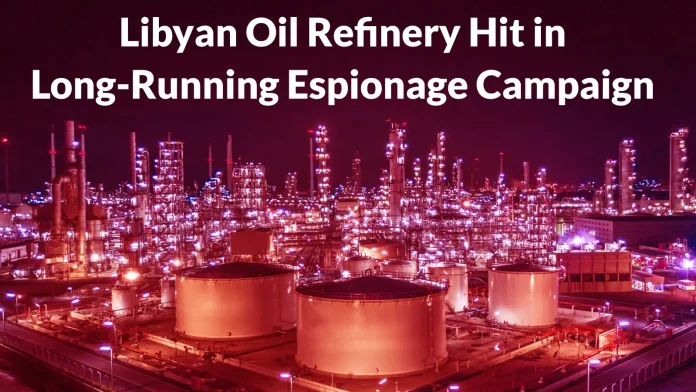
Libyan Oil Refinery Targeted in Prolonged Espionage Campaign Utilizing AsyncRAT
Between November 2025 and February 2026, a coordinated cyber-espionage campaign targeted a Libyan oil refinery, a telecommunications organization, and a state institution. The attackers deployed AsyncRAT, a publicly available remote access Trojan (RAT) known for its extensive surveillance capabilities, raising significant concerns about the security of Libya’s critical infrastructure.
AsyncRAT: A Versatile Espionage Tool
AsyncRAT is an open-source remote access tool that has gained popularity among both cybercriminal groups and nation-state actors due to its modular architecture and comprehensive surveillance features. It enables attackers to log keystrokes, capture screenshots, and execute commands remotely, making it highly effective for prolonged intelligence gathering. Its open-source nature complicates attribution, as it is accessible to a wide range of threat actors.
Targeted Lure Documents Exploit Political Events
Symantec researchers identified the campaign through forensic analysis of compromised networks, uncovering lure documents tied to Libyan political events. One such document was titled Leaked CCTV footage – Saif al-Gaddafi’s assassination.gz, referencing the February 3, 2026, killing of Saif al-Gaddafi, the second son of former leader Muammar Gaddafi. The use of such targeted lures indicates a deliberate focus on Libyan organizations.
Strategic Significance of Libya’s Energy Sector
Libya’s energy sector has become increasingly significant, with the country recording oil production of 1.37 million barrels per day last year—the highest in approximately 12 years. Amidst regional conflicts and concerns over rising oil prices, targeting a Libyan refinery carries clear geopolitical implications. Clashes in the Strait of Hormuz, through which about 20% of global oil supply flows, have unsettled world energy markets, drawing attention to oil producers beyond Iran.
Evidence of a Prolonged Campaign
Files on VirusTotal suggest that this campaign may have commenced as early as April 2025, with several files bearing Libya-themed names indicating a long-running, focused targeting effort. The threat actor is believed to have maintained persistent access to the oil company’s network from November 2025 through mid-February 2026, with additional activity recorded in December 2025. This persistence underscores the attackers’ intent to establish a quiet foothold for intelligence collection.
Multi-Stage Infection Chain
The infection began with a spear-phishing email containing a locally themed lure document designed to attract the target’s attention. A VBS downloader with a politically relevant filename, such as video_saif_gadafi_2026.vbs, was found on affected machines, downloaded from KrakenFiles, a cloud-based file hosting platform. This marked the start of a carefully staged, multi-step compromise.
Upon execution, the VBS file downloaded a PowerShell dropper disguised as image.png, which created a Windows scheduled task named devil from an XML configuration file stored at C:\Users\Public\Music\Googless.xml. This task ensured the dropper would run at a predetermined time, after which the task was deleted to remove visible traces and evade detection.
AsyncRAT was the final payload delivered, granting the attacker full remote control over the infected system. It could capture keystrokes, take screenshots, and execute commands. Its modular nature allowed the attacker to quietly push capability updates without disrupting the ongoing operation. This combination of flexibility and stealth made AsyncRAT an ideal tool for a campaign driven by long-term intelligence gathering.
Implications for Critical Infrastructure Security
This campaign highlights the vulnerabilities of critical infrastructure sectors, such as energy, telecommunications, and government institutions, to sophisticated cyber-espionage operations. The use of publicly available tools like AsyncRAT, combined with targeted social engineering tactics, underscores the need for robust cybersecurity measures.
Recommendations for Mitigation
Organizations in the energy sector, along with those in government and telecommunications, should consider the following measures to enhance their cybersecurity posture:
1. Employee Training: Conduct regular training sessions to help staff recognize spear-phishing attempts, especially those leveraging politically themed lures.
2. Email Filtering: Implement advanced email filtering solutions to detect and block malicious attachments and links.
3. Endpoint Protection: Deploy endpoint detection and response (EDR) solutions to monitor and respond to suspicious activities on devices.
4. Network Segmentation: Segment networks to limit the spread of malware and restrict access to sensitive systems.
5. Regular Updates: Ensure all systems and software are regularly updated to patch known vulnerabilities.
6. Incident Response Plan: Develop and regularly test an incident response plan to quickly address potential breaches.
Conclusion
The prolonged espionage campaign targeting Libyan critical infrastructure using AsyncRAT serves as a stark reminder of the evolving cyber threats facing nations. By understanding the tactics employed and implementing comprehensive cybersecurity strategies, organizations can better defend against such sophisticated attacks.