Inside Amazon’s Trainium Lab: The AI Chip Powering Industry Giants
In the rapidly evolving landscape of artificial intelligence (AI), the demand for efficient and powerful hardware has never been greater. Amazon Web Services (AWS) has emerged as a formidable player in this arena with its custom-designed Trainium chips, which are now integral to the operations of leading AI organizations such as Anthropic, OpenAI, and even tech giant Apple.
A Glimpse into the Trainium Lab
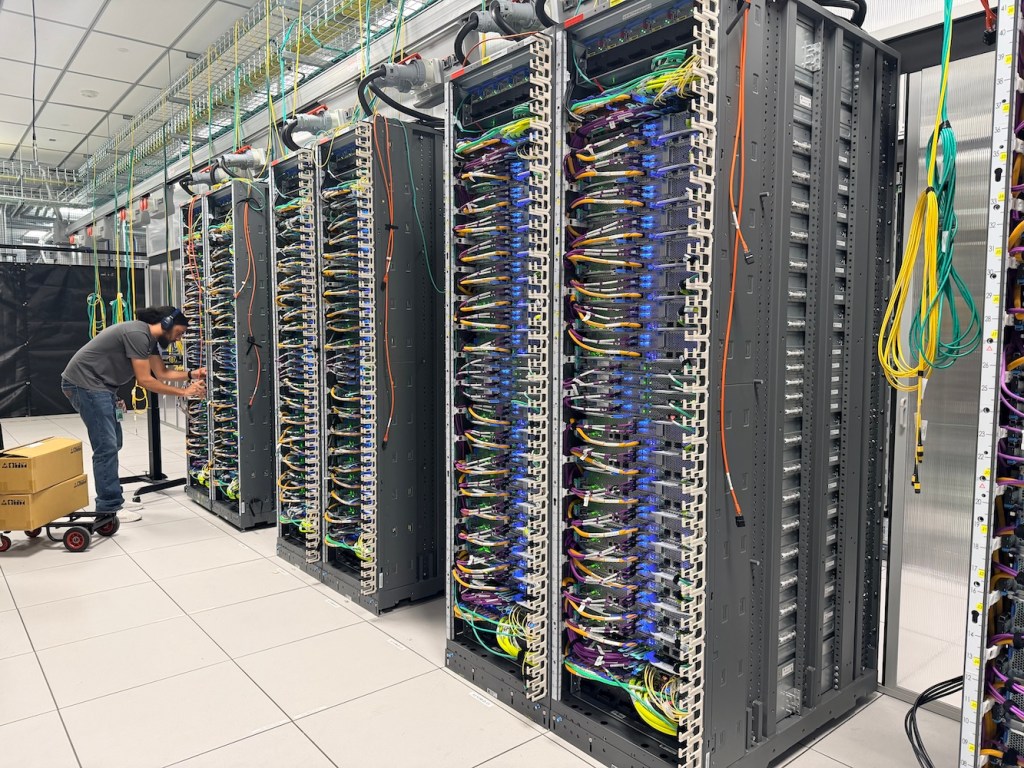
Recently, Amazon provided an exclusive tour of its state-of-the-art Trainium development lab, offering insights into the innovation driving its AI hardware advancements. The facility is led by Kristopher King, the lab’s director, and Mark Carroll, director of engineering. Their team is dedicated to pushing the boundaries of AI processing capabilities.
The Evolution of Trainium
AWS introduced its first-generation Trainium chip in December 2020, aiming to provide higher performance and cost efficiency for machine learning model training. The initial Trainium chip was designed to support popular machine learning frameworks like TensorFlow, PyTorch, and MXNet, offering 30% higher throughput and 45% lower cost-per-inference compared to standard AWS GPU instances.
Building on this foundation, AWS unveiled Trainium2 in November 2023. This second-generation chip delivered up to four times better performance and twice the energy efficiency of its predecessor. Trainium2 was made available in EC2 Trn2 instances, capable of scaling up to 100,000 chips in AWS’ EC2 UltraCluster product, providing 65 exaflops of compute power. This advancement enabled the training of large language models (LLMs) with hundreds of billions of parameters in a matter of weeks, significantly reducing development timelines.
Strategic Partnerships and Industry Adoption
The superior performance and scalability of Trainium chips have attracted major AI organizations. Anthropic, an AI research company, has been a significant partner, utilizing Trainium2 chips to train its advanced models. In November 2024, Anthropic raised an additional $4 billion from Amazon and designated AWS as its primary training partner. This collaboration includes working with AWS’ Annapurna Labs to develop future generations of Trainium accelerators.
OpenAI, another leading AI research organization, has also embraced AWS’ Trainium chips. In December 2025, reports emerged that Amazon was in discussions to invest up to $10 billion in OpenAI. This potential partnership would involve OpenAI utilizing AWS’ AI chips, including Trainium, to power its AI models, further solidifying AWS’ position in the AI hardware market.
Even Apple, known for its proprietary hardware and software ecosystems, has shown interest in AWS’ Trainium chips. While specific details of the collaboration remain undisclosed, industry insiders suggest that Apple’s AI initiatives could benefit from the performance and scalability offered by Trainium.
The Road Ahead: Trainium3 and Beyond
AWS continues to innovate, with the announcement of Trainium3 in December 2025. This third-generation chip promises to be four times faster and more energy-efficient than Trainium2. Trainium3 is expected to be built on a 3-nanometer process and is slated for release in late 2025. AWS CEO Andy Jassy highlighted the rapid adoption and success of Trainium2, noting that it has become a multi-billion-dollar revenue business with over one million chips in production and more than 100,000 companies utilizing it.
Conclusion
Amazon’s strategic investments in AI hardware, exemplified by the Trainium series, have positioned AWS as a key player in the AI infrastructure market. By providing powerful, scalable, and cost-effective solutions, AWS has attracted partnerships with leading AI organizations, including Anthropic, OpenAI, and Apple. As the demand for AI continues to grow, AWS’ commitment to innovation in AI hardware is set to play a pivotal role in shaping the future of artificial intelligence.