Introducing Ada: Read AI’s Revolutionary Email-Based Digital Twin Enhancing Productivity
In an era where efficiency and seamless communication are paramount, Read AI has unveiled its latest innovation: Ada, an AI-powered email-based assistant designed to revolutionize how professionals manage their schedules and information flow. Dubbed a digital twin, Ada operates tirelessly to handle tasks, ensuring users stay organized and informed without the usual manual effort.
Getting Started with Ada
Integrating Ada into your daily routine is straightforward. Users can initiate the setup by sending an email to [email protected] with the subject line Get me started. This simple step activates Ada, setting the stage for enhanced productivity and streamlined communication.
Efficient Scheduling Made Simple
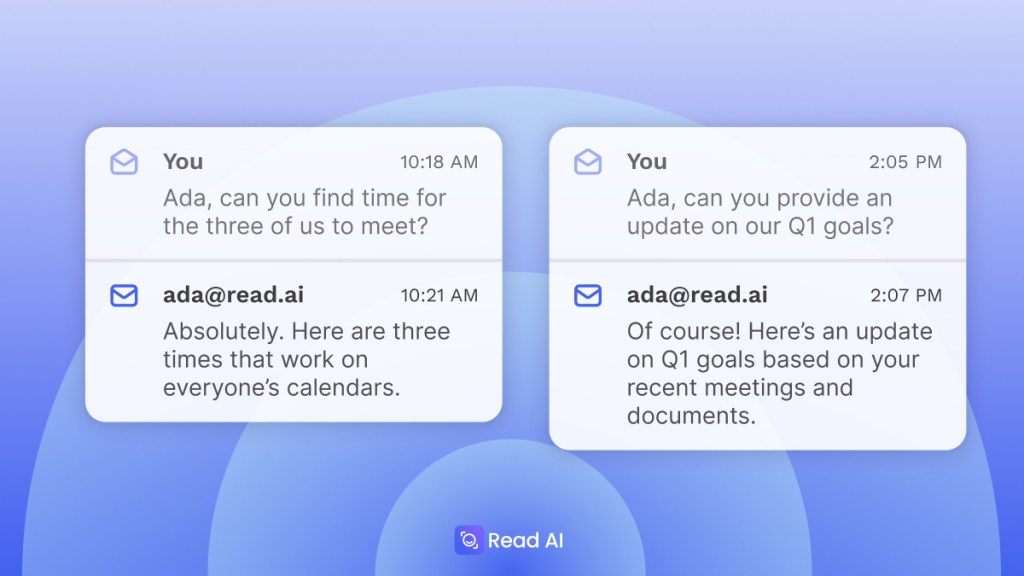
One of Ada’s standout features is its ability to manage meeting schedules with remarkable efficiency. When a user requests to arrange a meeting, Ada analyzes the user’s calendar and proposes available time slots to the other party. If the suggested times are inconvenient, Ada promptly offers alternative options, ensuring a mutually agreeable meeting time is established. Importantly, while Ada accesses your calendar to facilitate scheduling, it maintains strict confidentiality, never disclosing the specifics of your appointments to others.
Intelligent Information Retrieval
Beyond scheduling, Ada serves as a powerful tool for information retrieval. By tapping into your company’s knowledge base, previous meeting discussions, and conducting public internet searches, Ada can provide comprehensive answers to a wide array of questions. For instance, if you inquire, Ada, can you provide an update on how we are tracking for Q1 goals? Ada will compile relevant data and deliver a concise, informative response, keeping you abreast of critical developments.
Proactive Communication Assistance
Ada’s capabilities extend to assisting with email communications. When a question arises in an email thread, Ada drafts a response on your behalf, allowing you to review and refine it before sending. This feature not only saves time but also ensures that your communications are accurate and consistent. Crucially, Ada is programmed to protect your privacy, never sharing sensitive information without your explicit consent.
Advanced Contextual Understanding
Justin Farris, Read AI’s Vice President of Product, highlights that Ada’s functionality surpasses traditional AI assistants. Unlike systems that rely on Model Context Protocols (MCPs) to connect with external services, Ada constructs a dynamic knowledge graph based on your meeting data and integrated services. This approach enables Ada to deliver contextually rich and relevant answers, enhancing its utility over time. As Ada becomes more attuned to your workflow, it anticipates needs and suggests proactive actions. For example, if a follow-up task is mentioned during a meeting, Ada will prompt you to schedule it afterward, complete with pertinent details.
A Learning Companion
David Shim, CEO of Read AI, likens Ada’s integration into your workflow to onboarding a new team member. When you bring on a new employee, you train them. Similarly, as you incorporate Ada and connect more services to provide context, it progressively takes on more tasks for you, Shim explains. This learning process ensures that Ada becomes an increasingly valuable asset, adept at handling a growing array of responsibilities.
Expanding Accessibility
Currently, Ada operates through email, but Read AI has ambitious plans to broaden its accessibility. In the near future, Ada will be available on popular communication platforms such as Slack and Microsoft Teams, allowing users to leverage its capabilities across various channels and further integrating into diverse work environments.
Impressive Growth and Adoption
Read AI’s innovative solutions have resonated with a vast audience. As of early February 2026, the company boasts over 5 million monthly active users, with aspirations to double this figure to 10 million. The platform experiences approximately 50,000 new sign-ups daily, and a broader base of 100,000 users engages with Read AI’s content, including meeting summaries, without the necessity of account creation. While the United States remains the largest market, international growth is robust, with 60% of users located outside the U.S. Notably, revenue distribution is balanced, reflecting the global appeal of Read AI’s offerings.
Continual Innovation
Read AI is committed to enhancing its suite of AI-powered tools. In the past year, the company introduced Search Copilot, a feature designed to facilitate knowledge discovery for users. More recently, Read AI added functionalities that allow for the updating of customer relationship management (CRM) software, the sending of customized emails directly from meeting reports, and the ability to stay informed on topics based on both internal and web-based knowledge. These continuous advancements underscore Read AI’s dedication to providing comprehensive solutions that address the evolving needs of modern professionals.
Industry Trends and Competitors
The landscape of AI-driven meeting assistants is rapidly evolving, with several players introducing tools aimed at extracting actionable insights from meeting data. For instance, in September 2025, Granola introduced recipes, which are repeatable prompts designed to surface knowledge from meeting content. Similarly, Quill emerged from stealth mode with a $6.5 million funding round, offering integrations with platforms like Linear, Notion, and various CRMs to automate tasks. These developments highlight a growing recognition of the value that AI can bring to managing and optimizing professional communications.
Conclusion
Ada represents a significant leap forward in the realm of AI-powered assistants. By seamlessly integrating into existing workflows, understanding context, and proactively managing tasks, Ada empowers professionals to focus on strategic initiatives while it handles the intricacies of scheduling and information management. As Read AI continues to innovate and expand Ada’s capabilities, users can anticipate even greater enhancements to their productivity and efficiency.