Guardian: Revolutionizing Penetration Testing with AI-Driven Automation and Comprehensive Security Tool Integration
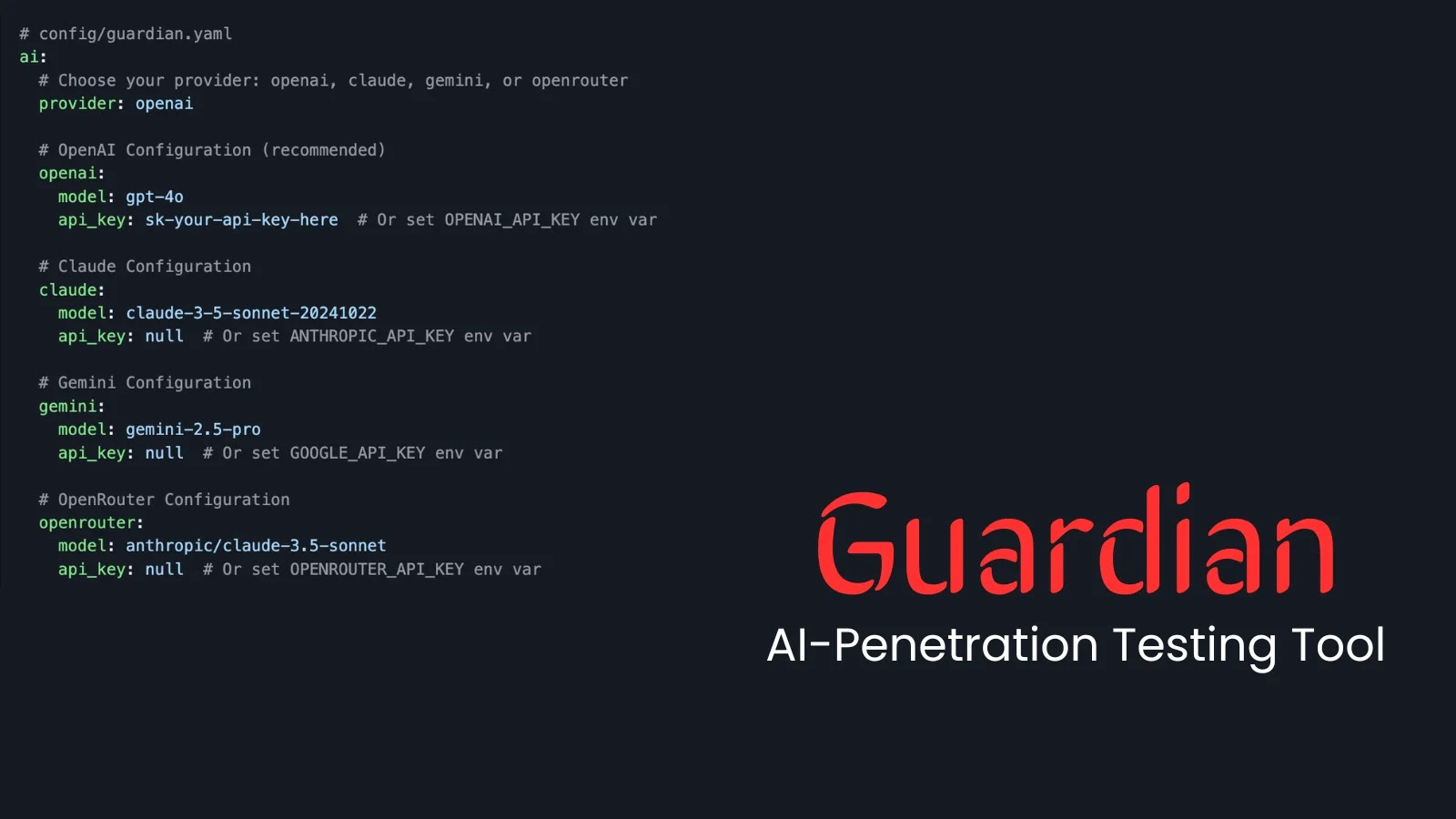
In the rapidly evolving field of cybersecurity, the introduction of Guardian marks a significant advancement in penetration testing methodologies. Developed by Zakir Kun and available as an open-source project on GitHub, Guardian is an enterprise-grade, AI-powered framework designed to automate and enhance security assessments. By integrating multiple large language models (LLMs) such as OpenAI’s GPT-4, Anthropic’s Claude, Google’s Gemini, and OpenRouter, Guardian offers intelligent and adaptive security evaluations with thorough evidence documentation.
Innovative Multi-Agent Architecture
Guardian’s core innovation lies in its multi-agent architecture, which orchestrates the collaboration of four specialized agents:
– Planner Agent: Establishes the overall strategy for the security assessment, ensuring a structured and comprehensive approach.
– Tool Selector Agent: Identifies and deploys the most appropriate tools from a suite of 19 integrated security utilities, tailoring the assessment to the specific environment.
– Analyst Agent: Interprets the data collected, differentiating between genuine vulnerabilities and false positives to provide accurate findings.
– Reporter Agent: Compiles the analysis into professional-grade documentation, facilitating clear communication of results and recommendations.
This collaborative framework enables Guardian to dynamically adjust its tactics based on identified vulnerabilities and system responses, effectively emulating the decision-making processes of experienced human penetration testers.
Comprehensive Security Tool Integration
Guardian integrates 19 well-established security tools across various domains, enhancing its capability to conduct thorough assessments:
– Network Scanning: Utilizes Nmap for detailed port scanning and service detection, and Masscan for rapid large-scale port scanning.
– Web Reconnaissance: Employs httpx for HTTP probing, WhatWeb for technology fingerprinting, and Wafw00f for Web Application Firewall detection.
– Subdomain Discovery: Incorporates Subfinder, Amass, and DNSRecon for comprehensive subdomain enumeration and network mapping.
– Vulnerability Scanning: Leverages Nuclei for template-based scanning, Nikto for web server assessments, SQLMap for SQL injection detection, and WPScan for WordPress-specific vulnerabilities.
– SSL/TLS Analysis: Applies TestSSL and SSLyze for in-depth analysis of SSL/TLS configurations.
– Content Discovery: Uses Gobuster, FFuf, and Arjun for directory and file brute-forcing, as well as HTTP parameter discovery.
– Advanced Security Analysis: Integrates XSStrike for advanced XSS detection, GitLeaks for scanning repositories for secrets, and CMSeeK for CMS detection and enumeration.
Guardian’s flexibility allows it to function effectively even if only a subset of these tools is installed. The AI adapts its testing approach based on available resources and the discovered attack surface. Asynchronous execution enables up to three tools to run concurrently by default, significantly reducing the overall duration of assessments.
Safety Mechanisms and Compliance
Guardian incorporates several safety mechanisms to ensure authorized and ethical use:
– Scope Validation: Automatically blacklists private RFC-1918 address ranges to prevent unauthorized testing of internal networks.
– Safe Mode: Prevents destructive operations by default, safeguarding against unintended system alterations.
– Confirmation Prompts: Implements configurable prompts before executing sensitive operations, ensuring human oversight and consent.
– Audit Logging: Maintains comprehensive logs of all AI decisions and actions for post-engagement review and accountability.
These features are critical for maintaining compliance with legal and ethical standards in penetration testing.
System Requirements and Deployment
To deploy Guardian, the following system requirements must be met:
– Python Version: Python 3.11 or higher is required to ensure compatibility with the framework’s dependencies.
– AI Provider API Keys: At least one API key from supported AI providers (OpenAI, Anthropic, Google, or OpenRouter) is necessary for the framework’s operation.
Guardian supports environment variable-based key management across various operating systems, including Linux, macOS, and Windows, facilitating flexible and secure deployment.
Future Roadmap and Enhancements
The development roadmap for Guardian includes several planned enhancements to further improve its functionality:
– Web Dashboard: Introduction of a user-friendly web interface for visualization and management of assessments.
– PostgreSQL Backend: Implementation of a robust backend for multi-session tracking and data management.
– MITRE ATT&CK Mapping: Integration of findings with the MITRE ATT&CK framework for standardized threat modeling.
– Plugin System Support: Development of a plugin architecture to allow for extensibility and customization.
– CI/CD Pipeline Integration: Facilitation of continuous integration and deployment workflows for automated security testing.
– Additional Model Support: Expansion to include support for additional AI models such as Llama and Mistral, broadening the framework’s capabilities.
These forthcoming features aim to enhance Guardian’s usability, scalability, and effectiveness in diverse security assessment scenarios.
Conclusion
Guardian represents a significant leap forward in the field of penetration testing by harnessing the power of AI to automate and enhance security assessments. Its multi-agent architecture, comprehensive tool integration, and adaptive strategies provide security professionals with a robust and efficient framework for identifying and mitigating vulnerabilities. As cybersecurity threats continue to evolve, tools like Guardian will be instrumental in maintaining resilient and secure systems.