RecoverIt: A New Tool Exploiting Windows Service Recovery for Stealthy Payload Execution
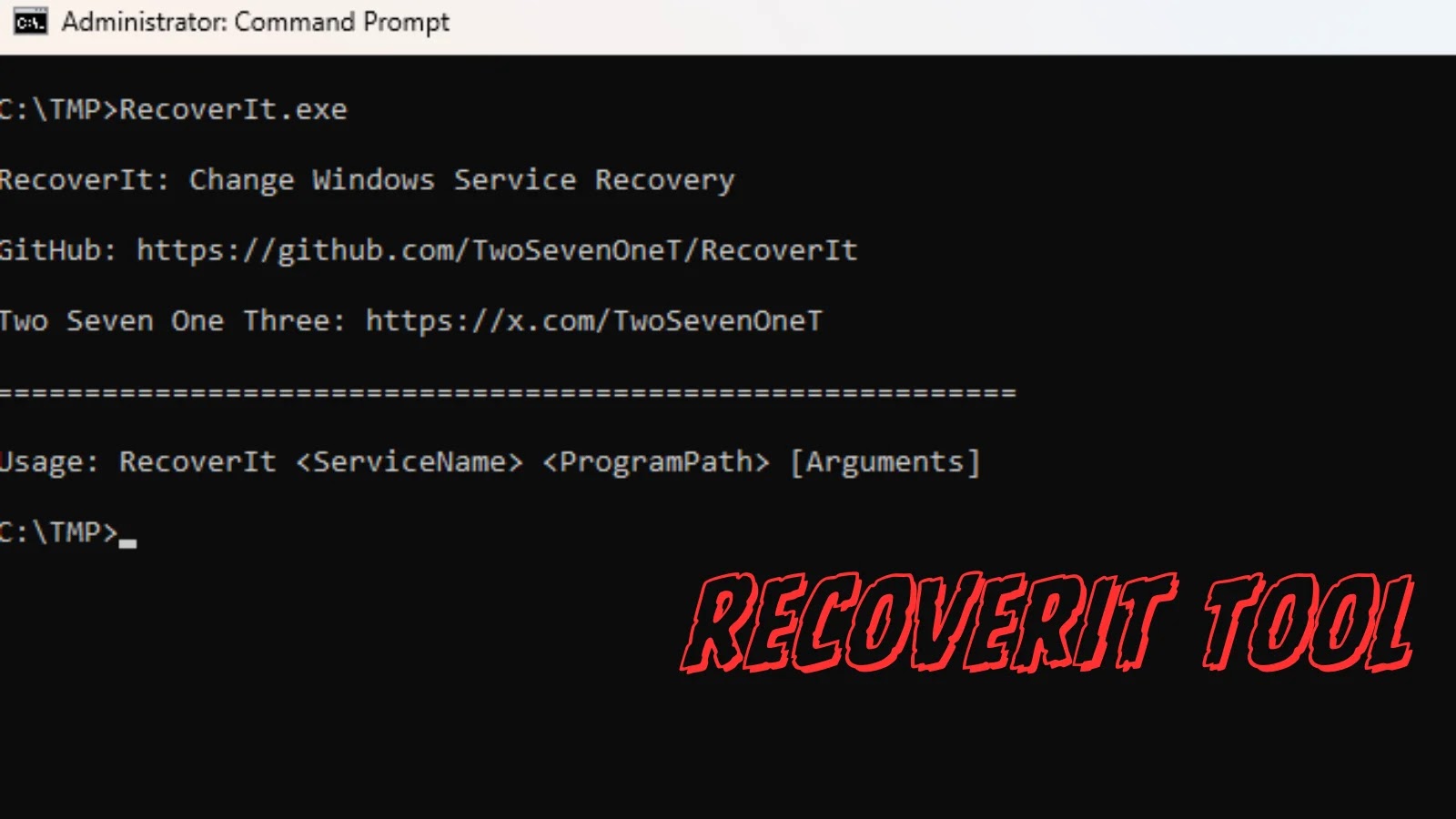
A newly developed open-source tool named RecoverIt has emerged, providing cybersecurity professionals with a novel method to achieve persistence and facilitate lateral movement within compromised Windows environments. Crafted by security researcher TwoSevenOneT, RecoverIt leverages the inherent failure recovery mechanisms of Windows Services to execute arbitrary code, effectively circumventing traditional detection methods employed by Endpoint Detection and Response (EDR) systems.
Understanding Windows Service Failure Recovery Mechanisms
Windows Services are integral components designed to perform specific functions continuously in the background. To enhance system resilience, the Service Control Manager (SCM) includes a Recovery tab for each service. This feature allows administrators to define specific actions that the system should undertake if a service fails unexpectedly. Common recovery actions include restarting the service, rebooting the computer, or executing a designated program.
Exploitation via RecoverIt
RecoverIt capitalizes on this recovery functionality by programmatically altering a service’s configuration to execute a malicious payload instead of a legitimate recovery tool. The tool operates with three primary inputs: the target service name, the program to execute upon failure, and any parameters required for that program.
For instance, the UevAgentService (User Experience Virtualization Agent) is known to crash immediately upon execution if the broader UE-V service is disabled on the host machine. By targeting such an unstable service, an attacker can establish a reliable trigger mechanism. Using RecoverIt, the attacker configures the service so that when it crashes, the Windows Service Control Manager automatically executes a predefined payload, such as a Command Prompt (`cmd.exe`) or a Cobalt Strike beacon.
This method is particularly insidious because the execution is initiated directly by `services.exe` as a recovery action, allowing it to blend seamlessly with legitimate system processes and potentially evade detection.
Evasion of Traditional Detection Methods
Historically, attackers seeking persistence through Windows Services have focused on modifying the `ImagePath` (or `binPath`) registry value, which specifies the executable to run when starting a service. However, this approach is well-known, and both system administrators and EDR solutions actively monitor for unauthorized changes to the `ImagePath`.
RecoverIt circumvents this scrutiny by leaving the legitimate `ImagePath` intact and instead modifying the `FailureCommand` and `FailureActions` configurations. As noted by the tool’s developer, SysAdmins tend to focus more on the ImagePath of services, leaving the recovery settings as a potential blind spot in many defensive strategies.
Detection and Mitigation Strategies
While the execution method employed by RecoverIt is stealthy, it is not entirely invisible. The primary challenge for defenders is that the execution of the malicious payload is not explicitly detailed in standard service crash event logs. Windows Event Logs may record service failures (e.g., UevAgentService terminating unexpectedly) but do not necessarily log the program that the recovery handler subsequently launches in the same event entry.
To effectively detect and mitigate this technique, security teams should broaden their monitoring scope. Detection logic should be updated to alert on changes to service recovery configurations, specifically monitoring for modifications to the `FailureCommand` and `FailureActions` settings. Implementing strict access controls and regularly auditing service configurations can also help identify and prevent unauthorized changes.
Conclusion
The release of RecoverIt underscores the continuous evolution of attack techniques aimed at exploiting lesser-monitored system functionalities. By leveraging Windows Service failure recovery mechanisms, attackers can achieve persistence and execute malicious payloads while evading traditional detection methods. It is imperative for cybersecurity professionals to stay vigilant, update detection strategies, and implement comprehensive monitoring to counteract such sophisticated threats.