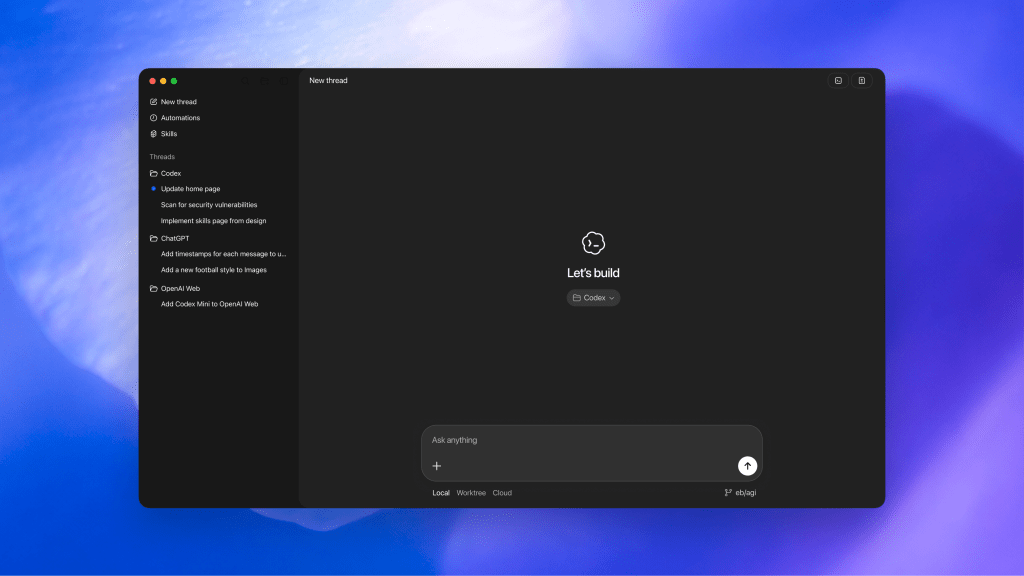
OpenAI Unveils Advanced macOS App for Autonomous Coding
OpenAI has introduced a groundbreaking macOS application for its Codex platform, marking a significant advancement in autonomous software development. This new application is engineered to facilitate multiple AI agents working concurrently on coding tasks, thereby streamlining the development process and enhancing efficiency.
The evolution of AI in software development has been transformative, with AI agents increasingly handling routine programming tasks. This shift has led to the emergence of agentic software development, where AI agents operate independently to execute coding assignments. OpenAI’s latest macOS app for Codex embodies this trend by integrating advanced agentic practices, enabling developers to manage multiple agents simultaneously and incorporate cutting-edge workflows.
This launch follows the recent release of GPT-5.2-Codex, OpenAI’s most powerful coding model to date. CEO Sam Altman emphasized the model’s capabilities, stating, If you really want to do sophisticated work on something complex, 5.2 is the strongest model by far. He acknowledged previous usability challenges and highlighted the new app’s role in providing a more flexible interface to harness the model’s full potential.
Despite Altman’s confidence, coding benchmarks present a nuanced picture. GPT-5.2 leads on TerminalBench, a test assessing AI performance in command-line programming tasks. However, competitors like Gemini 3 and Claude Opus have achieved comparable scores, indicating a competitive landscape. Results from SWE-bench, which evaluates AI’s ability to fix real-world software bugs, also show no definitive advantage for GPT-5.2. These findings suggest that while GPT-5.2 is a formidable tool, user experience and specific use cases play crucial roles in determining its effectiveness.
The new Codex app introduces several features designed to enhance its appeal. It supports background automations that can run on a set schedule, with results queued for user review upon return. Additionally, users can customize the agent’s personality to align with their working style, choosing from pragmatic to empathetic approaches.
A standout feature of the app is its ability to expedite software development. Altman noted, You can use this from a clean sheet of paper, brand new, to make a really quite sophisticated piece of software in a few hours. This capability underscores the app’s potential to significantly reduce development time, allowing developers to focus on innovation and complex problem-solving.
The introduction of this macOS app signifies OpenAI’s commitment to advancing AI-driven software development. By providing a platform where multiple AI agents can collaborate efficiently, OpenAI aims to empower developers to create sophisticated software solutions with unprecedented speed and flexibility.