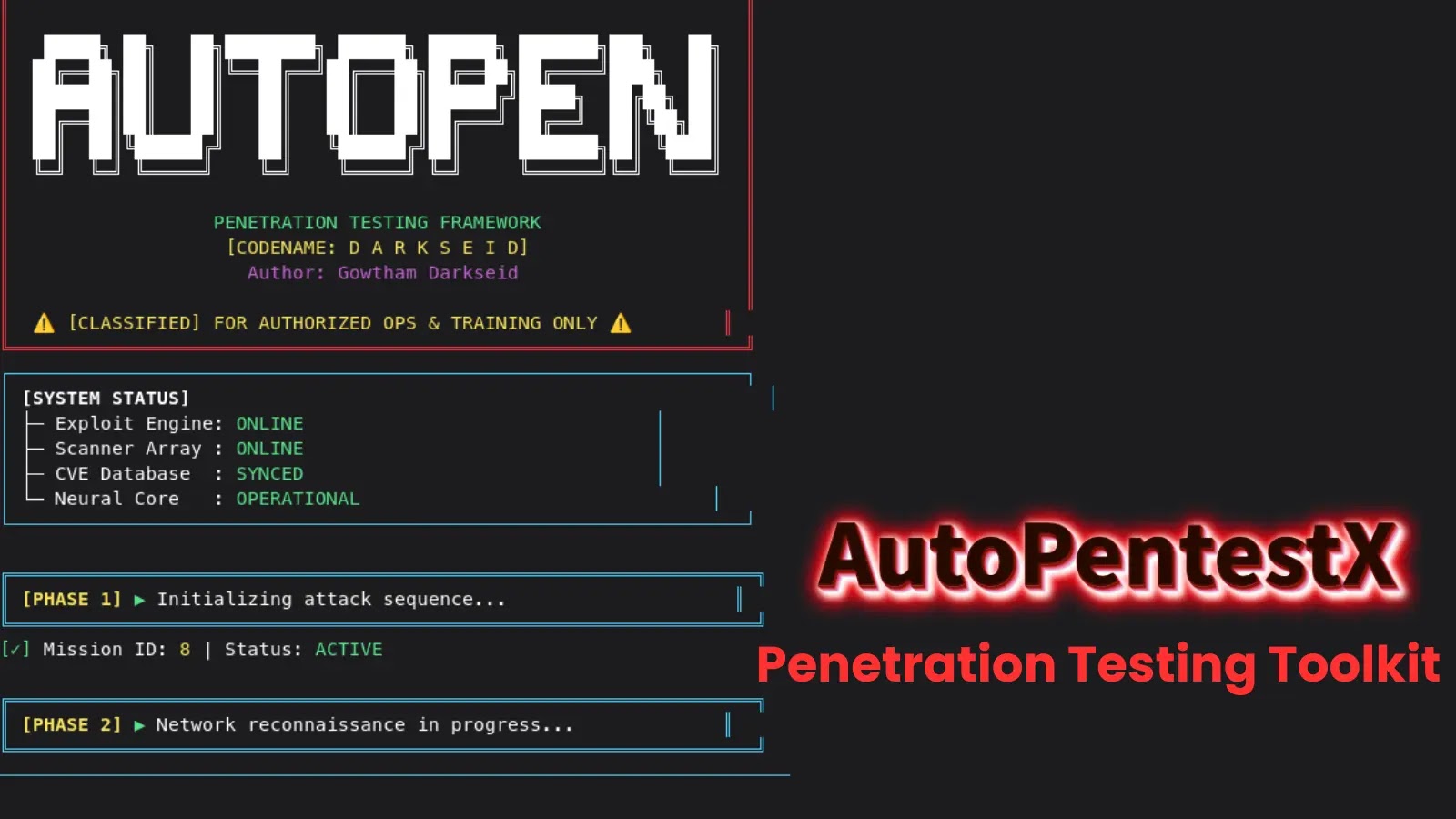
AutoPentestX: Revolutionizing Linux Security with Automated Penetration Testing
In the ever-evolving landscape of cybersecurity, the need for efficient and comprehensive security assessments has never been more critical. Enter AutoPentestX, an open-source automated penetration testing toolkit designed specifically for Linux systems. Developed by Gowtham Darkseid and released in November 2025, AutoPentestX empowers security professionals to conduct thorough evaluations with a single command, streamlining the penetration testing process while ensuring safety and precision.
Key Features and Capabilities
AutoPentestX is engineered to support Kali Linux, Ubuntu, and other Debian-based distributions. Its primary functions include:
– Operating System Detection: Identifies the target system’s OS to tailor subsequent testing procedures.
– Port Scanning: Discovers open ports to assess potential entry points.
– Service Enumeration: Catalogs active services to understand the system’s exposure.
– Vulnerability Assessment: Evaluates identified services for known vulnerabilities.
A standout feature of AutoPentestX is its ability to generate professional PDF reports, providing clear and actionable insights into the security posture of the assessed system. Emphasizing non-destructive testing, the toolkit ensures that evaluations do not disrupt the target environment.
Integrated Tools and Their Functions
AutoPentestX’s modular design incorporates several industry-standard tools, each serving a specific purpose:
– Nmap: Utilized for port and OS scanning, as well as service enumeration, integrated via the python-nmap library.
– Nikto: Conducts web server vulnerability assessments through subprocess execution.
– SQLMap: Detects SQL injection vulnerabilities, also executed via subprocess.
– Metasploit: Simulates exploits by generating RC scripts for manual review, ensuring no actual harm is inflicted.
– CVE CIRCL: Queries vulnerability databases using REST API calls to assess risks based on CVSS metrics.
– ReportLab: Facilitates the generation of detailed PDF reports through a Python library.
This modular approach allows users to customize their testing by skipping specific scans or exploit simulations using command-line flags, enhancing flexibility and control over the assessment process.
Installation and Usage
To deploy AutoPentestX, users need Python 3.8 or higher, root access, and essential tools like Nmap. The installation process involves cloning the repository and running the `./install.sh` script to install dependencies. Alternatively, users can set up a virtual environment and install requirements manually using `pip install -r requirements.txt`.
Once installed, initiating a full scan is straightforward:
“`bash
./autopentestx.sh
“`
This command triggers a comprehensive assessment, with results organized into `reports/`, `logs/`, and `database/` directories. The toolkit offers various options to tailor the testing process:
– `–no-safe-mode`: Disables safe mode (not recommended).
– `–skip-web`: Omits web-related scans.
– Custom tester names: Personalize the report with the tester’s name.
Depending on the target’s complexity, scans typically complete within 5 to 30 minutes. The resulting PDF reports include:
– Executive Summaries: High-level overviews of findings.
– Risk Classifications: Categorization of vulnerabilities, with critical issues defined as those with a CVSS score of 9.0 or higher.
– Remediation Advice: Practical recommendations for addressing identified vulnerabilities.
Reports also feature tables of open ports, detailed CVE information, and weighted scores that consider exploitability, providing a comprehensive view of the system’s security status.
Data Management and Compliance
AutoPentestX stores assessment data in an SQLite database, allowing for historical analysis and trend identification. Users can export data in JSON format for integration with other tools or platforms. The toolkit operates in safe mode by default, ensuring that all actions are logged for audit purposes and that no disruptive operations are performed on the target system.
It’s crucial to note that AutoPentestX is intended strictly for authorized penetration testing. Unauthorized use is prohibited and may violate legal statutes. Users must obtain explicit permission before assessing any systems to ensure compliance with applicable laws and regulations.
Future Developments
Looking ahead, the development roadmap for AutoPentestX includes:
– Multi-Target Support: Enhancing the toolkit’s capability to assess multiple systems simultaneously.
– Machine Learning Predictions: Integrating ML algorithms to predict potential vulnerabilities and attack vectors, further refining the assessment process.
These planned enhancements aim to bolster AutoPentestX’s effectiveness and adaptability in the dynamic field of cybersecurity.
Conclusion
AutoPentestX represents a significant advancement in automated penetration testing for Linux systems. By integrating a suite of powerful tools into a cohesive and user-friendly framework, it enables security professionals to conduct thorough and efficient assessments. Its emphasis on safety, comprehensive reporting, and modular design makes it a valuable asset in the ongoing effort to secure digital infrastructures.