Revolutionizing NYC Street Food: PopWheels Powers Carts with E-Bike Batteries
New York City’s vibrant street food scene is undergoing a transformative shift, thanks to Brooklyn-based startup PopWheels. Traditionally, food carts have relied on noisy and polluting gas generators to power their operations. However, PopWheels is pioneering the use of e-bike batteries as a cleaner, quieter, and more efficient energy source for these mobile eateries.
The initiative began as an experimental project last summer, spearheaded by David Hammer, co-founder and CEO of PopWheels. Hammer, a former Google employee, likened the endeavor to a classic 20% project, referring to Google’s practice of allowing employees to spend a portion of their time on innovative side projects. Initially, PopWheels’ battery packs were designed to power food delivery e-bikes. Recognizing the potential for broader applications, the team explored their use in food carts. Hammer emphasized the importance of addressing distribution and charging challenges over finding a perfect energy type.
PopWheels currently operates 30 charging cabinets across Manhattan, primarily serving gig workers who use e-bikes for deliveries. This network has effectively created a decentralized fleet, enabling the company to stock a limited variety of batteries to meet the needs of hundreds of customers. Many delivery workers commute from distant parts of the city, often requiring two batteries to complete a full day’s work. To accommodate this, local bodegas have started offering e-bike charging services, typically charging workers $100 per month. When considering battery wear and tear, the annual cost can approach $2,000.
PopWheels offers a more economical solution by charging customers $75 per month for unlimited access to its network. Hammer noted that the company has a long waitlist, indicating strong demand for their services. The startup’s charging cabinets, each capable of holding 16 batteries, are designed with safety in mind, featuring systems to swiftly extinguish any potential battery fires during charging. This focus on safety aligns with PopWheels’ founding mission to eliminate e-bike fires in New York City, a significant issue in recent years. After developing initial cabinets, the company secured a $2.3 million seed funding round in 2025.
Swap sites are typically small open spaces like parking lots, which PopWheels has retrofitted with fences and the necessary electrical connections to support several cabinets. Each cabinet draws about as much electricity as a Level 2 electric vehicle charger, which is to say not that much.
As PopWheels’ e-bike service expanded, the startup began exploring other opportunities. Hammer mentioned an underlying thesis that building urban-scale, fire-safe battery swapping infrastructure creates a foundational layer that various sectors can utilize. The idea to power food carts with e-bike batteries emerged after Hammer read about New York City’s efforts to decarbonize food carts. The team conducted feasibility studies and found that food carts typically spend around $10 daily on gas for generators. PopWheels’ subscription model, offering four batteries per day for the same cost, provides approximately five kilowatt-hours of electricity—sufficient for a typical cart’s needs. If additional power is required, cart owners can swap batteries midday.
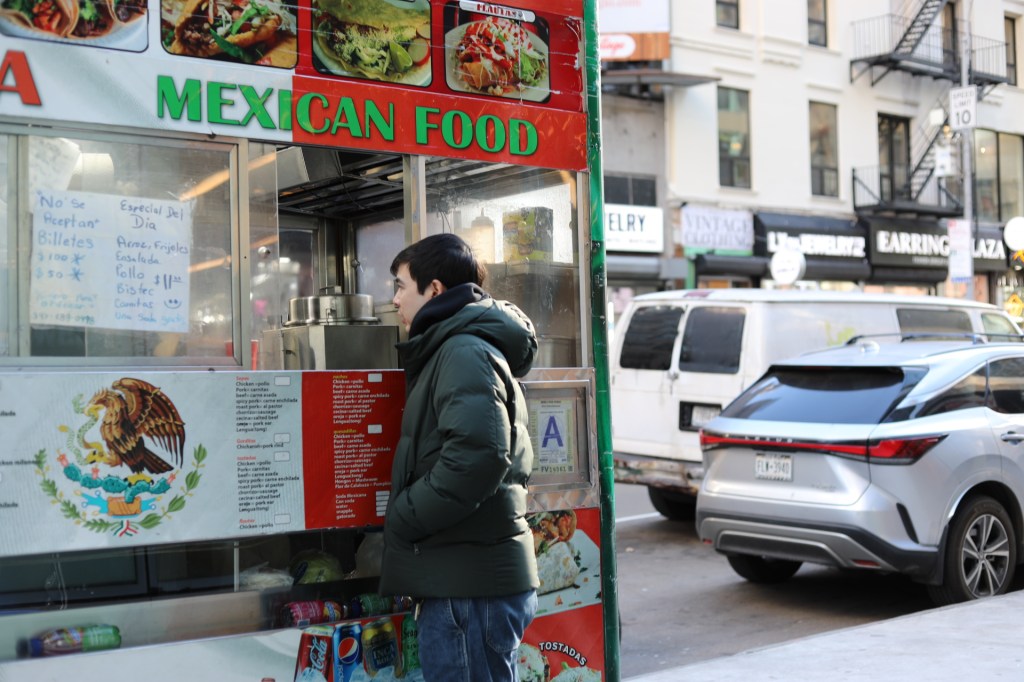
After realizing the math penciled out, PopWheels built a prototype adapter and trialed it at a small event at the Brooklyn Navy Yard during New York Climate Week. Since then, the startup has been working with the non-profit Street Vendor Project to move the idea forward. Last week’s demonstration with La Chona was the first time the batteries powered a food cart for a full day.
The response from the food cart community has been overwhelmingly positive. Hammer recounted multiple owners approaching him, intrigued by the noise-free operation and expressing interest in adopting the technology. PopWheels plans to aggressively roll out this solution starting this summer, aiming to be cost-neutral compared to gasoline while addressing quality-of-life issues associated with traditional generators.
This innovative approach not only enhances the street food experience for customers but also contributes to a cleaner and more sustainable urban environment. By repurposing e-bike batteries to power food carts, PopWheels is setting a precedent for creative solutions to urban energy challenges.