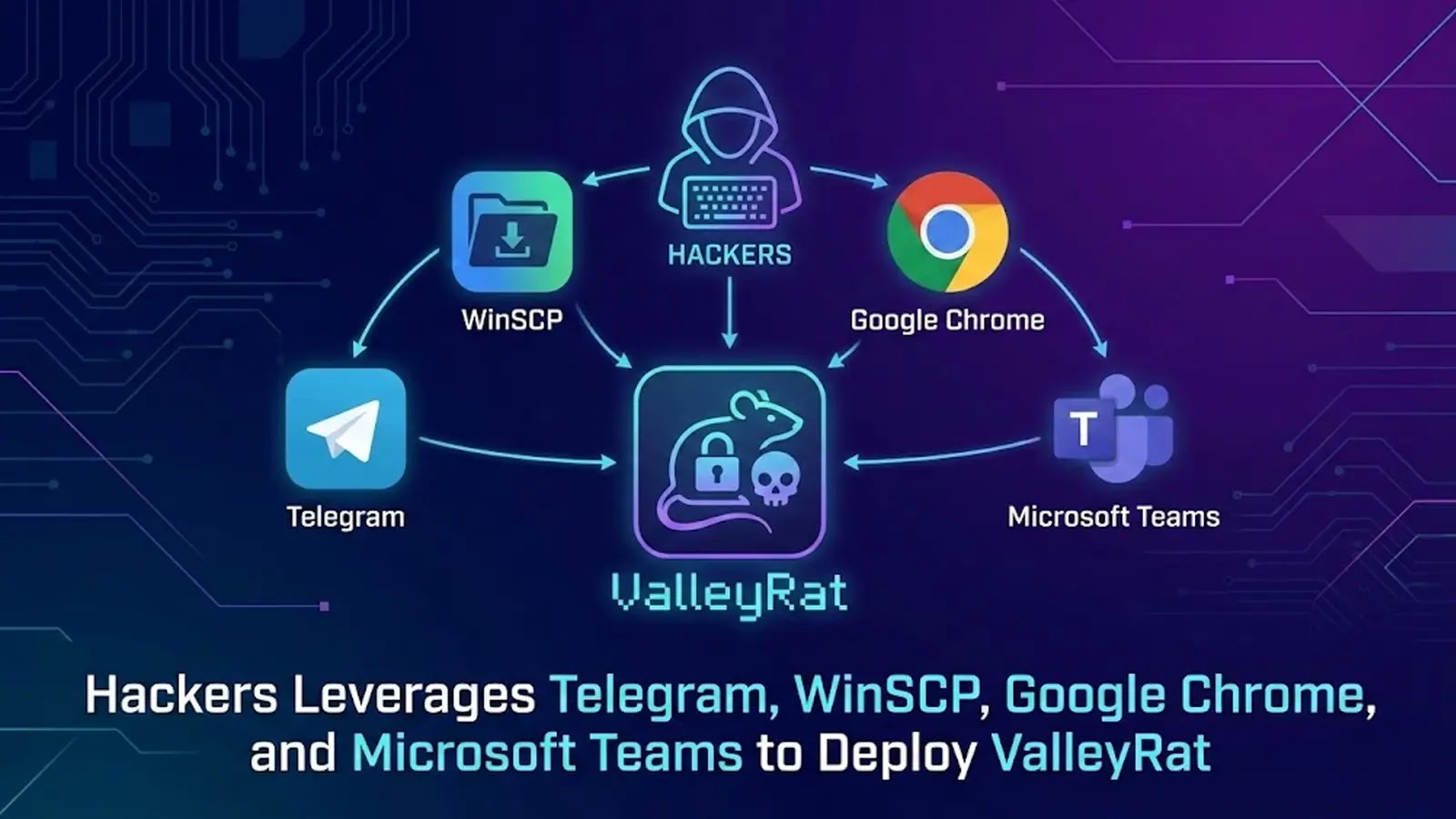
Cybercriminals Exploit Popular Apps to Deploy ValleyRAT Malware
A recent cybersecurity investigation has uncovered a sophisticated malware campaign that leverages trusted applications to distribute ValleyRAT, a remote access trojan (RAT) designed for prolonged system infiltration. This operation has been linked to the China-aligned Advanced Persistent Threat (APT) group known as Silver Fox, active since at least 2022.
Infection Vector and Initial Compromise
The attack initiates when unsuspecting users download what appear to be legitimate installers for widely used applications such as Telegram, WinSCP, Google Chrome, and Microsoft Teams. These downloads are typically facilitated through spear-phishing emails or malicious advertisements. While the installation interfaces mimic authentic processes, they concurrently execute hidden malicious activities in the background.
Technical Analysis of the Malware Deployment
Upon execution, the trojanized installer creates a directory at `C:\ProgramData\WindowsData\` and deposits several files, including a renamed 7-Zip executable (`funzip.exe`) and an encrypted archive masquerading as `main.xml`. The malware then employs PowerShell commands to add exclusions to Microsoft Defender, effectively disabling antivirus protections across the entire `C:\` drive.
The extraction command utilized is:
“`
C:\ProgramData\WindowsData\funzip.exe x -y -phtLcENyRFYwXsHFnUnqK -oC:\ProgramData\WindowsData C:\ProgramData\WindowsData\main.xml
“`
This process extracts `men.exe`, the primary orchestrator responsible for conducting environmental reconnaissance. It scans for security processes, including Microsoft Defender’s `MsMpEng.exe` and other security products like `ZhuDongFangYu.exe` and `360tray.exe`.
Persistence Mechanisms and Command-and-Control Communication
To maintain persistence, the malware establishes a scheduled task named `WindowsPowerShell.WbemScripting.SWbemLocator`, designed to resemble legitimate Windows components. This task executes an encoded VBScript (`X.vbe`) that launches the ValleyRAT beacon, ensuring continued access to the compromised system.
ValleyRAT’s capabilities include capturing user input, executing commands, and exfiltrating sensitive data. It communicates with command-and-control (C2) servers using encrypted protocols, allowing attackers to remotely control infected machines.
Attribution to Silver Fox APT Group
The Silver Fox APT group, also known as Void Arachne and The Great Thief of Valley, has a history of targeting critical infrastructure sectors through advanced cyber espionage and data theft operations. Their tactics often involve weaponizing trusted software applications to infiltrate organizations, particularly within the healthcare and public sectors.
Mitigation Strategies and Recommendations
To defend against such sophisticated threats, organizations should implement the following measures:
1. User Education and Awareness: Train employees to recognize phishing attempts and the risks associated with downloading software from unverified sources.
2. Application Whitelisting: Restrict the execution of unauthorized applications and scripts to prevent the installation of malicious software.
3. Regular Software Updates: Ensure all software, including security tools, are up-to-date to mitigate vulnerabilities that could be exploited by attackers.
4. Endpoint Detection and Response (EDR): Deploy EDR solutions capable of identifying and responding to suspicious activities in real-time.
5. Network Segmentation: Isolate critical systems to limit the spread of malware within the network.
6. Incident Response Planning: Develop and regularly update incident response plans to swiftly address potential breaches.
By adopting these proactive cybersecurity practices, organizations can enhance their resilience against advanced persistent threats like those posed by the Silver Fox group and their deployment of ValleyRAT malware.