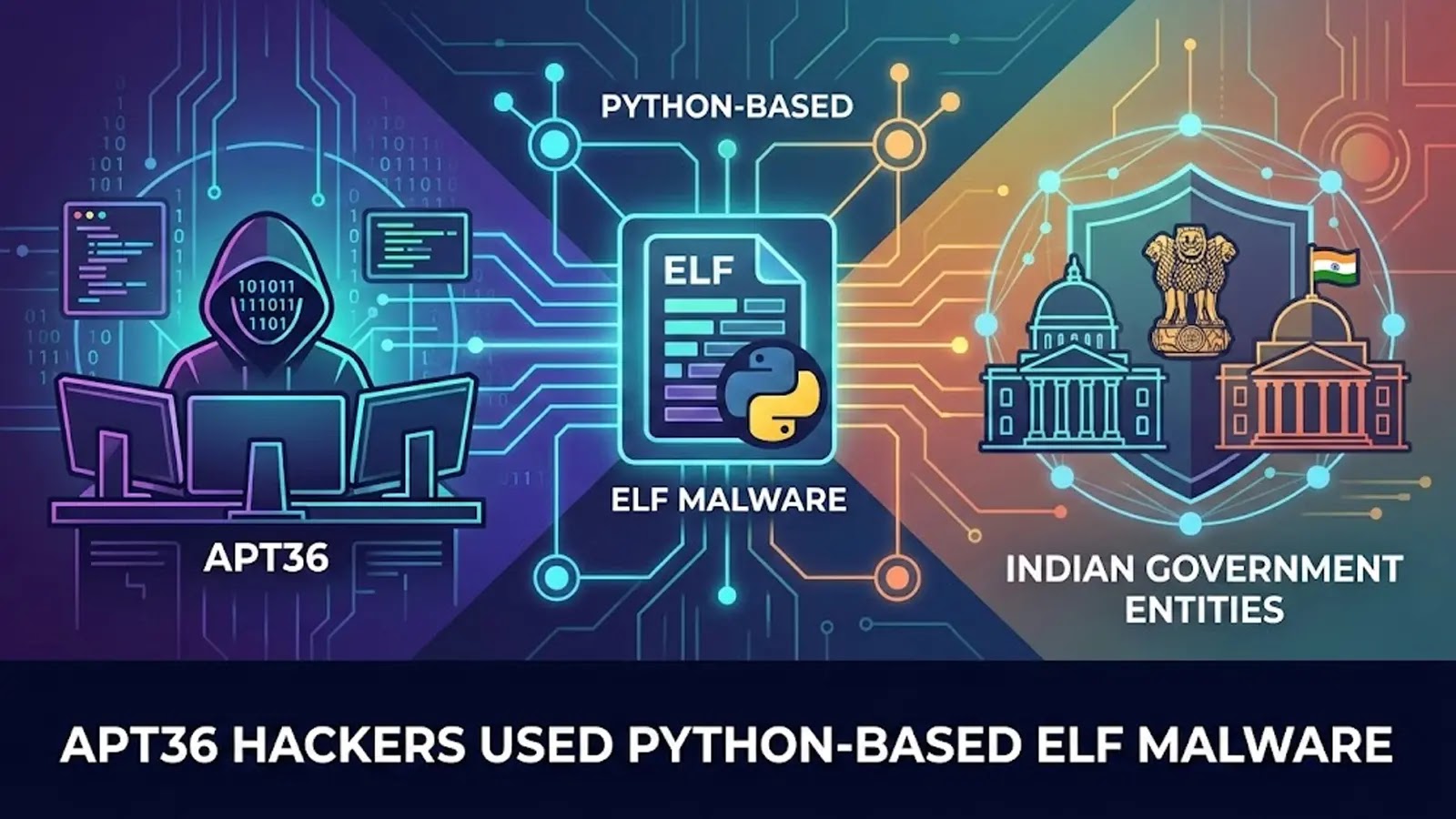
APT36’s New Python-Based ELF Malware Targets Indian Government Systems
In a significant escalation of cyber-espionage activities, the Pakistan-linked threat actor APT36, also known as Transparent Tribe, has developed and deployed a sophisticated Python-based ELF (Executable and Linkable Format) malware targeting Indian government entities. This campaign underscores the group’s evolving technical capabilities and their strategic shift towards compromising Linux-based systems, particularly the BOSS (Bharat Operating System Solutions) platform widely used across Indian governmental institutions.
Spear-Phishing Tactics and Infection Chain
The attack initiates with meticulously crafted spear-phishing emails containing weaponized Linux shortcut files (.desktop files). These files are designed to appear legitimate, enticing recipients to open them. Upon execution, the malware operates in a dual-layered manner:
1. Decoy Deployment: A benign PDF document is displayed to the user, serving as a distraction and reducing immediate suspicion.
2. Malware Installation: Simultaneously, in the background, the malware downloads and installs the actual ELF payload from attacker-controlled servers, establishing a foothold within the system.
This method allows the attackers to maintain stealth while ensuring persistent access to critical infrastructure.
Technical Analysis of the Malware
Upon execution, the malicious .desktop file initiates a multi-stage payload delivery process:
– Payload Retrieval: The shortcut fetches a decoy PDF to distract the user while concurrently downloading the ELF malware payload from a remote server.
– Execution and Persistence: The malware executes the payload and employs systemd user-level services to establish persistence, ensuring it remains active across system reboots and user sessions.
The ELF malware is a feature-rich remote access tool capable of:
– Command Execution: Running arbitrary shell commands on the compromised system.
– Data Exfiltration: Collecting and transmitting sensitive information back to the attackers.
– Screenshot Capture: Taking screenshots of the user’s activities.
– Command-and-Control Communication: Maintaining communication with the attacker’s server for further instructions and data transfer.
Strategic Implications and Evolution of APT36
Historically, APT36 has focused on Windows-based attacks. However, this campaign signifies a strategic evolution, demonstrating the group’s commitment to expanding their attack surface by targeting Linux platforms. By adapting their tools to exploit multiple operating systems, APT36 enhances their operational effectiveness and poses a broader threat to organizations with diverse computing environments.
Infrastructure and Operational Tactics
The campaign’s infrastructure involves recently registered domains and compromised servers located in multiple countries, indicating a well-coordinated and resourceful operation. For instance, the malicious domain lionsdenim[.]xyz was registered just 22 days prior to the attack, and the associated IP address 185.235.137.90 in Frankfurt facilitates payload delivery.
Mitigation Measures and Recommendations
To counter this persistent threat, Indian government agencies and organizations are advised to implement the following mitigation measures:
– Enhanced Email Security: Deploy advanced email filtering solutions to detect and block spear-phishing attempts.
– Endpoint Detection and Response (EDR): Utilize EDR solutions capable of identifying and mitigating malicious activities on endpoints.
– Strict Application Authorization Policies: Enforce policies that restrict the execution of unauthorized applications and scripts.
– User Education and Awareness: Conduct regular training sessions to educate employees about the risks of phishing attacks and the importance of verifying the authenticity of emails and attachments.
– Regular System Updates: Ensure that all systems, especially those running Linux distributions like BOSS, are regularly updated with the latest security patches.
Conclusion
APT36’s deployment of Python-based ELF malware targeting Indian government entities marks a significant advancement in their cyber-espionage capabilities. This campaign highlights the necessity for organizations to remain vigilant, adapt to evolving threats, and implement comprehensive cybersecurity measures to protect sensitive information and critical infrastructure.